Proposals are more than just bureaucratic paperwork. They are your first (and usually only) chance to win a potential client over.
Any proposal writer knows that proper proposal development is more than just listing your qualifications and checking all the compliance boxes. A lot of thought goes into each line of the most persuasive proposals. What to include. How to talk about it. How an audience will receive it. The goal of a proposal is to get someone to pick you for their project. Because the people reading your proposal are also juggling too many tasks with too little time, winning proposals do more than just check the right boxes. They stand out and get buy-in for your firm.
Why truly persuasive proposals are important
With all of the time you spend on a proposal, the reason to work with your company feels obvious.
But the prospect doesn’t know your firm in the same way, and your competition has the same goal that you do.
Starting a persuasive proposal on the right foot begins with a proposal cover page, but the principles need to be applied throughout your entire RFP response.
A “great” proposal that is free from any grammatical errors, with a perfectly crafted company message, is one thing. But that doesn’t mean that it’s persuasive.
Think of it this way: Everyone has been asked to include the same information in the proposal. Chances are, you and your competition will all promise to complete the project on time and within budget, using case studies to demonstrate past success, while highlighting the capabilities of key team members.
So, how do you overcome a sea of sameness to get buy-in?
That’s where persuasion comes into play.
Understanding the science of decision making
In the end, proposals come down to making a decision: “Who do we pick to work with?”
As human beings, we love to think we are rational creatures who use logic when making decisions. Yet, to get through each day, that’s often not the case.
The average adult makes approximately 35,000 decisions a day. In fact, researchers at Cornell estimate we make over 225 decisions a day on food alone. (No wonder it’s so hard to eat healthy!)
It’s only natural that we need a way to cope. Take it from Nancy Harhut, a neuromarketing expert and author of the book “Using Behavioral Science in Marketing.” Also, the co-founder and Chief Creative Officer of HBT Marketing, Harhut, explained in an interview with Strand:
“Humans, over the millennia, have developed certain automatic, instinctive, reflexive responses as a way to conserve mental energy...People couldn’t possibly weigh every bit of information before making a decision, or they’d never get around to making any decisions.”
As a result, persuasive proposals maximize those opportunities to trigger the automatic, instinctive, and reflexive responses.
What makes proposals persuasive: Top principles of persuasion to leverage
Given the 35,000 decisions we make (Every. Single. Day.), It’s understandable that our subconscious comes into play.
But it might play a bigger part than you thought: According to Harvard Business School professor Gerald Zaltman, 95% of all cognition occurs in the subconscious mind.
The following principles tap into the behavioral psychology that can influence the subconscious decision-making of potential prospects. (Remember, with great power comes great responsibility!)
1. The importance of using emotion in your proposals
Given the nature of proposals — and the many elements any RFP requires you to include — it’s common to focus on logic in your proposal.
While logic does play a part, that doesn’t mean you can forget about emotion.
This has been proven time and time again, yet we default to thinking that “this is a business decision, so I need to focus on reason and logic.”
Harvard Business Review is one of many publications that explain the power of emotion in decision-making.
Brain imaging (fMRI) shows that when people evaluate brands, they rely mainly on emotions — their personal feelings and experiences — rather than facts like brand attributes, features, and details.
Author Douglas Van Praet describes it this way: “The most startling truth is we don’t even think our way to logical solutions. We feel our way to reason…Emotions don’t hinder decisions. They constitute the foundation on which they’re made!”
Decision-making is an emotional process. We decide with our heart, then the head builds the logical case for that decision after the fact.
2. Don’t underestimate the importance of storytelling
One of the most powerful ways to engage with a reader’s emotions is through storytelling. Using a story, you give the reader something concrete that is literally encoded in the brain.
It is one thing to tell prospects that you always finish your projects on schedule. But tell an anecdote about how you overcame a challenge to do this for one specific company, and you prime your client to imagine their place in that success story.
There is plenty of data that backs up the science of storytelling, and that’s why it is such an important component of persuasive proposals.
Research from the London School of Business found that people retain only 5% to 10% of information if it consists of statistics alone. But when they hear a story, they remember 65% to 70%.
Harvard Business Review research shows that stories trigger the release of oxytocin, a hormone that promotes trust, and character-driven narratives are particularly effective in building connections. According to Jerome Bruner's research, facts are 22 times more memorable when embedded in stories.
When prospects read about you solving a problem like theirs, research shows their brain engages the same regions that light up during actual experiences. In simpler terms, the story feels real, even though they didn’t actually experience it.
Stories are not just an effective way to make a reader like you. They are also one of the best ways to be memorable in a crowd of 15 other competing proposals.
| How Shred.ai helps with storytelling. You can do a lot with AI for proposal writing! If you're struggling to find those compelling success stories buried in past proposals, Shred.ai can help surface winning content from your archive. Instead of starting from scratch or hunting through PDFs, you can quickly locate and reuse successful case studies that have already proven their persuasive power. |
|---|
3. Cialdini’s principle of authority
Dr. Robert Cialdini, considered the “father of persuasion,” has laid out seven key principles of persuasion.
The first that ties into proposal writing is the principle of authority.
Establishing authority is about proving you know what you're doing. While there is some overlap with social proof (our next principle), one of the best ways to do this is through third-party proof points.
People trust other people more than they trust brand claims and marketing promises. That’s why it’s important to find ways to build authority (and credibility) with both internal company statistics and external sources.
Examples include:
- Awards (for your company or individual team members)
- Certifications
- Partnerships
- Number of customers
- Number of repeat clients
- Reviews and star ratings
- NPS (Net promoter score)
- Employee retention rates
- Quotes in high-authority publications/media appearances
- Years in business
Establishing yourself as an expert is foundational to a persuasive proposal.
4. Social proof: Use past client wins to build confidence
Social proof builds on those third-party proof points and can be used to establish authority. One of the most powerful forms of social proof is showing that companies like your prospect have worked with you successfully.
People are much more inclined to do something if they have already seen someone else do it, especially if they see something good happen when they do. Jumping off a cliff into the ocean sounds crazy, but if you watch someone else do it and experience no consequences, it feels much safer to try it yourself.
This is why case studies and client testimonials are so effective in proposals. When a prospect sees that you've solved similar problems for similar companies, the decision feels less risky.
Don't just say "We completed 50 projects last year." Include specific examples: project photos, client quotes, and measurable results.
5. The principle of liking
It’s a common business phrase that’s important to remember: “We buy from people we know, like, and trust.”
Or, as Cialdini puts it, we are more likely to agree with people that we like.
Research from the Advertising Research Foundation supports this, finding that likeability is the top factor in predicting sales growth.
So, how do you maximize “likeability” in your proposals?
Highlight ways in which your companies overlap. Finding common ground about a proposed project and showing you are on the same page as your client will make them more likely to choose your proposal.
Focus on shared goals and values. When prospects see that you understand their world and speak their language, they're more inclined to work with you.
Likeability is also where you can bring some creativity into your proposals. Yes, you want to be professional, but see if you can also find opportunities to be personable.
Because, as the saying goes, “people buy from people, not from brands,” so let your humanity shine through.
Building a persuasive proposal: tips and writing techniques
Every proposal will be tailored to the RFP, but some steps should be included in each one.
Understand your audience
It’s impossible to be persuasive if you don’t customize the proposal to each project’s needs.
Doing so requires a true understanding of your target client. It requires advanced research and consideration, but it’s worth it.
The deeper you understand your audience, the better you can position your proposal as the answer to their specific challenges. Before you start writing, map out the audience's needs, pain points, and potential concerns. This empathy mapping exercise helps you speak directly to what matters most to them.
Keep language concise and clear
When writing your proposal, be direct. Be clear. Be concise.
Simple is often best. Everybody involved in the proposal process (including you!) is incredibly busy. While it is important to maximize your creativity, be disciplined, recognizing when your creativity helps persuade, versus when you are going off-track.
If you find yourself debating between two different ways of saying something, choose the simple and direct option. Read the sentence out loud. Does it sound like how people actually talk?
Can you get through it in one breath?
Shorter sentences are easier to process and improve comprehension. If you struggle to read a sentence aloud without pausing, it’s often a sign that it should be split into two.
Pick your tactics before writing
A core part of proposal management is to have a plan before you start. Otherwise, you end up bouncing from idea to idea, struggling to find focus.
While the end goal for all proposals is to net new business, there is a lot of strategy — and elements to customize — along the way. Think about how you want to convince someone that you are the right pick for the job.
Do you want to paint yourself as dependable? Show that your company's a strong collaborator able to manage a project with precise specifications?
If you figure out which of your company’s traits best appeal to a particular project’s decision criteria, you can focus on how to best communicate those advantages in your proposal.
Follow a clear structure
Your proposal should guide the reader through a logical journey. Here is an example of a structure that works:
1. Introduction
As simple as it is, do not forget to introduce your company, especially if you are writing to a potential customer and not a repeat one.
It’s also a great spot to:
- Incorporate some storytelling to build emotional connection and likability.
- Plant the seeds of your expertise with examples from past projects.
2. Highlight the problem
One of the most important parts of a persuasive proposal is showing the prospect you understand their problem.
It can be tempting to cut corners on this step. After all, the client already knows all of this. But they need to know that you understand the problem, too. Think of it this way: If the proposal were being presented in a sales meeting, you would want the prospects to start nodding a lot.
It’s giving people the feeling of “They get me.”
You want the proposal reviewer to think “yes, that’s true” as they’re reading. Start with the goal of a small “yes,” and you’ll have a great starting point to get buy-in and build trust.
Remember the principle of liking. Your client will be more inclined to work with a company that sees the project the same way they do.
3. Explain the proposed solution
This is the heart of your argument. You need to explain why you are the best firm for the RFP’s project.
Remember: decisions happen emotionally first, then get justified with logic.
By now, you should have built an emotional connection and can incorporate logic. Show how you will meet their needs on budget and within the required schedule.
If you have a creative solution, such as an architecture or construction proposal, here’s the spot to let it shine.
It’s about letting facts and feelings intermingle as you tell the story, helping the proposal reader visualize your solution.
Your creativity can be the key that triggers an emotion we all love to feel: Excitement.
Focus on what makes you unique: What do you bring to this project that no one else does?
4. Present the benefits
Don't just explain what you'll do — explain what it means for them.
What project management skills do you bring to create a positive experience? Can you reduce risk? Do you have a tactic to complete the project under budget? Make the benefits crystal clear.
This is your opportunity to make the prospect the hero of the proposal, inviting them to picture what success with you at the helm will look like. In addressing how you are uniquely positioned to solve the problem, you can leverage both emotion and logic.
5. Make a call to action
The final element is a call to action. Often, this is inviting the client to discuss the proposal further. Don’t trust that they will know what to do next. Make it crystal clear what the next step is.
This lowers the barrier for them to actually respond. Responding to an entire proposal (especially when it's 100+ pages) can feel overwhelming.
If you can get them to engage with you, you’ve opened the lines of 1:1 communication. This builds a relationship, which supports likability.
| Recommended reading: 33 more tips to help you write better proposals. Want to learn more easy tips to win more proposals? You can go here to find 33 more proposal writing tips. |
|---|
Remember to persuade with your proposal design and layout
In addition to the words written in your proposal, remember that layout and design also play a part in persuasive proposals.
The role of visual storytelling
Graphic design also has several scientific principles at play. For example, studies have found that using color makes content 39% more memorable and improves sales by 80%.
Formal proposals can run dozens of pages or more. Anyone would get exhausted if every one of those pages contained nothing but text. Adding little visuals is how you keep your reader engaged with your proposal.
In the architecture, engineering, and construction industry (AEC), visuals are also important to show examples of your work. You know what they say — a picture is worth a thousand words!
You can also use the design to help guide the reader’s eye and highlight what is important. Headers, font sizes, and color all build a visual hierarchy.
In the same way, don’t be afraid to give an important sentence its own paragraph. White space is a subtle yet powerful way to draw the eye of your reader.
Photos of people (be it your team members or a client who has given a testimonial) build trust by creating an authentic, human connection.
In fact, eye tracking studies have shown that we are drawn to faces, and you can use faces to guide the reader’s attention.
Even small design tweaks can make a big impact. Consider the following. Can you:
- Condense pages of dense copy into a graph?
- Use a call-out design to highlight critical statistics?
- Draw the reader’s eye with a pop of color?
Maximizing your design — and your time — with a digital asset management platform
OpenAsset is the first and leadingdigital asset management (DAM) software specifically designed for AEC marketers.
Digital assets like project photos and headshots are the best and fastest way to make your proposal leap off the page, and OpenAsset is the most effective way to manage them.
When you are on the clock and need to get a proposal submitted by tomorrow, OpenAsset's DAM can help you find and repurpose the content you need in minutes.
From bios to boilerplates, the benefits add up and can save you hours every week.
Frequently asked questions about persuasive proposal writing
Still curious about how persuasive proposals work? Here are some of the most commonly asked questions about persuasive proposal writing techniques.
What is a persuasive proposal?
A persuasive proposal leverages the psychology of human behavior, storytelling, and emotion to show you understand the client's situation — and can solve it — better than anyone else. It makes an emotional connection that is still grounded in data and third-party proof points.
What are the 4 P's of proposal writing?
The four P's of proposal writing are preparation, planning, production, and presentation:
Preparation: Research your client, understand their needs, and qualify the opportunity before you start writing.
Planning: Set clear objectives, repurpose templates with digital asset management tools, and map out your strategy for persuasion.
Production: Write clear, concise copy that balances emotional appeal with logical justification. Include compelling visuals and ensure compliance.
Presentation: Design an attractive layout, proofread carefully, and deliver your proposal in a format that's easy to review.
What is the best format for a proposal?
The best format for a proposal uses simple, straightforward language in a clear and easily digestible layout.
In general, the format will include an introduction to your company, a clear statement of the client's problem, your proposed solution and approach, relevant past projects or case studies, pricing, and a simple call to action.
How long should a proposal be?
A proposal should be as long as it needs to be to make a complete, convincing case and no longer. In many situations, the length is dictated by the client's requirements.
Beyond that, focus less on page count and more on clarity. Every section should earn its place by helping your client understand the problem, see your solution, and trust you to deliver it.
How do you start a proposal?
Before you start writing, research your prospect. Then, open your proposal with a short introduction that says who you are, the value you’ll bring, and one or two sentences that mirror the client's goals or challenges in their own terms.
From there, create a mini executive summary that showcases your solution and why someone should keep reading.
Power your proposals with OpenAsset
Whether you are a proposal writing novice or an expert, OpenAsset is here to help you create the best possible proposals faster and organize your digital assets better.
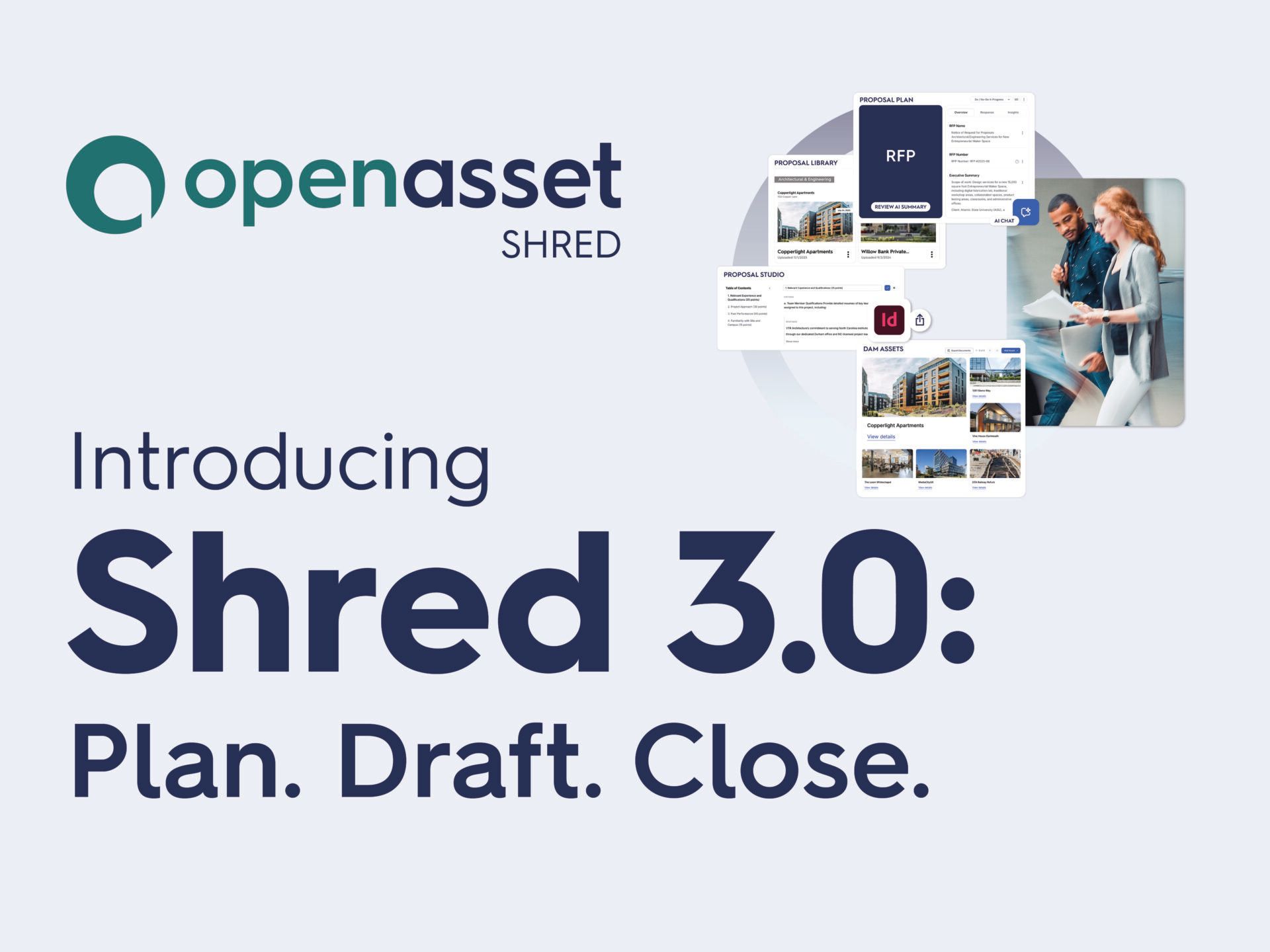
OpenAsset’s AI-powered proposal writing assistant, Shred.ai, is particularly effective at helping proposal writers with their projects. Every step of the way, Shred.ai is at your side.
If you’re in the ideation phase, you can use Shred.ai to find past proposals and use them for inspiration.
When you are doing research, Shred.ai can help qualify leads with real-time Go/No-Go analysis. If you are struggling to find a specific headshot, Shred.ai can help you locate it with its facial recognition and search features. When it is (finally!) time to submit, Shred.ai is an extra set of eyes to protect you from any critical compliance errors.
See what Shred.ai can do for you and your proposal process: