






Marketing for engineering firms: 10 strategies that win more project work in 2026

Mar 8, 2024
7 min

Last updated: September 18, 2026
Most of the advice that ranks for the search term “marketing for engineering firms” was written for companies that sell engineering products: components, equipment, and technical services pitched to procurement managers and plant operators. A consulting engineering practice doesn’t win work that way.
I’ve spent a decade in marketing roles inside architecture and engineering firms, including WSP, one of the world’s largest engineering consultancies, plus the architecture practices PRP and Gensler. I could count on one hand the times a marketing campaign directly produced a lead and a commission.
That isn’t a failure of marketing. It’s how this industry buys.
Engineering firms win work through qualifications, third-party validation, and relationships with the architects, developers, and public agencies who assemble project teams. The 10 strategies below reflect that, and they’re written for consulting practices: civil, structural, MEP (mechanical, electrical, and plumbing), environmental, and transportation.
What marketing means for a consulting engineering firm
Marketing for a consulting engineering firm is the work of getting your practice shortlisted. It builds the visibility, evidence, and reputation that decide whether your firm gets invited to bid, and how credible your submission looks when it lands.
That differs from marketing for an engineering products company, which is built around generating and converting leads. If you’re working out how to market engineering services, start from how they’re bought: the buyer is often another professional, and the sale runs through procurement or a selection process.
For the picture across all disciplines, see our guide to AEC marketing best practices.
How consulting engineering firms actually win work
Most public sector engineering work is won through procurement, and most private sector work comes through repeat business and networking.
Neither route runs on leads. The job of marketing is to make your firm easy to find and easy to justify: for procurement panels, for returning clients, and for the people who put project teams together.
10 marketing strategies for engineering firms
1. Position the firm around a specialty clients can name
Engineering RFPs (request for proposals), or, as they’re called in the UK, ITTs (invitation to tender), ask what your firm has done before. A capability statement that says “multidisciplinary full-service engineering” gives the reader nothing specific to hold onto. A civil engineering practice known for flood resilience, or an MEP consultancy known for hospital retrofits, gets the call when that project appears because specifics are what evaluators remember.
Your specialty should drive everything else you do: which award competitions you enter, which titles you pitch, and which events you attend.
2. Treat your project library as marketing infrastructure
I’ve used a digital asset management (DAM) system in every marketing job I’ve held. Keeping it consistently current is the foundation everything else here sits on, because your website is your shop window.
When the library slips, proposals (or “bids” in the UK) slow down because CVs are out of date or case studies are missing. Proposal/bid teams send around weekly emails asking who worked on a particular project, and those emails get missed as often as they get answered.
At one firm where I worked, award submissions for the British Homes Awards and New London Architecture (NLA) were held up because the right project material couldn’t be found in time. We got a deadline extension, but the entries went in rushed, and the projects didn’t get shortlisted. A rushed submission, pulled together from memory and Google, is a weaker submission.
A stale library shows up in recruitment too. If your website only shows old projects, candidates notice and turn away. It undercuts the story you’re telling about who you are now.
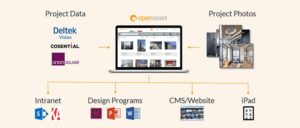
A purpose-built DAM such as OpenAsset keeps project photography, staff CVs, and case studies in one searchable library, so the same current material can feed the website, proposals, award entries, and press outreach.
3. Treat qualifications and proposals/bids as marketing assets
The qualifications package is the marketing output that most directly turns into work for a consulting engineering firm. I never wrote the bids myself, but everything marketing produced fed into them: the CVs, the case studies, the award list, the project photography, and the capability statement at the top of the document.
Most marketing advice files proposals under “sales” and then ignores them. In the US, federal work means the SF330 architect-engineer qualifications form; in the UK, pre-qualification questionnaires (PQQs) and framework submissions play the same role.
Build the reusable pieces once and version them by sector; your bid team’s speed depends on them.
Our guides to engineering proposals and how to create winning proposals cover the assembly side in detail.
4. Enter the awards that matter, and win some
Awards are a major part of winning work in engineering, and most marketing advice on this topic skips them entirely.
In a lot of bids, you’re asked directly how many awards you’ve won, and which ones. It isn’t always a scored line item, but the answer turns up as a dedicated section or as part of the capability statement.
Awards keep working outside the bid:
- They sit on your website as third-party proof.
- They show up on Glassdoor when candidates research you before an interview.
- Award ceremonies put your competitors’ clients and prospects in the room with you.
- Press coverage from getting shortlisted or winning leads to good publicity and increased visibility to your clients.
At WSP, the ones that counted were the awards run by the Institution of Civil Engineers (ICE), the Association for Consultancy and Engineering (ACE), NCE, Construction News, the Chartered Institution of Highways and Transportation (CIHT), and the Institution of Structural Engineers (IStructE).
Because WSP was ahead on sustainability with its Future Ready program, we pursued sustainability awards too, along with people awards such as the Women in Construction and Engineering (WICE) Awards and anything recognizing young talent.
Engineering has an image problem, especially in the UK. Coming from France, where engineering is seen as a more aspirational and prestigious profession, I’ve always found this baffling: engineers train for years and quite literally build everything we live in.
Winning awards boosts morale and pushes back on that image. And seeing diversity recognized in your firm, at leadership level, tells the next generation of engineers that your firm is a place where talented people from all backgrounds are supported, and great work gets noticed.
Pick four or five programs your clients recognize and go all in on those submissions, rather than spreading a small team across 20 entries.
5. Get into the engineering trade press
Trade press coverage gives an engineering firm and its people a credibility an advert never will, because it’s earned.
At WSP, UK leadership was keen to appear in Infrastructure Intelligence, ACE’s magazine, because every major firm in the sector reads it, including your competitors. See a rival named on a project, and management wants to know why it wasn’t you.
But you need something to say. Engineering press generally covers four things:
- Project news. Needs a good angle, a punchy headline, strong quotes, and something different about the project.
- Thought leadership. Around 500 words; it should be informational and topical without being salesy. React to something happening in the industry and offer a solution.
- Reports and research. The strongest coverage, and the most work. At WSP we mapped every stretch of London where housing could be built above existing rail and tube lines, worked out how much housing that represented, and earned coverage in the Telegraph and the Evening Standard. Research like that builds steady visibility and positions the firm as the expert voice on the issue. It can even open doors for discussion with major clients that were previously beyond your reach.
- Reaction to political and industry announcements. Get a comment out within 30 minutes of an announcement so you’re part of that morning’s press roundup. When a client’s CEO reads their cuttings, your name next to theirs is precisely the visibility you want.
You don’t need a PR agency at the start if you don’t have the budget for it. Write something human and topical, free of jargon, find journalists’ emails on the title’s website, and pitch directly with a strong headline.
Done well, coverage compounds into conference invitations, government advisory work, and a seat at the table on industry policy.
In the US, Engineering News-Record (ENR) is the trade publication of record. New Civil Engineer (NCE) and Construction News are the UK staples. Architects’ Journal carries real prestige with architecture clients, as do Property Week and Estates Gazette for reaching developers; ENDS Report matters in environmental work, and Place North West and The Business Desk carry weight regionally.
6. Make the website and search work as your shop window
An engineering firm’s website and paid search earn their keep mainly for recruitment and validation, since everyone checks the site before deciding you’re credible. Across rebrands and website launches at three firms, SEO was barely part of the conversation, because commissions came through procurement and relationships.
Don’t expect the website to be where your work comes from. But fully expect every bid evaluator, journalist, and candidate to check it before acting. Your website must make your firm’s value and accomplishments clear, in jargon-free language that can be easily understood by potential clients, collaborators, and press teams alike.
Project pages are the asset worth building. Pages that name the discipline, the sector, and the location (“structural engineering for healthcare in Manchester”, “transport planning for local authorities”) are what search engines rank and what AI assistants such as ChatGPT and Google’s AI Overviews draw on when someone asks which firms have done this work.
In 2026, a growing share of that research and checking happens inside AI answers before anyone clicks through.
For layout and content ideas, see these engineering website examples.
7. Run LinkedIn and a newsletter as a firm
Social campaigns did a job for brand awareness at the firms where I worked; they didn’t produce pipeline, but they kept us visible. Judge LinkedIn on those terms: it’s where your award wins, project news, and firm announcements get seen by the architects, developers, and future recruits who follow the industry.
A newsletter is the more underrated channel. Free tools exist up to a decent volume, and even sent quarterly it’s low effort with real upside. Every firm I’ve worked at has generated real inquiries from one.
8. Pick a handful of associations and events where clients actually are
For an engineering firm, two or three conferences your clients (or potential clients) actually attend beat a dozen generic ones. Buy tickets for your best networkers and lock in lunches and meetings in advance; don’t just show up and hope.
Run your own client engagement too: roundtables, breakfast seminars, webinars, and next-generation events. These don’t need to be expensive. Use your office space, or ask a partner or supplier to co-host, since they’ll benefit from the exposure too.
In the US, the Society for Marketing Professional Services (SMPS) and the American Council of Engineering Companies (ACEC) are the homes for engineering marketers and firm leadership.
In the UK, the bodies that consistently mattered in my work are ICE, ACE, IStructE, the UK Green Building Council (UKGBC), CIHT, and the NLA, where developers and architects are members. In London, ICE and NLA events are where clients are likely to be; in the North West, Place North West, which runs events as well as regional news, is an affordable starting point.
If budget allows, membership groups such as the London Business Network and the Aldersgate Group add access to high-profile people and a route into policy conversations.
9. Market to the architects, developers, and colleagues who bring you onto projects
Engineers and architects are different professions, and they don’t love being lumped together. On many projects, the engineer is appointed by and reports to the architect, who, in turn, reports to a developer. Many times I’ve had to seek press approval from the architect, who then sought approval from the developer.
The practical consequence: depending on how the contract is structured, architects and developers are clients in their own right. Your marketing needs to speak to them directly, as well as to the end client at the top of the chain. That’s why Architects’ Journal and the NLA appear on the lists above.
Your own colleagues are a referral source too. You’re appointed to a project, few people realize a colleague offers exactly the sub-service the client needs, and the client appoints someone external: an opportunity lost from your own lap. It happens constantly, and short, regular internal presentations fix it cheaply.
The other side of this relationship is covered in our guide to marketing for architects.
10. Measure visibility, shortlists, and repeat inquiries
Nobody in this industry checks Trustpilot before appointing an engineering consultancy. Review platforms and lead-generation services work for firms selling to consumers, and do little for practices bidding on infrastructure and buildings.
What’s worth tracking follows from how the work is won, and shows you the mix you’re actually winning:
- Whether you’re being invited to bid, and how often you make the shortlist.
- Press mentions, and whose projects your name appears alongside.
- Inquiries that trace back to a newsletter, an event, or a roundtable.
- Recruitment outcomes, since candidates read your website and your awards.
A win teaches you something beyond the fee: how the project was won, and where the next marketing hour should go. Set expectations with leadership on the same basis. Brand visibility compounds; procurement and relationships convert it.
Where to start, based on your firm
The biggest structural distinction in an engineering firm’s marketing strategy is whether the firm mostly bids for public or private work. A marketing plan for an engineering company starts from that mix rather than from a channel list.
Mostly public work
Opportunities are often public knowledge years in advance; everyone knew programs like Crossrail and HS2 were coming long before the tenders landed, so you can plan a campaign calendar around what’s announced.
But you generally can’t entertain clients while actively bidding for public work, because anti-bribery and bias policies are in play. Visibility has to come through media coverage, conferences, and thought leadership. In some cases, you may be able to organize small roundtables or panel discussions in your office and invite them to speak or take part, but this must be executed delicately.
Much of the marketing for civil engineering firms sits in this bucket, since roads, rail, and water infrastructure are publicly procured.
Mostly private work
More relationship-led. The same public visibility still helps, and low-key formats such as breakfast seminars are a better way to build those relationships properly.
A two-person marketing team
If it’s just you and one other person: pick your four or five awards, choose two or three events, run your own roundtables, pitch the press directly, and start a newsletter, even a quarterly one. Drop the lead-generation services and review platforms entirely.
What the best-marketed engineering firms do differently
The best-marketed engineering firms run fewer activities in a tighter loop.
Their project library is current, allowing their website, bid, award entry, and press pitch to all draw from the same up-to-date material. Their people are visible in the titles their clients read and at the events their clients attend, and their comment is out while the story is still being written.
Kept up over years, that visibility compounds into bid invitations, a track record your capability statement can point to, and clients who come back.
Make yourself easy to find, and easier to remember, for the people choosing the next project team.
Frequently asked questions about marketing for engineering firms
Which marketing channels work best for engineering firms?
Trade press, industry awards, client events, and a simple newsletter deliver the most for consulting engineering firms, because each puts the firm in front of the clients, architects, and developers who decide which firms get invited to bid. Review platforms and lead-generation tools rarely deliver, as they’re built for consumer businesses.
What marketing strategy should an engineering company use?
An engineering company’s marketing strategy should start from its work mix. Firms bidding for public work can plan campaigns around a pipeline that’s made public years in advance, staying visible through press and conferences since client entertainment generally has to stop during live bids. Firms chasing private work should also consider relationship formats such as roundtables and seminars.
How can engineering companies improve their marketing?
Engineering firm marketing improves fastest when your team cuts scope: a handful of award competitions entered properly, events chosen because clients attend them, and press pitched directly by you rather than through an agency.
How do engineering companies generate new business?
Engineering companies win most new business through procurement, repeat clients, and referrals from the architects and developers who assemble project teams. Marketing’s role is to get the firm shortlisted and remembered rather than to produce leads directly.
What does a strong brand position look like for an engineering company?
A strong brand position for an engineering company is a specialty clients can repeat: a discipline, a sector, and the evidence to back it, such as named projects and awards. “Multidisciplinary full-service engineering,” for example, is a weak position because nobody can remember what to invite you to.
Should engineering firms invest in SEO and paid search?
SEO and paid search pay their way for engineering firms mainly through recruitment and validation, since candidates, journalists, and bid evaluators all check your website before acting. In my 10 years inside architecture and engineering firms, search was rarely where commissions came from, so fund it as a shop window rather than as a pipeline channel.
Get started with OpenAsset
An engineering firm’s awards, bids, press outreach, and website all draw on the same raw material: current project photography, up-to-date staff CVs, and case studies you can access when the deadline is short.
OpenAsset is a digital asset management and proposal platform built for architecture, engineering, and construction firms. It gives marketing and bid teams one searchable library for project images, employee CVs, and reusable proposal content, connected to the Adobe InDesign templates that bids are built in and the systems engineering firms already run, such as Deltek Vantagepoint and Procore.
Shred, OpenAsset’s AI proposal tool, surfaces past proposal content the moment the next tender lands.
Engineering firms such as Affiliated Engineers and Nitsch Engineering run their project libraries this way. Nitsch, with a two-person marketing team, tracked its hours and saw a return within the first year.
See how OpenAsset supports engineering firms, or book a demo.
Amélie Barrau de Backer is Head of Marketing, EMEA at OpenAsset, bringing over 15 years of senior marketing and communications experience across the built environment. An award-winning communicator, she has led marketing strategy at some of the sector’s most respected names, including Gensler, WSP, and PRP, delivering campaigns that have featured in the BBC, The Times, and the Guardian.