






Marketing for Architects: 10 Strategies to Get More Clients

Jul 28, 2023
7 min

Last updated: September 21, 2026
Most marketing advice for architects starts from the assumption that your next client will find you through a Google search, but that’s rarely how the profession works. In my work at OpenAsset with architecture and engineering practices across Australia, New Zealand, and Southeast Asia on positioning, pursuit strategy, and proposal operations, I see a consistent pattern: firms secure most of their work through bids, repeat clients, and long-term relationships that take years to build.
Search still matters. It just isn’t what generates the lead. It’s what a client uses to check you out after your name comes up, which is a different job and needs a different response.
What has changed is how prepared those clients are when they show up. Across my markets, clients arrive at shortlist conversations with opinions already formed. They’ve done the research. They’ve scrolled your LinkedIn, read your project pages, and perhaps run your name through an AI summary. The firms that haven’t caught up to that reality are still treating marketing as something that activates after a lead arrives.
Effective marketing ensures your firm is visible to ideal clients, builds credibility before initial meetings, and enables quick responses when opportunities arise. The ten strategies below draw from practices of consistently successful firms, backed by OpenAsset’s 2024 survey of AEC marketing professionals.
Disclosure: OpenAsset sells the digital asset management and AI proposal software referenced in strategies 4 and 9. The survey data cited throughout is our own; external figures are attributed to their sources.
What marketing for architects means
Marketing for architects is the work of making your firm visible and credible to the clients you want. Done well, it gets you invited to bid, keeps you on shortlists, and makes sure clients remember you when their next project comes around.
It covers more than promotion. Your positioning, project portfolio, proposals, events, PR, social media, and client relationships all carry your marketing. Advertising is not the same thing, and it plays a minor role at most architecture firms.
One idea stands in the way, and architects absorb it in design school: the work speaks for itself. It’s a beautiful sentiment, but in the marketplace, it kills business. Marketing’s real job is simpler than most firms think. Take the genuine complexity of what your firm does, and make it clear to the people who need to commission it.
How architecture firms win work
Architecture firms win most of their work through competitive bids, repeat clients, and referrals. The industry data I work from shows that 75% to 85% of revenue typically comes from repeat clients and direct referrals, while cold inbound contact or public RFPs account for the remaining 15% to 25%.
Proposals carry much of that weight. In OpenAsset’s 2024 State of Proposals in AEC Marketing survey, a study of 535 AEC marketing professionals, almost 70% of respondents said a proposal was required for at least half the projects they won. In the same survey, 63% said their team spends more than half of its time on proposal creation.
Marketing capacity at an architecture firm is largely proposal capacity, and referrals only reach clients who already know you. I’m blunt with firms about the downside of that story: “We get most of our work from word of mouth” is now an indicator of risk, not a flex. It means you’re invisible to the clients who don’t already know you exist.
10 marketing strategies for architecture firms
1. Start with what the business wants to win
The baseline pattern I see is consistent: firms that lose treat marketing and business development as a reactive event. Firms that win treat marketing as proactive business infrastructure. Everything else on this list flows from that.
Every strategy gets easier when it serves a named business goal: the sectors the firm wants to grow, the clients it wants to keep, the size of projects it wants to be known for. Marketing with no specific aim is where budgets go to die.
My colleague Amélie Barrau de Backer, OpenAsset’s Head of Regional Marketing EMEA, lived this from the inside. When she joined PRP, a UK architecture practice, marketing was a one-person operation, and Amélie was that person. She started by understanding what leadership was trying to achieve as a business, then worked backwards from there, and grew the function into a five-person marketing and business development team. Her advice for firms starting the same climb:
“Build trust with leadership by showing results, and let that earn you the space to grow the team.”
— Amélie Barrau de Backer, Head of Regional Marketing EMEA, OpenAsset
2. Position as a specialist and translate design into client value
Generic positioning is the profession’s most stubborn blind spot. Take a shot of espresso every time a firm describes itself as “innovative,” “sustainable,” or “collaborative,” and you’ll be awake for a week.
The firms that win position themselves as specialists who solve a specific, high-value problem, and they describe that problem in the client’s language. For healthcare clients, that means patient recovery times and staff burnout rates. For developers, it means construction cost, risk, and lease-up velocity. Portfolio text written for other architects has the opposite effect. When you market in code, you only reach people who already know you.
3. Make your project photography a program, not an afterthought
Project photography matters more now, as AI-generated renders are free yet lack client personalization. A photograph is your ultimate truth mechanism: proof you translated a complex brief into a real, functioning space. Renders no longer differentiate. Documented buildings do.
A real photography program budgets the shoot from project inception rather than from whatever margin survives construction. Briefs call for people using the space, not sterile empty rooms, and shoots can run on a hybrid basis with stills and short-form video captured in the same session. Splitting shoot costs upfront with the builder and engineers saves 30% to 50% of the budget, in my experience.
The program should also cover what most firms skip: the messy middle of construction, and a return visit 12 to 18 months after handover to record how the building performs in use. That material is harder to produce than a launch-day gallery, which is exactly why clients find it credible.
4. Build a searchable content library
Photography, project descriptions, and staff CVs are the raw material for every proposal, award entry, and post your firm will produce, and most firms can’t find them. Our 2024 survey found that 77% of teams pull proposal content from previous proposals, and only 36% have a searchable, tagged database.
The pattern in firms without a digital asset management (DAM) system is consistent: teams search by photographer name or year instead of sector or building type, and marketing coordinators sacrifice days per proposal hunting for assets.
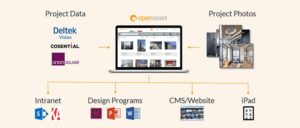
Centralizing in a project-based DAM, tagged by the attributes teams search for, cuts content discovery across a multi-studio portfolio to under an hour and lets staff find assets without going through a marketing gatekeeper. For example, OpenAsset customer Willmeng Construction gave its pursuits team back more than 30 hours per proposal, almost 2,000 hours over a year, by consolidating its assets in OpenAsset DAM. The firm also exceeded its company-wide goal of returning 30 minutes per employee per day. Read the full case study below.
5. Treat proposals as your highest-converting marketing and say no more often
A proposal is often the first document of yours that a client reads closely, and the numbers show how stretched the function is. In our 2024 survey, 64% of teams submitted on the day of the deadline, and only 25% said they could hit their company’s submission targets with current resources. Teams that maximize their efficiency and get time back through our first four strategies can submit early instead, which tends to mean your proposal is read first and read properly.
The discipline that changes those numbers is a go/no-go process. In my experience, a competitive pursuit absorbs $50,000 to $100,000 in non-billable time. Cold RFPs rarely pay that back. When the organization doesn’t already know you, win rates sit at 15% to 20%, often lower. Re-bid for an existing client and they jump to 70% to 80%.
My verdict: A BD strategy that’s built around monitoring public RFP portals and writing frantic responses to organizations that don’t know you exist turns your business development into a game of chance rather than a structured marketing strategy.
Improve your architecture proposal process and protect it with honest no-gos.
6. Make your firm legible to search engines and AI tools
Commissions rarely start with a search, but shortlists get checked online. The client who heard your name at an industry dinner will look you up before the meeting, and an AI assistant asked to suggest firms for a project type will do the same.
The difficulty is that architecture websites are built to be looked at rather than read, and a homepage of unlabeled images tells a crawler nothing. Give every project page text covering location, building type, client type, materials, and outcomes, so both a search engine and a language model can tell what you built and who you built it for.
Maintain consistent firm details, specialties, and locations across your website, LinkedIn, and industry registries. AI answer engines synthesize recommendations from corroborating signals, meaning profile contradictions unnecessarily reduce your visibility.
7. Put your people on stages and be selective about awards
Networking is the most underrated activity in architecture marketing. Your firm’s partners are expected to show up, speak, and build relationships over lunches and dinners, but they’re already running the business, so opportunities go unattended. Train your associates and associate directors earlier, then send them out.
Speaking at the right venue multiplies the effect. A principal on stage at a healthcare design summit or an infrastructure forum reaches exactly the right audience, and generates clips, quotes, and posts afterward. The developer who heard that talk at an Urban Land Institute (ULI) event in Singapore rarely calls the next day. But they may call 18 months later, already trusting you.
Awards work on the same delay, and they deserve the same selectivity. Amélie Barrau de Backer, who managed awards budgets at the UK practices where she worked, is direct about why:
“They’re important, yes, and they’re good for team morale, but they’re also expensive, and at this point every magazine and events business seems to run its own awards programme because it’s a money-maker for them. My advice is to strip it right back to the ones that genuinely do something for your business and your people.”
— Amélie Barrau de Backer, Head of Regional Marketing EMEA, OpenAsset
I’d sharpen that with one strategic filter: prioritize awards your clients judge, such as the Property Council of Australia or Urban Development Institute of Australia programs, over awards judged by other architects, and fund those properly.
Then work every win. Award citations are third-party signals that AI search engines read when assembling a shortlist, so a win should feed press, project pages, LinkedIn, and the next three submissions.
Read Amélie’s tips on submitting and winning architecture awards below.
8. Publish a point of view where buyers already are
Thought leadership does the opposite of project PR. PR says: look at this building. Thought leadership says: here is a problem our clients face, and here is how design solves it.
Two Australian firms do this at scale. Hassell, an international design practice headquartered in Australia, publishes original workplace research tracking thousands of office workers. BVN, a Sydney and Brisbane architecture practice, gives away an open-source guide to circular office strip-outs. Both earn trust before a shortlist exists.
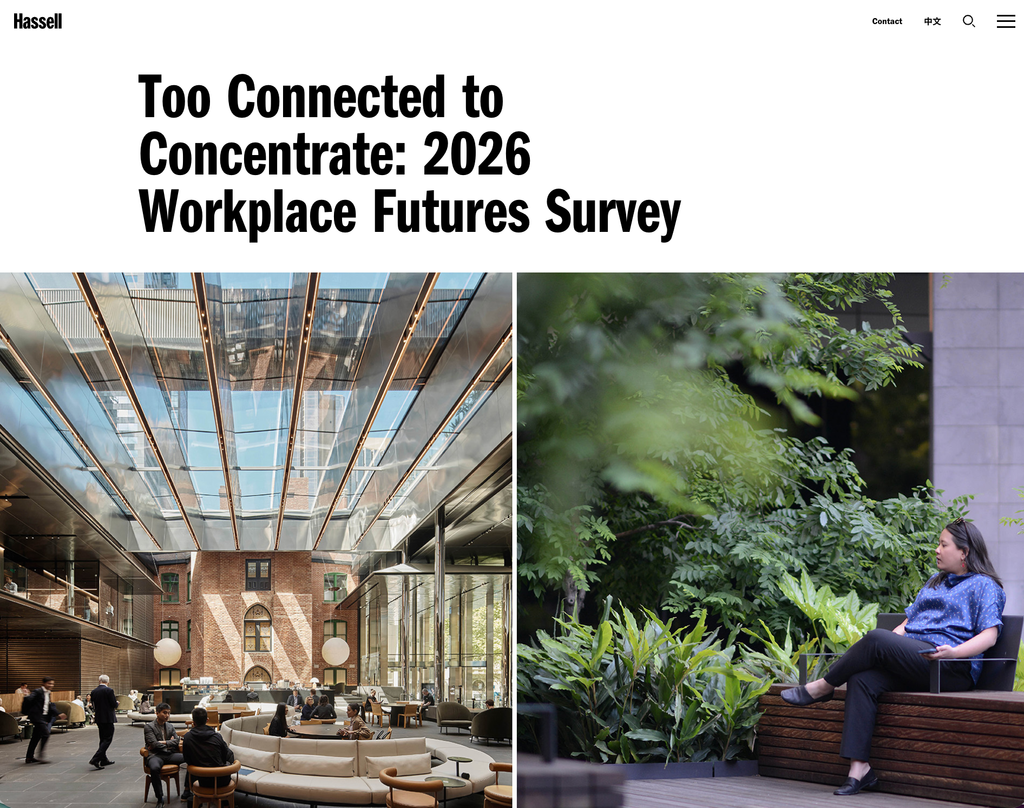
Hassell’s latest workplace survey, Too Connected to Concentrate: 2026 Workplace Futures Survey, available on Hassell’s website.
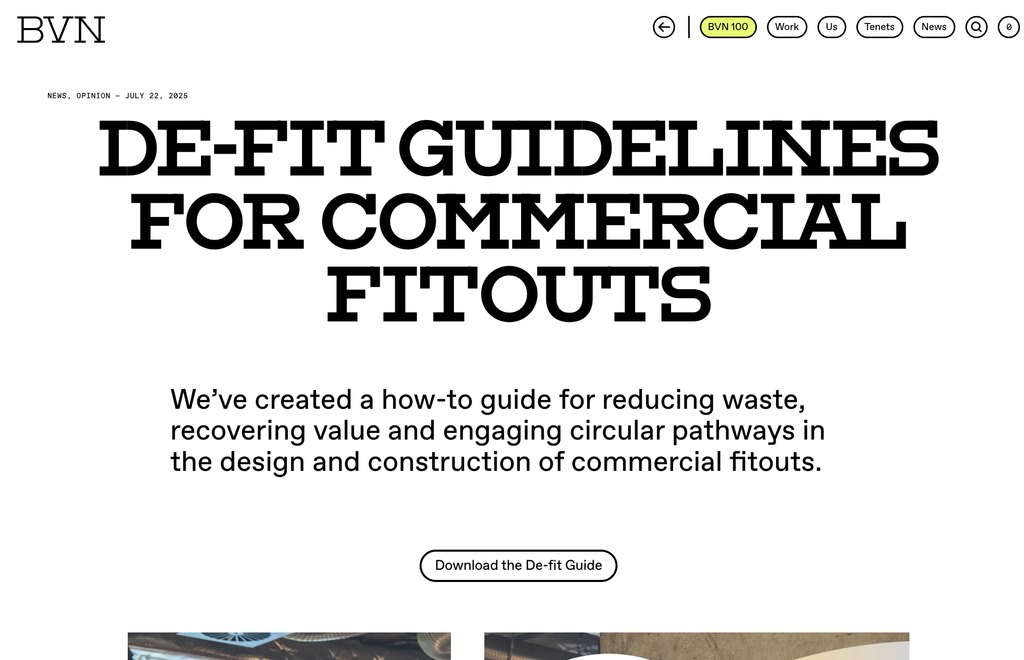
BVN’s how-to guide for designing commercial fitouts, available on BVN’s website.
Distribution matters as much as substance. LinkedIn is where developers, procurement teams, and boards spend their professional attention, and individual voices outperform firm accounts. Only a small fraction of your market is ready to hire at any moment, around 5% by the estimate I work from, so publish for the 95% who aren’t ready yet.
9. Use AI as infrastructure, not authorship
AI adoption in architecture marketing is already mainstream. The Association of Consulting Architects (ACA), the Australian body representing architectural practices, surveyed 270 Australian practices for its 2026 Pulse Check in May 2026. It found that 70% of practices now use AI, that 57% of those adopters apply it to marketing and proposals, and that 68% have no formal AI policy.
Generated content is not a point of view. When polish is free, clients filter for what’s recognizably human. A lot of AI output is polished, competent, and easy to forget, because the tool doesn’t supply the thinking. It doesn’t know your firm’s specific point of view, your hard-won experience, or the particular way your team sees a brief.
The real opportunity is on the infrastructure side: a centralized bid bank that surfaces relevant past responses for the question in front of you. Most firms are sitting on an archive of past bid responses covering nearly every question they’ll ever be asked, and nobody can find the right one on deadline. Shred, OpenAsset’s AI proposal tool, was built for exactly this. It searches a firm’s past proposals and suggests relevant content and structure, while the bid team keeps editorial control.
The risks are just as clear. Unchecked output produces inaccuracies and formulaic responses, and a client who spots either one has a reason to doubt the rest of your submission. AI has to be a support tool, not a substitute for thinking.
10. Set a real budget, and measure what connects to pipeline
For budget benchmarks, I defer to Amélie Barrau de Backer, who set and defended marketing budgets inside UK practices for years:
“Most surveys put marketing spend somewhere between 4% and 8% of annual revenue for smaller firms, going higher if you’re pushing into new sectors or markets. For a 20-50 person firm, that usually works out to somewhere between £60k and £150k a year, with client entertainment and relationship-building still typically the biggest single line item.”
– Amélie Barrau de Backer, Head of Regional Marketing EMEA, OpenAsset”
In US dollars, that range works out to roughly between $80,000 and $200,000 per year.
Then measure what connects to your pipeline. Four numbers tell you almost everything about whether your marketing is working:
- Go/no-go ratio: what percentage of opportunities you’re actively walking away from.
- Proposal win rate: industry benchmarks put the average at 37% to 44%, with high performers reaching 55% and above.
- Shortlist-to-win conversion.
- Sources of new business. Follower counts feel like progress but don’t pay salaries.
Our 2024 survey suggests room to improve industry-wide: 80% of teams track win rate, yet only 40% run a win/loss analysis on a regular basis. If you skip this analysis, you may repeat what lost as readily as what won.
Where to start, based on your firm
Solo practitioners and studios under 20 people
Most of this list is too heavy for you, and that’s fine. Pick three items: a productive referral habit with past clients, a portfolio that’s current and easy to share, and one visibility channel you’ll maintain.
Firms of 20 to 500 people with a dedicated marketing function
This is the 10-point list above, in order. Start from your leadership’s business goals, then build the photography program, content library, and proposal discipline before expanding into events and awards. Budget scales with headcount, so treat the range in strategy 10 as a floor once you pass 50 people.
Multi-office firms
Maintaining consistency across locations is a common challenge, especially when offices do not share images, CVs exist in disparate formats, or teams spend extra time reinventing proposal content. Centralizing your content library first allows every office to bid using the firm’s strongest assets. Our 2024 State of Proposals in AEC Marketing report details how organizations of various sizes manage this process.
Sector is the other variable. Residential clients buy on trust and lifestyle, commercial clients on ROI and risk, and institutional and public-sector clients through committees and procurement frameworks. Weight these strategies toward the buyers you serve.
Wherever you start, my closing thought is the one to live by: the work never speaks for itself. It’s the infrastructure around it that gives it a voice.
Frequently asked questions
How do architecture firms get new clients?
Mostly through competitive bids, repeat clients, and referrals. Roughly seven in ten teams told OpenAsset’s 2024 State of Proposals in AEC Marketing survey that at least half of their won projects came through a proposal. The firms that win consistently are known and credible before the opportunity arrives, and organized enough to move quickly once it does.
How much should an architecture firm spend on marketing?
Between 4% and 8% of annual revenue is the benchmark range that Amélie Barrau de Backer, OpenAsset’s Head of Regional Marketing EMEA, has worked with at smaller firms. A 20-to-50-person practice typically lands at USD $80,000 to $200,000 (£60,000 to £150,000) per year. Budget above that range if you’re entering a new sector, where you are paying to build relationships that don’t exist yet.
Does SEO matter for architecture firms?
More than it used to, but not as a lead engine. Clients and AI tools use search to vet you after your name comes up, not to discover you. That makes the priority clear: every project page needs readable text, not just images, and your firm’s name, specialty, and locations should match across your site, LinkedIn, and industry registries.
What’s the biggest marketing mistake architecture firms make?
Spreading budget too thinly across every award, event, and channel. The firms that get the most from marketing pick fewer activities, tie each one to something the business is trying to win, and fund them properly.
Get started with OpenAsset
OpenAsset’s digital asset management platform allows marketing teams at architecture, engineering, and construction firms to keep project photos, employee CVs, and proposal content in one searchable library, connected to tools they already use like Adobe InDesign and Deltek. If your photography investment is sitting in unsearchable folders, or bid deadlines keep arriving faster than your team can find the right content, book a demo and see how the platform fits your workflow.
About the authors
Caroline Caneva is Head of Regional Marketing APAC at OpenAsset, where she works with architecture and engineering practices across Australia, New Zealand, and Southeast Asia on positioning, pursuit strategy, and proposal operations.
Amélie Barrau de Backer, Head of Regional Marketing EMEA at OpenAsset, contributed the quoted material in strategies 1, 7, and 10 and the budget FAQ. She spent six years building the marketing function at PRP, a UK architecture practice, from a one-person operation into a five-person marketing and business development team, and worked in marketing at WSP and Gensler before that.
Caroline Caneva has spent over twenty years inside the architecture, design, and construction industry — working alongside the practitioners, understanding the pressures, and building the kind of marketing that moves things forward in this sector. Her career spans marketing and growth leadership at some of Australasia’s most recognised design practices, including a full rebrand across eleven studios at Plus Studio. Seven years at the Design Institute of Australia gave her a sector-wide view of the professional community, and her contribution to Australian design was awarded with an Honorary Fellowship (FDIA hon).
Caroline’s experience now informs her work as a speaker, writer, and advocate for how technology and AI can practically transform the way built environment firms market themselves and win work.