






What are the top AEC marketing tools in 2026?
Apr 6, 2026

Last updated April 6, 2026
Key takeaways: AEC marketing tools in 2026
- AEC teams are small and lean. When you need to get work done fast with little manpower, support tools and software are critical. As teams stay small while workloads get larger, marketing software is not optional.
- Purpose-built tools are best. The biggest shift in AEC marketing software is the move towards tools fine-tuned for the industry, and with the advent of AI, these tools are getting even more powerful and specific.
- The best marketing stacks are connected. No matter which part of the tech stack, software benefits from the ability to talk to the rest of your tools. The point of software is to make life easier, and few things make life easier than being able to see everything in one place.
Architecture, engineering, and construction (AEC) marketers need support tools now more than ever. In 2026, the typical AEC marketing team runs small, lean, and busy. Without support tools to help juggle customer relationships, manage internal information, and provide meaningful analytics, it’s hard for a modern marketing team to do everything their company asks. And, of course, brand new AI-powered tools can also help.
In 2026, the question isn’t if you need quality software that lets you do more. Adopting these tools is simply best practice. Instead, the question is which ones will make your life easiest.
That’s a harder question than it looks. The marketing software landscape is enormous. There are thousands of platforms promising to save you time, boost your win rate, and transform your workflow, but most of them weren’t built with AEC in mind. They don’t know what an SF330 is. They’ve never heard of a go/no-go process. They can’t tell the difference between a project sheet and a project description.
Some tools, though, were built specifically for this industry, or have evolved to serve it well.
No matter what pain point you’re experiencing or which part of the software stack you’re in the market for, you can find an effective, tailor-made solution that meets your needs. The biggest challenge is just figuring out which one!
Table of contents
How do AEC firms use marketing tools?
Do AEC firms need specialized marketing solutions?
What changed about AEC marketing software in 2026?
- AI and automation
- Training time
Criteria for evaluating AEC marketing tools
Top software tools and technology for AEC marketers
- CRM platforms
- Proposal response automation tools
- Email marketing and automation tools
- Project management and collaboration tools
- Website builder tools and content management software
- Social media tools
- Design software
- Digital asset management tools
- Networking, bidding, and lead sources
- SEO and content optimization tools
- Analytics and reporting software
How to evaluate your tech stack
Elevate your tech stack with OpenAsset
How do AEC firms use marketing tools?
AEC marketing teams are small by almost any industry standard. They are often juggling proposals, portfolio management, social media, client outreach, award submissions, and brand consistency. Often, they do it all at once, sometimes with just one or two people. Marketing tools exist to make that workload manageable.
AEC firms can use tools to make a number of tasks faster and easier: organizing and presenting past work, staying visible between pursuits, and using analytics to know what’s working.
Importantly, the best AEC marketing stacks aren’t the biggest ones. They’re the ones where the tools talk to each other and every platform serves a clear purpose. A proposal tool connected to a DAM. A CRM that feeds into email campaigns. Analytics that inform what gets prioritized next. That is when software stops being convenient and becomes invaluable.
Do AEC firms need specialized marketing solutions?
The short answer is: often, yes.
While not necessarily required, marketing software made just for the AEC industry comes with a number of perks.
This is most obvious when working with proposals. AEC proposals aren’t like sales decks or product pitches. They follow strict rules and need specific things: project stories, staff resumes, past performance records, and sometimes government forms.
A generic AI writing tool doesn’t know the difference between a qualifications-based selection and a design-build RFP. A purpose-built tool like Shred.ai does.
Customer relationship management (CRM) software is another clear example. AEC sales cycles are long and relationship-driven. AEC-specific platforms offer AEC-specific features, from the go/no-go decision all the way through proposal submission and project close-out. A general CRM can be set up to do something similar, but it takes a lot of extra work to get there.
That said, not every tool in your stack needs to be AEC-specific. SEO tools, email platforms, social media schedulers, and design tools work just as well for an engineering firm as they do for anyone else.
The real question isn’t whether a tool has “AEC” in the name. It’s whether the tool fits how your team works and the problems you actually need to solve. Where those problems are unique to AEC, purpose-built solutions almost always win. Where they’re not, the best general-market tool is usually the right call.
What changed about AEC marketing software in 2026?
The short answer: 2026 looks a lot like 2025.
Previously, OpenAsset interviewed over 500 AEC marketing professionals about the state of the industry. The report found that teams were small, stretched thin, and spent most of their time trying to keep up with bloating workloads.
63% of respondents claimed more than 50% of their team’s time was spent working on proposals. And even focusing that hard on one task, only 25% thought they could fill every proposal the company targeted.
All of this is still true in 2026, but the good news is that we’re starting to find solutions to these problems. More powerful tools, quick-working AI, and a focus on deleting repetitive and time-consuming busywork have all made the workload more bearable.
AI and automation
AI was the buzzword of the year in 2025, and that doesn’t look like it will change in 2026.
Pretty much any AEC software company from OpenAsset to Unanet to Deltek has introduced an AI tool that supports that company’s core mission better than ever.
In OpenAsset’s case, that is Shred.ai, an automation tool that turns old proposal archives into a searchable, AI-powered library. In doing so, Shred.ai lets marketing teams overcome bottlenecks with additional muscle and streamlined workflows. It’s like a secretary hired just to organize decades of old files and project data into something you can use in a fraction of the time.
Training time
At the same time that computing tools are getting more powerful than ever, Vectorworks found that AEC workers have less time than ever to learn how to use them.
It’s understandable how we’ve gotten here. Marketing teams are expected to do a lot with a little, and when you’re behind on a tight deadline, taking time out of your day to attend training seminars can feel unthinkable.
But just like an overworked team can fall more and more behind on projects, ignoring new technology will make a team fall more and more behind the productivity curve.
AEC software is here to help marketers and make their jobs easier, and the trend works both ways. Find time now to invest in more efficient tools, and you will have even more time later to spend on other priorities.
Criteria for evaluating AEC marketing tools
The best AEC marketing tools, purpose-built or otherwise, all share a few key traits regardless of what they do. They are easily usable by small teams with minimal training, plug seamlessly into the rest of your tech stack, and provide the information you need quickly and efficiently.
When researching potential tools, consider these points:
- Capabilities: Most important, of course, is to ensure that a tool has the functions you are looking for. When you go shopping for new software, have an intended use case or pain point you want to solve first, then find the tool that directly addresses it.
- Ease of use: Ease of use can mean more than just being quick and easy to use. How well documented is the tool? How fast is it to learn? Can you find a tutorial in 10 seconds on YouTube, or do you need to hunt through a 100-page design document if you have a question? How much of it works immediately out of the box, and what requires some setup?
- Integrations: If your tech stack uses a dozen different programs, their ability to all talk to each other becomes very important very fast. When programs are already designed to work together, your entire workflow just moves more easily. It is important to make sure that potential tools have built-in integrations with your existing ones, or you’ll be passing files across the office with USB flash drives. Remember flash drives?
- Implementation: Often, the most popular tool is a universal one, but that doesn’t mean it’s the best. Software built specifically for your industry is more likely to have the tools and understanding to properly support your business. Universal tools can handle AEC-specific tasks, but they aren’t built expressly for them. In some cases, you might have to do some backend work to build your own functions to do what an AEC-specific tool does out of the box.
- Data and analytics: Many software tools will also provide some level of analytics for you to study. Look for dashboards that surface the metrics most relevant to your goals, whatever they might be. Bonus points if the tool can connect its data to the rest of your stack.
- Cost efficiency: After all those other considerations, you also need to balance price against your budget. Being cost-efficient is not about buying the cheapest tool, but considering the practical uses of more expensive tools before you splurge on them. A more expensive tool often has better support, more integrations, and a bunch of extra features that could be useful — but you still pay for all the features you don’t use.
Top software tools and technology for AEC marketers
AEC tools perform many different tasks, and each category comes with its own considerations. But no matter what form of support you need, you are guaranteed to be well-covered.
CRM platforms
Above all else, AEC marketing is about building and maintaining healthy business relationships.
In order to accomplish this, CRM (customer relationship management) platforms are one of your most useful tools. After years of experience, Rachelle Ray, marketing guru and head of AEC marketing innovation at OpenAsset, has found this to be one of the industry’s founding truths.
“The AEC industry is almost entirely built on relationships,” Ray said. “Which makes a strong CRM foundational to every part of your business. The technology alone isn’t enough, though. Your team needs to be fully bought into the tool, understand the value, and actively use it.”
CRM platforms help manage pipelines, capture a complete view of leads, and automate personalized marketing campaigns. Today, 80% of AEC firms use some form of CRM system, whether a dedicated platform or a module within their ERP.
- HubSpot: HubSpot offers several useful automation tools for email campaigns, contact nurturing, and tracking proposal collateral engagement. If your firm has a dedicated BD coordinator handling pursuit tracking in spreadsheets or another system, HubSpot can complement that workflow reasonably well.
- UnaNet: UnaNet is designed specifically for AEC marketers, and you can tell from the feature list. It shows pursuits, contacts, firms, and project history, supports Go/No-Go decision workflows, and has several features that track companies, projects, and even individual contacts in your system. UnaNet can tell you your company’s entire history of interactions with someone at a glance.
- Salesforce: Salesforce is built for sales first and marketing second. That means it will require significant investment in implementing custom tools that can track the long-term, relationship-based nature of the industry. If your company is already invested in Salesforce, you can modify it to work for the marketing team, too. But if you are starting fresh, you will have an easier time looking elsewhere.
Proposal response automation tools
If you work in AEC marketing, you already know the pain of proposal season. Stress-inducing problems abound, from tight deadlines to hours spent copy-pasting from old submissions. It’s one of the biggest bottlenecks in the industry, and proposal response automation tools exist specifically to open it wide.
These platforms help your team find, reuse, and refine past proposal content faster. They cut down on repetitive work and free you up to focus on strategy: the creative decisions and messaging that actually make winning proposals.
- Shred.ai: Built specifically for AEC, Shred.ai turns fragmented archives of past proposals into a searchable, intelligent library that powers faster, more compliant RFP responses. With that achieved, it can surface old, reusable content, autofill repetitive boilerplate sections of proposals, and double-check your work for compliance errors.
- QorusDocs: QorusDocs is an AI-powered proposal management software that automates the creation of personalized pitches, presentations, proposals, and RFP responses, allowing different teams to collaborate in one place. QPilot, its AI assistant, auto-generates first drafts, centralizes bios and case studies, and ensures brand consistency across submissions.
- Responsive: Rebranded from RFPIO, Responsive is used by enterprise-scale companies to manage RFPs, RFIs, security questionnaires, and due diligence inquiries. Core capabilities include automating the completion of documents, spreadsheets, and questionnaires, along with a centralized AI-enabled content library, workflow automation, and collaboration tools for cross-functional teams.
Email marketing and automation tools
You already know that winning proposals takes time and constant contact. Follow-up emails, nurture campaigns, drip emails — all invaluable to keep your firm top of mind throughout the process.
Email marketing is an important but time-intensive part of the process, but that’s where automation comes in. For AEC marketers, the right tools can mean the difference between a firm that stays relevant and one that gets forgotten.
Email automation takes the repetitive work off your plate, sending the right message to the right contact at the right time, without you having to personally write every little email.
It also builds something harder to quantify but just as valuable: trust. Consistent, well-timed communication tells clients and prospects that your firm is organized, thoughtful, and paying attention.
- Mailchimp: One of the most widely used email marketing platforms available today, Mailchimp is a solid starting point for smaller AEC teams that want to send campaigns, build simple automations, and track performance without a steep learning curve. It includes predictive and behavioral targeting tools, though costs can climb as your contact list grows. It’s not built specifically for AEC, but it’s accessible and well-supported.
- ActiveCampaign: A strong choice for teams that need more muscle. ActiveCampaign is built for businesses that have outgrown basic email tools but aren’t ready for enterprise-level complexity. In 2025, they launched “Active Intelligence,” an AI-powered system designed to help marketers build automations, create segments, and surface opportunities with less manual effort.
- Marketo: Built for enterprise-level B2B marketing, Adobe Marketo Engage is designed to attract the right buyers, nurture them across channels, and keep sales and marketing in sync. Adobe was named a Leader in the 2025 Gartner Magic Quadrant for B2B Marketing Automation Platforms. It’s a powerful platform, but it comes with complexity and cost that require a dedicated marketing operations team to make it worth it.
Project management and collaboration tools
When you’re juggling proposals, photography shoots, and award submissions all at once, staying organized isn’t optional. It’s survival.
Project management and collaboration tools won’t write your proposals for you. But they help your team stay aligned, meet deadlines, and avoid the chaos of tracking everything through email threads and sticky notes. For small AEC marketing teams wearing a lot of hats, that kind of structure matters.
- Asana: Asana is one of the most popular project management platforms on the market. It lets teams assign tasks, set deadlines, track progress, and automate routine workflows, all in one place. Its fall 2025 release introduced AI Teammates (in beta), which can be assigned tasks just like human team members and respond with updates where your team already collaborates.
- Notion: Notion is an all-in-one workspace that combines notes, documents, task management, and databases in a single platform. Its Suggested Edits feature lets team members propose changes without altering the original content, which is useful for collaborating on drafts and shared documents without losing track of the original.
- Monday.com: Monday.com organizes work into visual boards where teams can track projects, campaigns, and processes in one place. It supports over 200 integrations, including Slack, Google Drive, Zoom, and Salesforce, along with built-in time tracking and workload management tools. For AEC marketing teams specifically, it handles campaign management, content calendars, and approval tracking well.
Website builder tools and content management software
AEC marketers wear a lot of hats. You’re writing proposals, managing assets, coordinating with principals, and trying to carve out time for actual strategy. Your website should be working for you, not adding to your to-do list.
A good content management system puts the controls in your hands. You should be able to update a project page, swap a photo, or publish a thought leadership piece without filing a ticket or waiting on IT. The tools below make that possible at different levels of complexity and scale:
- WordPress: In 2025, WordPress powered around 44% of all websites and over 60% of those using a content management system, making it the most widely used CMS in the world. It’s highly flexible, with thousands of themes, powerful page builders, and over 59,000 free plugins to extend its functionality. Whether you need a simple portfolio or a full content hub, it can handle any task you can imagine.
- Squarespace: A design-first platform that’s particularly easy to use thanks to its drag-and-drop editor and intuitive interface. If your main focus is an online portfolio, Squarespace is a strong option. It’s a visually polished choice for smaller teams that want a professional-looking site without a big technical lift.
- Drupal: A powerful, open-source CMS built for organizations that need serious control over their content. Its enterprise-grade security, scalability, and multi-language supportmake it a viable option for larger AEC firms with dedicated IT resources. Fair warning: it comes with a steeper learning curve than competing options.
Social media tools
You have probably listened to more than one marketing seminar talking about the power of “thought leadership.” And in the AEC field, building relationships is one of the most important aspects of the job.
One of the best ways to build both is by being active in places like LinkedIn, where your clients, prospects, and peers are spending time.
Consistent, intelligent use of social media is one of the best ways to build your reputation. The right reputation builds trust and brand recognition. And trust and brand recognition get your foot in the door with all kinds of people before you even meet them.
Prospective clients already know you before they’ve even put out a request for bids, and when industry experts start looking for their next job, they already view you as a hot place to be.
Ray views this as more than just a perk. It’s a vital way to keep your business thriving.
“Having a consistent social media presence and posting strategy is a critical part of solving one of AEC’s most persistent problems today: recruiting top talent,” Ray said. “Your marketing efforts shape the first impression of your firm, not only for clients, but for prospective future hires as well.”
Regardless of the reasons you do it, every AEC marketing team should be on social media. And these are the best tools to make that process as effortless as possible:
- Hootsuite: An all-in-one social media management platform that lets you schedule posts, monitor conversations, analyze performance, and manage engagement across multiple networks from a single dashboard. Hootsuite’s built-in AI assistant can also help generate captions, hashtag suggestions, and post ideas, as well as repurpose existing content into new posts.
- Sprout Social: A more analytics-forward option well-suited to teams that want to go deep on data. The platform provides features for social media scheduling, analytics, reporting, and team collaboration tools, helping organizations streamline workflows and monitor brand visibility.
- Canva: A leading design tool for social media experts everywhere, Canva’s intuitive interface lets those with minimal design experience create professional-looking posts. Its Brand Kit feature keeps logos, fonts, and colors consistent across everything you publish. A free plan is available, with expanded features starting at $110/year for Pro.
Design software
Inevitably, every marketing team is going to have to make something new. Whether your medium is video, photography, or print advertisement, your team’s creatives probably already have a design suite that they have worked with for a decade and can’t imagine living without.
Adobe has loomed large over this field since it was born. We still call photo editing “Photoshopping” today. No matter the project, Adobe is guaranteed to have the software to get it done.
But their Creative Cloud does have weaknesses, especially on the cost front. Adobe’s products are pricey and subscription-only. Their biggest competitors all take advantage of this by allowing you to buy their software once and use it forever.
Chief among their competitors is Affinity by Canva. After purchasing Affinity, Canva has implemented its software into its own product line. Affinity by Canva is now free, with professional tools for photo editing, graphic design, and page layout included at no charge — though AI features like Generative Fill require a paid Canva plan.
Layout design tools
- InDesign: The industry go-to for creating professional layouts and print-ready documents. Recent updates include the ability to convert PDFs into editable InDesign documents, AI-generated alt text for images, and real-time collaboration for editing directly in a browser. It has a learning curve, but integrates tightly with Photoshop and Illustrator, making it well-suited for AEC marketing teams that need polished, print-quality proposals, brochures, and leave-behinds.
- Canva Pro: While mainly marketed towards social media, many marketers use Canva Pro for design work, especially if their materials will only be distributed online. Pro includes 140+ million stock photos, videos, and templates, up to 1,000 Brand Kits, and 1TB of storage.
Photography editing tools
- Photoshop and Lightroom: Photoshop is the industry-standard tool for retouching, compositing, and transforming photos, now with a heavy focus on generative AI. Lightroom is a cloud-based photo editing and management tool that lets you edit, organize, and share photos across any device, with edits syncing automatically. Together, they don’t just let you edit photos any way imaginable, but also eliminate common issues that arise when multiple people collaborate on a project.
- Affinity by Canva: Formerly Affinity Photo, this software is built around non-destructive editing — from RAW development to retouching and compositing — with GPU acceleration to keep complex files fast and fluid. It also includes tools like Smart Selections, live filters, and batch processing.
Video editing tools
- Premiere and After Effects: Adobe, again, has multiple offerings depending on how heavy-duty your needs are. For standard video editing, Premiere is a solid choice. For more specialized effects, Adobe After Effects is a significantly more powerful (but also complex) system. These two programs often work hand-in-hand, with After Effects projects often embedded directly inside of a Premiere timeline. If you use one, the other is highly recommended for that compatibility alone.
- Apple Final Cut Pro: For Mac users, Final Cut Pro is the editing tool of choice. Apple has a long history of maintaining tools for their own walled garden of products, and Final Cut Pro is their fully featured video editing offering. The most recent update added expanded controls for ProRes RAW video shot on iPhone.
- DaVinci Resolve: The only solution that combines editing, color correction, visual effects, motion graphics, and audio post-production all in one tool.DaVinci Resolve 20, the most recent major release, adds over 100 new features, including several AI tools. Depending on your needs, you may even be able to use it for free!
Digital asset management tools
AEC marketing runs on content. Project photos, renderings, staff bios, case studies, award submissions — the list is long, and it grows with every project you pursue. Without a system to manage it all, things get messy fast.
Only around half of AEC firms have a dedicated DAM system in place. The rest rely on folder-based or SharePoint solutions, and in the worst cases, files are scattered across network drives with little to no structure.
DAM systems solve this by providing a centralized, searchable platform that accelerates workflows, enhances cross-team collaboration, and optimizes asset use. They also help with brand consistency, version control, and making sure your team never sends a client an outdated logo or an unapproved rendering.
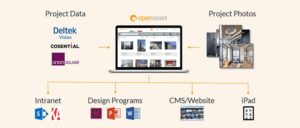
- OpenAsset: The only project-based DAM platform built specifically for AEC teams. It gives you one place to store, organize, and find everything from project files to employee data to branded templates. Because everything ties back to your projects, it helps you move faster when creating proposals, collaborating with teammates, or keeping your portfolio up to date.
- Bynder: An AI-powered DAM with the ability to search by image, text, and even speech, making it easier to find assets and extract maximum value from your digital content. It connects with 145+ integrations out of the box and is ISO 27001, SOC 2 Type II, and GDPR certified, so those concerned about integrations will find their home here. It is not built for AEC specifically, but well suited to large marketing teams.
- Brandfolder: A cloud-based DAM platform established in 2012 that was acquired by Smartsheet in 2020 for $155 million. It centralizes digital assets in one place with features like automated tagging, duplicate detection, Brand Intelligence analytics, and customizable permissions for both internal teams and external stakeholders.
Networking, bidding, and lead sources
Finding new project opportunities is one of the biggest challenges in AEC marketing. The right lead generation platform helps your firm discover projects early, track bids, and stay ahead of competitors.
These tools aren’t just for contractors. Architecture and engineering firms have their own options too, from public-sector lead services to government portals and newspaper clipping aggregators that surface RFPs before they’re widely known.
Here are some of the most widely used bidding and lead generation platforms across architecture, engineering, and construction:
- Dodge Construction Network: A comprehensive project data and intelligence platform serving the full AEC lifecycle. Dodge provides project leads, market forecasts, and analytics across planning, bidding, and post-bid phases.
- ConstructConnect: A cloud-based platform that combines project leads, bid management, takeoff, and estimating. ConstructConnect includes legacy tools like BidClerk, SmartBid, and iSqFt, with access to over one million public and private projects.
- BuildingConnected (Autodesk): A bid management and subcontractor prequalification platform with a network of over 1.5 million construction professionals. It’s part of the Autodesk Construction Cloud ecosystem.
- IMS (Integrated Marketing Systems): IMS is a subscription-based lead service built specifically for architecture and engineering firms. IMS delivers daily, agency-verified advance notices for public-sector RFPs and RFQs, and monitors CIPs, bond measures, and public notices. It’s now powered by Dodge Construction Network.
- PlanHub: A cloud-based preconstruction bidding platform that connects general contractors, subcontractors, and suppliers. It’s free for GCs to post projects, with a growing network of over 500,000 professionals.
For a deeper look at construction-specific platforms, check out our guide to construction bidding websites.
SEO and content optimization tools
SEO and content optimization tools are an important, if perhaps not mission-critical, part of your marketing strategy. Many AEC marketing teams run small and lean, and when they do, this is one of the first things they outsource somewhere else.
For those who do manage their own search optimization in-house, however, these tools are invaluable:
- Ahrefs: A comprehensive SEO and marketing intelligence platform trusted by 44% of Fortune 500 companies. Ahrefs is especially well-regarded for its backlink analysis and keyword research capabilities. It’s a powerful tool, but it comes with a learning curve and a price tag to match.
- SEMRush: An all-in-one marketing tool with over 55 tools and reports. Beyond keyword research, it covers SEO, content marketing, competitive research, PPC advertising, and social media, making it one of the more versatile options on this list. It’s not cheap, but it covers a lot of ground for teams that want fewer tools overall.
Analytics and reporting software
Work somewhere long enough, and you are bound to notice a few areas where your pipeline has room to improve. Data isn’t just a way to track how successful your marketing team is, but the bedrock of any argument for why it should change.
“Marketers often ask: ‘How can I make a case for more resources?’” Ray said. “The answer is look at the data. Then tell a strategic story with metrics, like you would when positioning your firm in a proposal. But to do that, you must have metrics.”
You shouldn’t just have metrics on your social media accounts. Productivity, workload, ROI, and anything else that can be measured, should be measured. Companies are large entities that contain a lot of competing opinions, and the easiest way to get them all in alignment is to show, not tell, how the company is doing.
- Google Analytics 4: For as long as it has been a name, Google has been the standard in analytics. GA4’s cross-platform tracking captures user behavior across both websites and mobile apps, and recent integrations allow marketers to connect its data directly with Google Ads and Search Console for deeper insight into ad effectiveness.
- Microsoft Power BI: Power BI is a suite of business analytics tools designed to analyze data and share insights through rich dashboards available on every device. It lets teams build interactive reports, connect to a wide range of data sources, and share findings across the organization.
- Google Looker Studio: As of mid-2025, Google Looker Studio offers over 900 native and partner connectors, pulling in data from marketing platforms, databases, CRMs, and more with no SQL required.A Pro tier is available for teams that need more advanced collaboration and governance features.
How to evaluate your tech stack
No software decision is made in a vacuum. You have to consider how new tools will interact with existing ones, how much they cost, and what outcomes they will achieve.
And that’s before you get into AI, an entirely new realm of technology we are all exploring and learning about in real time. How do you even begin to choose an AI tool?
First, you need to have a clear reason to make a decision at all. If your process isn’t broken, don’t fix it. Every tech stack conversation should start with a clearly defined problem to solve.
A few examples: Your team is consistently running into the same bottleneck, you are struggling to meet deadlines and keep your head above water with the amount of work coming in, or there is a piece of software that nobody is using (or, worse, has to use every day and hates).
Any time somebody at your company goes, “My job is great, except for this one thing,” there is a perfect target for evaluation.
Next is to analyze what, exactly, could fix the problem. Sometimes, there is a ready-made solution like Shred.ai that can automate your specific problem away. Sometimes, the solution is to simply hire another living, breathing person. The more time you can spend researching, the smoother this process will go.
Particularly because there will often be multiple solutions, or an entire industry of them, to choose between. Among those solutions, there will be countless pros and cons to compare, but the better you define your problem and the more work you do studying how to fix it, the more obvious the correct fit for your company will be.
Elevate your tech stack with OpenAsset
We’re not just a software provider. We can also help you with the very first step of that tech evaluation process. If you feel that there is something holding your marketing back but can’t quite put your finger on why, take OpenAsset’s Proposal Power Index quiz.
Once you have taken that first step, you will be well on your way to identifying the problem you need to solve.
It might even turn out that OpenAsset’s DAM or Shred.ai solutions are exactly what you need. If deadlines, repetitive data entry tasks, or a disorganized library of legacy documents are getting in the way of the excellence you know your marketing team is capable of, OpenAsset is here to help.