






AEC marketing in 2026: What actually wins work at architecture, engineering, and construction firms

Jun 10, 2025
6 min
Last updated: July 31, 2026
I spent 15 years running marketing inside architecture and engineering firms, including WSP, Gensler, and PRP, before joining OpenAsset. In all that time, I never saw a firm win a commission because of a social media post or an award win. Most work in this industry is worth a million pounds at minimum, and contracts that size are won through bids, relationships, and reputation.
This guide covers what marketing teams at architecture, engineering, and construction firms can actually do to win work in 2026.
What is AEC marketing?
AEC marketing is the work of building an architecture, engineering, or construction firm’s reputation and relationships so you are invited to bid on, and win, the right projects. The discipline of AEC marketing spans visible and authoritative proposals, award submissions, conference speaking, trade press, LinkedIn, client events, and the project portfolio behind all of it.
In the UK, the same work is usually called marketing for the built environment, and proposals are called bids.
This guide is written for marketing coordinators, marketing managers, and business development or bids leads at mid-market firms: architecture practices of roughly 20 to 500 people, and engineering and construction firms of roughly 100 to 500.
Why AEC marketing isn’t generic B2B marketing
AEC firms don’t function the way typical B2B businesses who sell products, subscriptions, or services do. AEC firms win work in two different markets, and each asks something different of marketing.
Public-sector work is pursued in the open.
Tenders above certain thresholds must be published on Find a Tender, the UK government’s procurement portal, or on SAM.gov for US federal work. Any qualified firm can respond. In the UK, thresholds were lowered in January 2026 and recalculated to include VAT, so more public contracts now fall inside the formal bid process.
Marketing’s job in the public market is recognition: the evaluators reading your bid should already know your name from awards, rankings, trade press, and conference platforms. Royal Institute of British Architects (RIBA) design competitions, for example, ask firms to list their RIBA award history in the submission itself.
Private-sector work is invited.
A developer sends the brief to firms they know, or simply decides at the outset who they want. If you do not have the relationship, you will never hear about the opportunity at all. Marketing’s job here is keeping relationships warm: client dinners, roundtables, your own events, and a LinkedIn presence that reinforces every project milestone.
The split between the two markets is a leadership decision. Some firms I have worked with aimed for a 50/50 split between public and private work; others ran 60/40 in favor of private. Campaigns shift the balance too: a push into multifamily housing or build-to-rent targets a largely private-sector audience, so that campaign gets built around relationships rather than tender responses.
Who does the work is the other structural difference. Below roughly 200 employees, one team usually handles both marketing and bids. Above that line, bids becomes a separate full-time function, because responding to tenders becomes a complete job on its own. The two stay close either way: at PRP, marketing and the bids team reviewed the week’s pursuits with the Board every Monday, and we designed our marketing campaigns to support upcoming opportunities.
What the data says about AEC marketing teams
OpenAsset’s 2024 State of AEC Marketing report found that 69% of AEC marketing teams have fewer than 10 people, even at larger firms.
The same report found that 35% of firms spend less than 25% of their time on long-term marketing and brand strategy, and 40% of marketers dedicate under a quarter of their time to creating new content.
A 10-person marketing team at a 200-person firm cannot do everything in this guide. The teams that perform pick the channels that match how they have won work.
The fundamentals of AEC marketing
Know your ideal client
Agree on target sectors with leadership at the start of the year, then shape the campaign plan around those goals. In AEC, the sharper question is which sectors and which clients, not which job titles.
Understand the buyer’s journey and the AEC sales cycle
The journey runs from “we know this firm’s name” through “we would invite them to bid” to a formal evaluation. You should map content to those stages: the press for recognition, project stories for consideration, and clean qualification packages for the decision.
Keep the brand consistent
Multi-office firms handle this differently. WSP let regional offices run their own campaigns; Gensler ran marketing globally, and UK LinkedIn content had to earn its place with a global audience. Whatever the model, every office needs the same approved logos, templates, photography, and boilerplate.
Treat project photography as your core marketing asset
Your projects are the product. The same photography feeds your website, bids, award submissions, press outreach, and social posts. This is also where I see the most wasted budget, which I come back to below.
The channels that actually win AEC work
Award submissions
Awards are third-party validation in an industry that runs on it. They build credibility with peers and clients, but only if you pick the right ones.
The trap is FOMO. Chasing every award would practically be a full-time job, and an award rarely wins a commission on its own. Nearly every firm in the AJ100, the Architects’ Journal’s ranking of the UK’s largest practices, has picked up a design award at some point; it is not rare air.
The awards that get noticed are the ones that clients outside the design press recognize. In the UK, that means RIBA, the Royal Institution of Chartered Surveyors (RICS), and Civic Trust awards. In the US: the American Institute of Architects (AIA) Awards, the American Council of Engineering Companies (ACEC) Engineering Excellence Awards, and, for construction, the Associated General Contractors of America (AGC) Build America Awards and Engineering News-Record (ENR) Best Projects.
Work out early which awards your clients will actually see and respect, then use everything a win produces. Invite clients to the ceremony: you strengthen your relationship, hear what is happening in their business, and sometimes pick up leads on new work. List your wins in bids, since many tenders ask for award history directly.
Industry rankings work the same way. At one of the practices I worked in, our position in the World Architecture 100 (WA100) ranking for later living gave credibility to our work-winning efforts, and we placed it at the front of capability statements.
One thing to stop doing this second: paying for empty, lifeless project photography that tells no story. Award juries, editors, and clients all respond to images with people and purpose in them.
Conference speaking and trade press
The most prolific thought leaders in the media are the ones being invited to speak at conferences. The more your people appear in the press and on panels, the more their names surface when conference organizers go looking for speakers.
There are two routes onto a stage at a major industry conference: you sponsor, which can run to £25,000 of your marketing budget, or the organizers can invite you. That is why the same names crop up from one conference to the next.
A pitch lands when you understand what the conference is about, spot the gaps in the speakers already booked, and make the case for why your speaker has the authority to say something different. Pitch early; slots fill quickly. If a client or partner is sponsoring the event, ask them to recommend you as a speaker.
Conferences increasingly want speakers from underrepresented backgrounds, and this is where most firms come up short. The obvious move is to put a senior name forward, but leadership in this industry is still the least diverse layer of it. The people who would actually broaden a panel are in middle management, and they are the ones we rarely put on a stage. Build a speaker bench that goes deeper than the board.
Trade press runs on the same reputation loop. In the UK, leadership at the firms I worked in read the Architects’ Journal and Building Design daily, and WSP’s UK CEO paid close attention to Infrastructure Intelligence. In the US, ENR and Architectural Record play the same role. Principals hear about their thought pieces from clients within days of publication.
LinkedIn: relationship reinforcement, not lead generation
LinkedIn is the one social platform that matters across the industry. Its job is reinforcing relationships in public, not generating leads.
The project announcement is the core format, and it has unwritten rules. Before you post anything, check there is no NDA in place. It sounds obvious, but it happens more than you would think. It is an easily avoidable error.
Then check if your client would be happy for you to post: they may be waiting for trade press coverage before anything goes on social media, and jumping the gun can undermine that plan. Ideally your project manager flags the planning decision well in advance, so a joint release is ready the day after the announcement.
Once the client confirms, the anatomy of a good project announcement is clear:
- Tag the client. No exceptions.
- Lead with what makes the project unique, with the right image.
- Add a quote from the project manager, and a client quote if you can get one.
- Link to the full story on your website.
- Tag everyone involved: design team, contractors, consultants. They reshare, extending reach beyond your own network.
If you forget to tag the client on a planning permission post, you will be emailed about it. Your managing director will be emailed about it too.
A consistent LinkedIn presence also does recruiting work for you. My colleague Rachelle Ray, Head of AEC Marketing Innovation at OpenAsset, puts it this way: “Your marketing efforts shape the first impression of your firm not only for clients, but for prospective future hires as well.”
Client events, email, and content with an AEC angle
Where private-sector work is the priority, most of the budget should go toward client entertainment and proactive business development: lunches, dinners, roundtables, and inviting clients to speak at events you run. Unusual formats often work best. Wreath-making workshops and pasta-making classes have worked for my teams, because they build a personal relationship rather than a transactional one.
Involve your clients in your campaigns early and support their own award submissions. That leads to invited bids.
Membership organizations bring these efforts together. In the US, the Society for Marketing Professional Services (SMPS) is the professional home for AEC marketers; OpenAsset is an SMPS Premiere Sponsor. In the UK, bodies like New London Architecture (NLA) and the Institution of Civil Engineers (ICE) offer the same mix of campaigns, events, and awards to get involved with.
Email in AEC means a client newsletter and event follow-ups, not automated nurture sequences. A monthly note covering firm news, thought pieces, and completed projects keeps you in inboxes between conversations.
Content marketing works when the content is your projects. Project stories, white papers with a known industry name writing the foreword, and research that can influence policy all earn attention. With AI Overviews now answering many searches before anyone clicks, the content that still gets read and cited in 2026 is the content only your firm could write: named projects, real numbers, firsthand judgment.
How to build a successful AEC marketing plan
Seven steps turn the channels above into a plan leadership can hold you to:
Identify your goals
Set them with leadership, and be specific about their purpose: enter a new sector, deepen key client relationships, win a place on a named framework.
Determine your KPIs
Match your KPIs to your goals. Brand goals: press mentions, speaking slots, award shortlists, search visibility. Relationship goals: event attendance, repeat-client ratio. Pursuit goals: bid win rate and submission volume. Attribution is imperfect in this industry, and directional evidence you trust beats precision you invented.
Plan your marketing budget
Attack fixed costs first (tools, retainers, sponsorships), then allocate by sector priority. If private-sector work is your goal, weight your budget toward client entertainment and events rather than paid media.
Choose your channels
Pick based on how your firm wins work, public or private, and on what your team can sustain. Three channels done consistently and powerfully beat seven done occasionally and limply.
Create and distribute content
Build the year’s calendar around known tender cycles, award deadlines, and conference dates, so campaigns land when decisions are being made.
Track and measure success
Review this monthly: what got coverage, who attended, and which bids cited certain credentials. Ask where new inquiries actually came from. Leads often go straight to the author of a thought piece, and you will never hear about them unless you ask.
Test, learn, and refine
Drop what did not earn its place last year. Awards entered out of habit are the usual first cut.
Examples of AEC marketing
Every channel above runs on the same raw materials: project images, staff resumes, and past proposal content. These two firms show what changes when that material stops being the bottleneck.
Taylor Australia: cutting resume prep time in half with OpenAsset
Taylor, an Australian construction firm, was spending 12 to 20 hours per proposal building staff resumes. After centralizing employee and project content in OpenAsset, Submissions Manager Elizabeth Mackison’s team cut resume preparation time in half. “[OpenAsset is] changing our lives,” Mackison said.
Read the full Taylor case study.
Robins & Morton: one image library across every office
US construction firm Robins & Morton made OpenAsset its central image library, with approval workflows and trained admins across offices. “The confidence we now have is worth every bit of the transition,” said Asset Coordinator Adria Klein.
See how Robins & Morton structured their library.
AEC marketing tools, briefly
We keep a separate, regularly updated guide to the best AEC marketing tools, covering CRM, automation, and analytics. The foundation underneath the stack is digital asset management.
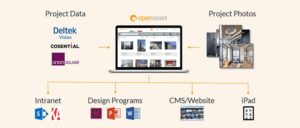
OpenAsset’s AEC-specific DAM gives your marketing and bids teams one searchable library for project photography, employee resumes, and proposal content, integrated with the systems AEC firms already run: Deltek, Procore, and Adobe InDesign.
Shred, OpenAsset’s AI-powered proposal tool, works from that same library to surface past proposal content in seconds, though your team still owns the strategy and the storytelling.
FAQ
What does AEC stand for in marketing?
Architecture, engineering, and construction. One caution: the acronym barely registers in the UK, where practitioners say “the built environment.” Spell out the industries when writing for a British audience.
How is AEC marketing different from traditional B2B marketing?
The unit of sale. Typical B2B businesses sell individual product units or software subscriptions through funnels and lead generation. AEC firms sell projects worth a million dollars and up through bids and invitations. Awards, press, speaking, and relationships outweigh lead-gen tactics because the firm must be known and trusted before those decisions happen.
What should an AEC marketing plan include?
Sector goals agreed upon with leadership, KPIs matched to those goals, a budget weighted by public versus private priorities, channels the team can sustain, a calendar built around tender cycles and award deadlines, and monthly reviews.
Do AEC firms get leads from social media?
Rarely, and almost never for significant work. In my 15 years inside AEC firms, I could not trace a single major commission back to a social media campaign. LinkedIn still earns its place, but as relationship reinforcement: project announcements, client tagging, and visibility that pays off later in invitations and evaluations.
Which awards matter most for AEC firms?
The ones your clients see and respect, not the ones your peers collect. In the UK: RIBA, RICS, and Civic Trust awards. In the US: AIA Awards, ACEC Engineering Excellence Awards, AGC Build America Awards, and ENR Best Projects.
Win more of the work you want in 2026
The firms that market well in 2026 are not the ones doing the most marketing. They pick the right awards, put the right people on the right stages, keep client relationships warm in public, and back it all with a portfolio they can deploy in hours, not days. If finding the right project image or resume is still your slow part, see how OpenAsset works.
Amélie Barrau de Backer is Head of Marketing, EMEA at OpenAsset, bringing over 15 years of senior marketing and communications experience across the built environment. An award-winning communicator, she has led marketing strategy at some of the sector’s most respected names, including Gensler, WSP, and PRP, delivering campaigns that have featured in the BBC, The Times, and the Guardian.