






OpenAsset vs. SharePoint: What architecture firms need for better digital asset management

Jun 2, 2023
4 min

Last updated: August 2026
Microsoft SharePoint is the system OpenAsset most often replaces. It is also a comparison prospective customers regularly ask us to make, usually as a practical question: “Is SharePoint good enough for managing our project images, or do we need a real DAM?”
The SharePoint-versus-DAM comparisons come with a hedge: the two are complementary, so keep both (that conclusion is written for no firm in particular).
For an architecture firm, the decision comes down to a short list of checkable criteria: 1) how project images are stored and resized, 2) how the images are found, 3) whether the library connects to Adobe InDesign and the firm’s project systems, and 4) how employee CVs are maintained.
We first published this comparison in 2023. This 2026 update reflects what architecture firms have told us since.
Why architecture firms outgrow SharePoint for digital asset management
Most architecture firms never researched and chose SharePoint for image management. SharePoint arrives with Microsoft 365, runs the intranet, and becomes the default home for the marketing folder because it is already there.
That default holds firm until project photography accumulates, which we have noted as a crucial proposal element. Architecture firms evaluating OpenAsset describe the same breaking points of SharePoint to our sales team:
- Project images degrade as they move. One firm told us its images came out compressed, after being downloaded and re-shared through SharePoint multiple times.
- Photo file sizes strain the folder structure. A marketing folder that works for documents ends up strained by full-resolution project photography.
- SharePoint doesn’t connect to InDesign. An IT manager at one mid-market architecture firm concluded SharePoint could not serve as the central asset hub for the marketing team’s proposal work for exactly this reason.
Schmidt Associates, an architecture and engineering firm with offices in Indianapolis and Louisville, ran into a related version of the problem before centralizing its assets: project photos on Flickr, proposal copy in Word documents, and an intranet on SharePoint.
Greg Hempstead, the firm’s Project Delivery Systems Manager, complained about the needless redundancy of such a system in our Schmidt Associates’ case study.
“We were doing a lot of the right things—but doing them five different times in five different places.”
— Greg Hempstead, Project Delivery Systems Manager, Schmidt Associates
SharePoint vs. OpenAsset: what’s different for an architecture firm
A digital asset management (DAM) system is a centralized, searchable library for a firm’s images and visual files, with the metadata, image renditions (copies served at different sizes), and permissions needed to put those files to work. Microsoft SharePoint is a content management and collaboration platform; document libraries are one of its many functions.
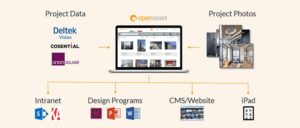
OpenAsset is a DAM built specifically for architecture, engineering, and construction (AEC) firms: it organizes assets by project and connects them to proposal production through InDesign templates and integrations with Deltek Vision, Deltek Vantagepoint, Procore, and Unanet CRM.
For an architecture firm, the comparison runs across six capabilities:
| Capability | SharePoint | OpenAsset |
| Storage and file handling | Cloud document libraries; files stored as uploaded, no automatic image renditions | Cloud image library; upload once, serve any size automatically |
| Search and metadata | Document-oriented search; custom image metadata requires configuration | Project-based structure, AEC keyword taxonomy, AI Visual Search |
| Proposal and InDesign workflow | No direct InDesign connection | Drag-and-drop InDesign plugin and branded templates |
| AEC integrations | None built in; connects to Microsoft 365 apps (Office, Teams, OneDrive) | AEC integrations such as Deltek Vision, Deltek Vantagepoint, Procore, and Unanet CRM |
| External sharing and permissions | Site- and library-level permissions; sharing by link | Portals with per-recipient access control and download monitoring |
| Employee and CV management | Nothing purpose-built | Employee Module with InDesign CV templates |
Where SharePoint works for an architecture firm, and where it breaks down
SharePoint earns its place at architecture firms as an intranet and a document system. Contracts, meeting minutes, HR policies, and project documentation sit comfortably in SharePoint libraries, and Microsoft 365 permissions and co-authoring suit that material well.
A small firm with low proposal volume and a modest photo library can manage its images the same way without much friction. If that describes your firm, SharePoint is probably enough.
The case for a SharePoint alternative starts when images become the workload:
- SharePoint treats an image as a document. It does not generate resized versions, so every proposal and award submission needs its own manually resized copy, and duplicates multiply across folders.
- Search is built around document text rather than visual content; finding one usable hero image among thousands of files means opening them one by one.
- With no Adobe InDesign connection, every image placed in a proposal gets downloaded first.
For proposal work, a purpose-built DAM beats SharePoint on four capabilities
A DAM built for AEC work separates itself from SharePoint in four capabilities architecture firms use daily:
1. Automatic image resizing.
A photo uploads once and serves at any size, which removes the manual Photoshop work behind most duplicate files.
2. AEC-specific metadata and keywording.
Assets attach to projects, and a keyword taxonomy built for AEC work keeps a growing library searchable over time.
3. InDesign templates for proposals and CVs.
Images, project sheets, and resumes flow into branded layouts through the InDesign integration without leaving the library. The Employee Module keeps staff CVs current in one place instead of in scattered InDesign files.
4. Integrations with the firm’s project systems.
Project and employee records sync from systems such as Deltek Vision, Deltek Vantagepoint, Procore, and Unanet CRM, so the library mirrors the firm’s actual project data.
Implementing a DAM can reduce the time a team spends searching for assets by 50%, the estimate we publish in OpenAsset’s digital asset management guide.
Some OpenAsset clients have run OpenAsset alongside SharePoint rather than replacing it. OpenAsset does not currently offer a native SharePoint connector; the FAQ below covers how firms connect the two.
Why Nitsch Engineering ruled out SharePoint
SharePoint displacement stories in our case studies come from across AEC, and the most fully documented one comes from a Boston-based civil engineering firm. Nitsch Engineering had 85 employees and a two-person marketing team at the time it went looking for a DAM.
The team’s marketing drive had accumulated multiple sizes and crops of the same images. One team member described the situation in the case study as “spending forever searching for and forever resizing images.”
Nitsch Engineering’s case study describes systems like SharePoint as requiring extensive configuration and coding to work as a DAM, and quotes the team’s verdict on that route: “prohibitively expensive, so much so that there was no way to justify the cost.”
Before buying anything, the team tracked its time spent finding and resizing images for a couple of months. That ROI analysis showed OpenAsset would pay for itself within the first year. By 2024, the firm was managing more than 24,800 images in OpenAsset.
Signals an architecture firm has outgrown SharePoint
Architecture firms that end up replacing SharePoint tend to recognize themselves in a few of these signals:
- Finding a photo takes longer than using it. Firms we’ve talked to that were interested in OpenAsset DAM because they wanted to replace shared drives and document systems have described spending up to three hours locating a single usable project photo.
- The same image lives in five sizes in five folders. Every use requires its own manual resize.
- Offices don’t share a library. Each location keeps its own drive, and nobody can find another office’s photography.
- CVs are maintained by hand in separate InDesign files, and keeping them current is somebody’s part-time job.
- Resizing happens the night before submissions, because proposal deadlines, not the filing system, drive the calendar.
More than one of these at the same time is a reason to evaluate a DAM.
FAQ: SharePoint and DAM questions architecture firms ask
Is SharePoint a digital asset management system?
Microsoft SharePoint is a content management and collaboration platform, and its document libraries can act as a light DAM. It stores files and applies permissions, and its search runs on document text. It lacks the image-specific functions of a dedicated DAM: automatic renditions, visual search, image-level metadata at scale, and connections to layout tools such as InDesign.
Can an architecture firm use SharePoint as its DAM?
An architecture firm with a small photo library and only occasional image-heavy pursuits can manage images in SharePoint. The limits show up once project photography grows into the tens of thousands of files, more than one office needs the same library, or proposals demand resized images on deadline.
Does OpenAsset integrate with SharePoint?
OpenAsset does not currently offer a native SharePoint connector. Firms that keep SharePoint as an intranet connect it to OpenAsset through links, OpenAsset’s REST API, or a custom integration built for their workflow. OpenAsset now substitutes for much of what firms previously used SharePoint for on the asset side.
Will Copilot fix SharePoint’s image search?
Microsoft Copilot works from the content SharePoint can already index, so it inherits SharePoint’s limits with images. An IT manager at one architecture firm we spoke to made precisely this point while evaluating DAM options.
ⓘ SOURCE-NOTE: call-log flag C, see Appendix D before publishing
AI search over images depends on image-aware metadata and visual recognition, which is the index a DAM is built on.
What’s the best cloud DAM for AEC proposal work?
OpenAsset is the only DAM built specifically for AEC firms, and proposal work is the workflow it is designed around: a cloud image library with automatic resizing, Adobe InDesign templates, an employee CV module, and integrations with the project systems AEC firms already run. A generic cloud DAM handles storage and search; proposal assembly stays outside the tool.
Deciding whether your firm needs more than SharePoint
SharePoint remains a capable intranet and document platform, and architecture firms that adopt a DAM rarely remove it from those roles. The decision in front of a marketing coordinator or proposal manager is narrower: whether project images, CVs, and proposal production belong in a system built for them.
Firms across AEC saw the cost of staying put before they moved: Nitsch Engineering through tracked hours spent finding and resizing images; Schmidt Associates in the same work being done in disconnected systems.
If your firm is weighing the same decision, OpenAsset’s architecture solutions page shows how our DAM handles those image, proposal, and CV workflows.
Eric Liou is the Chief Product Officer at OpenAsset, where he leads product vision and strategy across product management, design, and AEC marketing innovations. With extensive experience in product leadership, he has built a strong track record of advancing AI-driven solutions that enhance efficiency, collaboration, and impact for industry professionals.
At OpenAsset, Eric is focused on building tools that streamline workflows and empower AEC firms to succeed in an evolving landscape. He is passionate about the intersection of technology and user experience, and is committed to delivering the next generation of AI-powered solutions tailored to the unique needs of AEC professionals.