






OpenAsset vs. Bynder, Canto, and Brandfolder: Why AEC firms choose project-centric DAM

Aug 5, 2026
6 min

Should you pick the digital asset management platform with the deepest feature list, or the one built for the way your firm actually works? And when Bynder, Canto, and Brandfolder all look more full-featured than OpenAsset on a spec sheet, how do you tell which of those differences will matter once your team is scrambling to assemble a proposal the night before a deadline?
If Bynder, Canto, or Brandfolder are on your shortlist next to OpenAsset, this comparison is written for you: marketing leads, IT directors, and knowledge services managers at architecture, engineering, and construction firms.
One disclosure up front: I lead content at OpenAsset, so I have a stake in this. I’ll still tell you where Bynder, Canto, or Brandfolder is the better fit, because for some firms it is. I’ll cover where the general-purpose platforms beat OpenAsset, where OpenAsset wins for AEC work, how their pricing models differ in practice, and how to tell which category of DAM fits your firm.
What is project-centric DAM, and why does the data model matter for AEC firms?
A project-centric DAM (or digital asset management system) organizes digital assets by project, employee, and pursuit rather than by brand, campaign, or file type, so AEC firms can find the right image for the right proposal without rebuilding how their work is structured.
The common assumption is that DAM platforms are interchangeable, so you pick the one with the most features. For AEC firms, that’s a mistake. The data model and organization system that powers a DAM decides how its search, integrations, and AI features behave, and general-purpose platforms run on a model designed for brand teams.
Bynder, Canto, and Brandfolder organize assets the way a marketing department thinks: by campaign, product launch, or brand hierarchy. AEC firms don’t work that way. Their assets belong to projects, the people who delivered them, and the pursuits they’re chasing next.
Amélie de Backer, OpenAsset’s Head of Regional Marketing for EMEA, worked inside AEC firms like WSP and Gensler before joining us. She says:
“In our industry, marketing campaigns are short-lived; nobody remembers a specific campaign name from five years ago, and future team members won’t have that context. A DAM like OpenAsset is used by architects, engineers, and bid teams, not just marketers. When they need to pull together a design and access a statement, a planning submission, or a bid, they search by the project name, location, or the specific people involved, never by a marketing campaign. Organizing by project and person ensures that assets remain findable and useful across the entire business for decades.”
— Amélie de Backer, Head of Regional Marketing, EMEA, OpenAsset
Where Bynder, Canto, and Brandfolder excel
Bynder, Canto, and Brandfolder are strong digital asset management platforms, and with several capabilities, they go deeper than OpenAsset.
If your evaluation is weighing raw DAM breadth, these platforms earn their reputation.
One firm we spoke to, who was weighing OpenAsset against the alternatives, put the common perception plainly: OpenAsset’s DAM capabilities “appear lower than full-feature DAMs like Bynder and Brandfolder, which have DAM as their bread and butter.” That’s a fair read on specific features:
- OCR search inside documents and images: Bynder and Brandfolder can find words inside scanned files and images. OpenAsset DAM does not offer OCR (optical character recognition) text-in-image search today. OpenAsset Shred, our proposal-writing software, offers limited OCR abilities for certain searchable/text-based PDFs.
- Video transcription: The general-purpose platforms offer automatic speech-to-text and search inside video content. OpenAsset does not transcribe video.
- Asset volume and brand portals: For global brands operating at very large asset volumes with external-facing brand portals, a general-purpose DAM may offer more specialized tooling and capacity. By contrast, OpenAsset offers specified support for the use cases AEC teams care about: it connects assets to AEC projects, people, clients, sectors, websites, and proposal workflows.
Their reviewers on G2, the software review site, back this up. A creative services manager wrote that across 8,000-plus assets, Bynder’s natural-language AI search “performed extremely well,” and brand teams routinely praise these tools for fast search and easy external sharing.
If those capabilities are central to your use case, take them seriously in your evaluation. OpenAsset isn’t built for teams focused on general-purpose DAM breadth.
OpenAsset DAM vs. Bynder, Canto, and Brandfolder: Side-by-side comparison
On AEC-specific criteria, OpenAsset and the three general-purpose platforms diverge sharply, and the comparison runs in both directions.
| Capability | OpenAsset | Bynder | Canto | Brandfolder |
| Organizes by project, employee, and pursuit | ✓ Native | ✗ | ✗ | ✗ |
| Employee module (staff CVs, bios, credentials) | ✓ Native | ✗ | ✗ | ✗ |
| Pursuit / RFP proposal workflow | ✓ With Shred | ✗ | ✗ | ✗ |
| Native Deltek and Procore integration | ✓ Native | ✗ | ✗ | ✗ |
| AI assistant trained on your proposal library | ✓ Shred (powered by Claude) | ✗ | ✗ | ✗ |
| OCR text-in-image / scanned-PDF search | ✗ | ✓ | ✓ | ✓ |
| Automatic video transcription | ✗ | ✓ | ✓ | ✓ |
| G2 rating, mid-2026 | 4.7 (204 reviews) | 4.5 (1,135) | 4.4 (1,770) | 4.4 (1,427) |
The pattern in the table is clear: OpenAsset wins on everything tied to the AEC project model, and loses on general-purpose features like OCR and video. Which set of features matters more to you and your team is the actual decision in front of you.
Where OpenAsset outperforms for AEC firms
OpenAsset’s advantage for AEC firms comes from the one thing the general-purpose platforms can’t retrofit: a data model built around projects, people, and pursuits.
OpenAsset’s own G2 reviews come from proposal coordinators, pursuit strategists, and architects. One wrote:
“OpenAsset gets our sales process and understands how we approach our pursuits … This is the only DAM that is tailored to AEC.”
— Amy B., G2 review for OpenAsset
The project layer
Search “healthcare projects with exposed concrete” in OpenAsset, and you get project photography tied to the job, the team, and the client. Every employee record links to the projects that person delivered.
That structure is why pursuit teams find what they need. One enterprise pursuit team told us their previous DAM held only a small fraction of the photos they actually needed for proposals, even though the system worked as designed.
The integrations that run AEC firms
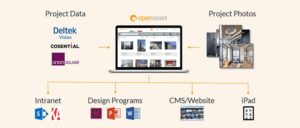
OpenAsset connects natively to Deltek Vision, Deltek Vantagepoint, Procore, and Unanet, the systems AEC firms already run. General-purpose DAMs don’t offer these connections. With them in place, project, employee, and asset data stay synchronized automatically.
The Shred connection
Shred, OpenAsset’s AI proposal layer, sits on top of the DAM and drafts from your real proposal library and project assets. No general-purpose DAM offers this, because none have the project data model that makes the AI useful. AI proposal tools without a DAM are building on sand: the AI is only as good as the assets it can draw from.
How much does each platform cost?
Neither OpenAsset nor Bynder, Canto, or Brandfolder publish standard pricing, so the honest comparison is about what you’re paying for, not a dollar figure.
All four platforms price by individualized quote, scaled to the users, storage, and features your business needs. We don’t publish exact figures for our own pricing, and we won’t try to guess Brandfolder’s, Canto’s, or Bynder’s.
However, what’s worth understanding is the logic behind a DAM’s pricing model, and the structural reason OpenAsset may land higher on a line-item basis.
OpenAsset isn’t priced as pure storage. The platform bundles the project data layer, the employee module, AEC integrations, and proposal capabilities that a general-purpose “asset management library” doesn’t include.
One AEC firm told us that our storage pricing came in sharply higher than their prior DAM vendor for their particular storage needs. And while that may be technically correct when analyzing price as a single line item, it misses the bigger picture: you’re not buying the same product.
When you evaluate cost, compare the total scope of features you’re getting and how they map to your use cases, not storage rate.
Ask each vendor what’s included beyond storage
For example, OpenAsset offers many features that are built to complement marketing, proposal creation, and general workflows within the architecture, engineering, and construction industries, including:
- Integrations with systems AEC teams already use, such as Deltek, Procure, InDesign, WordPress, Unanet, and more.
- AEC-specific data infrastructure to support easy organization, governance, and search for project records, employee profiles, text libraries, and images.
- InDesign template exports and an ability to easily sync your projects to your website.
- Specialized proposal workflow capabilities through Shred, including customizable Go/No-Go decision-making, and AI-assisted proposal drafting, RFP analysis, and asset recommendation.
- A connected data layer that ties assets to projects, people, clients, sectors, and pursuits.
The majority of general-purpose DAMs may have a lower sticker price, but lack all of these AEC-focused features, which means they will be less useful to your team. And remember: A lower storage price for a tool your pursuit team won’t use is the more expensive outcome.
Can I start with brand assets and add project data later to OpenAsset DAM?
Yes. Starting with brand assets and adding project data later is a supported way to get started with using OpenAsset DAM.
If Bynder, Canto, or Brandfolder appeal mainly because your immediate need is brand assets, that alone doesn’t decide it. Starting with brand assets is a practical path for firms that have an immediate brand-asset need and a larger project library to build over time.
Rachelle Ray, a former proposal writer and AEC marketer who now leads OpenAsset’s AEC Marketing Innovation team, describes it this way:
“Starting with brand assets is a great quick win. It gets your team up and running in OpenAsset fast, and aligned on brand language right away, without the heavier lift of gathering project data.”
— Rachelle Ray, Head of AEC Marketing Innovation, OpenAsset
From there, you add projects in stages rather than all at once. Two approaches work well:
- Start with your top five to 50 projects. These usually have the most complete data already, so they’re fast to upload and immediately useful.
- Add projects as you use them. Tie new uploads to your proposal closeout or marketing workflow so the library grows on its own.
This trade-off gives you day-one value via a searchable brand library. In the long-term, OpenAsset’s project-centric power grows as more of your project data goes in.
Who should choose a general-purpose DAM instead of OpenAsset
Choose Bynder, Canto, or Brandfolder over OpenAsset when your firm’s primary need is brand and marketing asset management, not project and proposal work.
OpenAsset isn’t the right fit for every firm with architecture, engineering, or construction in its description. A general-purpose DAM is the better choice when:
- Your dominant use case is brand and creative, not proposals. Marketing-intensive practices, brand-driven real estate, or in-house agency teams may get more from a campaign-organized DAM.
- Volume is the core problem. If you’re managing millions of marketing assets rather than hundreds of project photo sets, the general-purpose platforms are built for that scale and scope. OpenAsset is best suited for small to enterprise-level AEC firms (generally 50-5,000 employees) who are looking to organize project, pursuit, and employee-based files.
- OCR or video transcription is central. If finding words inside scanned documents or searching spoken content in video is a daily need, OpenAsset doesn’t match these platforms there today.
- An external brand portal is the priority. If your main requirement is customizable, external-facing brand sharing, those features are deeper on the general-purpose side.
Who should choose OpenAsset
Choose OpenAsset when your firm organizes its work by project and needs its DAM, integrations, and proposal workflow to reflect that.
- You’re an architecture, engineering, or construction firm that thinks in projects, employees, and pursuits.
- You run Deltek Vision, Deltek Vantagepoint, Procore, or Unanet and want your asset library synchronized with them.
- You’re building or scaling a proposal team and evaluating AI proposal tools, where the Shred connection adds value that no general-purpose DAM can.
- You need an employee module for CVs, bios, and credentials tied to project history.
- You’ve outgrown SharePoint or shared folders for managing project photography across offices.
Frequently asked questions about OpenAsset vs. Bynder, Canto, and Brandfolder
Does OpenAsset have OCR search like Bynder and Brandfolder?
No. OpenAsset doesn’t offer OCR text-in-image or scanned-PDF search today. Instead it offers AI Visual Search, which finds images by what’s in them, such as “crew in hard hats” or “substation at night,” plus layered metadata and project search. Shred can also search text inside a PDF when that PDF already contains selectable text, though image-only scans would need OCR applied first.
Can OpenAsset handle video?
You can store and organize video in OpenAsset and find it through manual metadata like project, keywords, and captions. What it won’t do is transcribe video or search the spoken words inside a clip. If “type a phrase someone said on camera and find the exact moment” is a requirement, that’s not supported today.
Can OpenAsset replace our SharePoint setup as an image repository?
For project photography and marketing assets, yes, and it’s one of the most common switches firms make. SharePoint stores files but doesn’t organize them around projects, people, and pursuits, nor connects to the AEC systems above. Many firms keep SharePoint for documents and move image and project assets into OpenAsset.
Is OpenAsset DAM a full-featured DAM or a specialized AEC tool?
Both, with a deliberate focus. OpenAsset is a digital asset management and proposal platform that helps architecture, engineering, and construction firms organize assets by project, employee, and pursuit and assemble proposals faster. That focus means it goes deeper on the project model and AEC integrations, and lighter on general-purpose DAM features like OCR and video transcription.
Conclusion
Our honest summary: Bynder, Canto, and Brandfolder are excellent digital asset management platforms for brand teams, and OpenAsset is built for the way AEC firms actually organize work, by project, employee, and pursuit. That structural difference, not the length of the feature list, is what determines which platform your team will still be using in three years.
You came in weighing four platforms that all looked capable on paper. Now you can separate the differences that affect daily AEC work from the ones that only matter on a spec sheet.
The next move is to map your own evaluation against your real workflow. List the five things your team does most with assets, and check which platform’s data model supports them without workarounds.
How to take action now:
- List your five most common asset tasks, from proposal assembly to CV updates, and test each platform against them.
- Confirm which of your systems (Deltek, Procore, Unanet, SharePoint) each DAM connects to natively.
- Decide whether OCR and video search are real daily needs or “nice-to-haves.”
- If you’re proposal-driven, evaluate OpenAsset and Shred together, not the DAM alone.
Go deeper: Compare the platforms one-on-one in Bynder vs. OpenAsset, Canto vs. OpenAsset, and Brandfolder vs. OpenAsset.
See it on your projects: request an OpenAsset demo for your AEC firm.
Sources and references
- G2 platform ratings (as of mid-2026) and verbatim reviewer quotes, used in the comparison table and the customer-voice passages:
- Amélie de Backer, Head of Regional Marketing, EMEA, OpenAsset. Direct quote on the AEC project data model (internal interview, June 2026)
- Rachelle Ray, Head of AEC Marketing Innovation, OpenAsset. Quote on phased brand-first onboarding (internal interview,, June 2026)
- OpenAsset product capabilities (OCR status, AI Visual Search, video, Shred, native integrations), from the OpenAsset product team and OpenAsset Help Center Product Release Notes and Shred Success Center, July 2026
Landon Iannamico is a content marketing expert with 6 years of experience helping B2B SaaS brands tell their stories and establish their verbal identities. He specializes in crafting brand narratives and producing content that breaks down complex concepts for highly specific, knowledgeable audiences across the data, AI, and engineering industries.