







What is the SF330? A proposal manager’s guide to Standard Form 330

Aug 30, 2023
6 min

Last updated: August 26, 2026
Every SF330 I’ve helped assemble came down to the same question: how well does your firm remember its own work? Not just in general, but against the specific, granular requirements buried in that RFP’s solicitation documents? The federal government doesn’t ask for a persuasive essay, it asks for names, projects, roles, and dates, cross-referenced in a matrix, and it disqualifies firms that can’t line those up.
The hard part isn’t surfacing a few strong resumes or project examples. It’s matching projects to the scope of work at a granular level, then figuring out which of those projects have the strongest overlap across your team — internal staff and external teaming partners alike.
In my proposal management work with AEC firms, I’ve seen how much work the SF330 can be. Building a resume or project sheet from scratch takes one to two hours, plus another hour or two of tailoring to the specific RFP. Multiply that by ten example projects and a full roster of key personnel, and the form becomes a real lift. Federal procurements can take months, and firms usually start assembling their portfolio before the RFP even drops.
This guide walks through what the Standard Form 330 is, who has to submit it, what every section requires, and how to build the data foundation that makes the form fast instead of painful.
What is the SF330?
Standard Form 330 (SF330) is the form the U.S. General Services Administration (GSA) requires architecture and engineering firms to use to present their qualifications for federal architect-engineer (A/E) contracts. When working with federal (and some state) agencies, AEC firms submit an SF330 instead of a standard proposal. The form is a mandated part of the federal solicitation process, designed to ensure the government selects contractors on qualifications rather than price. Price quotes are notably not part of the SF330: fee negotiation happens after the agency has already chosen the firm it wants to work with.
That approach is called qualifications-based selection (QBS), and it comes from the Brooks Act of 1972 (Public Law 92-582), which requires federal agencies to select A/E firms on qualifications and negotiate price afterward.
Quick facts:
- Issued by: the U.S. General Services Administration (GSA)
- Governing regulation: FAR 36.702, which tells contracting officers when each part of the form applies
- Replaced: the SF254 and SF255, both retired in 2004
- Current edition: July 2021, available in the GSA forms library
- Structure: Part I covers the specific contract you’re responding to, in Sections A through I. Part II is a general overview of your company’s information and qualifications
The July 2021 edition is still current as of July 2026. The GSA published an information-collection notice about the SF-330 in the Federal Register on May 22, 2026, but it did not produce a new version of the form. I still sometimes see firms submitting the 2016 edition, so be sure to check the edition date in the form’s footer before every submission.
Who needs to submit an SF330?
Any firm pursuing federal architect-engineer contracts submits the SF330. That includes architecture firms, civil and structural engineering firms, MEP engineering firms, landscape architecture practices, and surveying and mapping firms chasing work with agencies.
Agencies that frequently request an SF330 include the U.S. Army Corps of Engineers (USACE), the Department of Veterans Affairs, and the General Services Administration.
In most cases, assume you will have to submit both parts of the SF330. FAR 36.702 directs agencies to use Part I when the contract amount is expected to exceed the simplified acquisition threshold, and it lets the contracting officer request Part I below that threshold as well. Part II applies regardless, as the general qualifications record agencies keep on file.
If your firm never pursues federally funded work, you likely won’t need this form. Plenty of successful AEC firms build entirely commercial portfolios and never encounter it. The SF330 only enters your life when you deal with public-sector pursuits — either because the pursuit is directly attached to the federal government, or because it’s attached to a state or municipal entity that wants to remain compliant with federal regulations for their own administrative, organizational, or grant-based purposes.
Inside the form: Part I and Part II
Part I: Contract-specific qualifications
Part I is the part you tailor for every pursuit. It runs from Section A through Section I:
| Section | What it contains |
| A | Contract information: title, location, solicitation number, and public notice date. |
| B | Architect-engineer point of contact: the person at your firm the agency should contact, with name, title, phone, and email. |
| C | Proposed team: your firm plus subconsultants, as well as the expected role each company will be filling. |
| D | Organizational chart of the proposed team. Remember that this chart must be included as an attachment, and this section is just a checkbox to confirm you have done so. |
| E | Resumes of key personnel. You must complete one Section E for each person. |
| F | Example projects that best illustrate the team’s qualifications. You must complete one Section F for each project. Look in the original solicitation to find how many examples you should include. If not otherwise specified, the limit is 10 projects. |
| G | A matrix illustrating which of the key personnel in Section E participated in your example projects in Section F. |
| H | Additional information, including anything the solicitation requests. |
| I | Authorization: signature of an authorized representative. |
There are several details to watch out for when filling out these sections.
- Above all else, study the original request carefully for special instructions. Though the GSA form is standard and fixed, not every agency uses or evaluates them the same way. Often, there will also be specific requests on what to include in Section H, the most open-ended part of the form.
- Outside of any exceptions laid out in the solicitation, formatting is strict and must be followed. Resumes need to be tailored to fit Section E’s format and include every single detail it asks for, must be kept to a single page (unless otherwise specified), and should be built around the five projects most relevant to this contract.
- When choosing projects in Section F, always prioritize relevance over just talking about your biggest projects. Always favor work from the past decade, but keep an eye out for special requests in the solicitation that may limit the window to five or even three years.
- Unless the solicitation says otherwise, Section E covers key staff only, not everyone who will touch the project.
- Section I is easy to forget. It is the authorized representative’s signature, and an unsigned SF330 is an incomplete SF330.
Part II: General qualifications
Part II is your firm’s high-level overview: background, office locations, employee counts by discipline, and what sorts of projects you have experience with.
This is a fairly simple and stripped-down summary. The only part that might be tricky is finding the right profile codes to accurately describe your employees and your project experience. Profile codes are the GSA’s category system for A/E disciplines and project types, and both sets have to fit within the options listed on the form.
Each office or branch involved in a pursuit typically files its own Part II, and agencies expect the information to be current, so most firms refresh it annually. Part II also asks for your firm’s Unique Entity ID (UEI) from SAM.gov. If your Part II boilerplate still lists a DUNS number, update it — the federal government retired DUNS in April 2022. Guides that still reference DUNS are working from an outdated version of the process.
How to Fill Out the SF330
While the SF330 looks simple on the surface, the scale of most federal projects means submissions rarely are. A single pursuit can involve multiple subconsultants, dozens of resumes, and ten project sheets that all have to agree with each other.
The SF330 is primarily an organizational challenge, not a writing one. The three sections below cover where to start, what templates can and can’t do for you, and the mistakes that get firms screened out.
Start with Section G
My number one piece of advice: don’t fill out the SF330 front to back. Start with Section G.
Every section of the SF330 is connected to the others. The person named in a Section E resume, the projects listed on that resume, the projects detailed in Section F, and the X marks in Section G all have to agree. Decisions made in one section ripple into the next, and evaluation panels check those connections. Luckily, the SF330 already asks you to include an at-a-glance summary of all of them in one spot.
Section G is a matrix that ties the entire document together. Down one axis, it tracks the key personnel listed in Section E. Across the other, the example projects you chose for Section F. An X marks each project a person actually worked on.
Sparse matrices are a warning sign to evaluators, because agencies read Section G to answer one question: has this exact team done this exact kind of work together before? They can illustrate just as clearly to you where there are holes in your pitch or you might need to look for a better example.
Building the matrix first forces the right strategy conversation. You pick people and projects as one decision, not two. Then Sections E and F become documentation of choices you’ve already pressure-tested, and Section D’s org chart follows from the same roster.
This is the same connect-the-dots discipline I teach for proposal win themes, applied to a federal form. The form is designed to reward teams with real shared history, so choose a team and a project list that prove that history.
Why there’s no master template for filling out the SF330
“SF330 template” is one of the most-searched phrases related to this form. Unfortunately, a master template that helps you fill out the entire SF330 in an easy, reusable, fill-in-the-blanks manner doesn’t exist in any meaningful way. The form’s structure is fixed by the GSA, and the content that matters — your firm’s people and projects that match the contract — changes with every pursuit.
What does save time is creating a kit-of-parts of component templates that address the information different sections of the SF330 ask for. This way, you can quickly surface relevant, well-formatted information to fill out the repeatable units that make up an SF330. For example, you could create:
- Resume templates for Section E, so every person’s qualifications follow the same one-page format.
- Project sheet templates for Section F, with consistent fields for scope, role, cost, and completion date.
- An org chart template for Section D that you restock with each pursuit’s roster.
Firms that maintain these components in Adobe InDesign or Microsoft Word, with the underlying people and project data kept current, treat each new SF330 as an assembly job rather than a writing job. Firms without those components start from a blank page every time, which is where the one-to-two-hour-per-sheet drafting cost comes from.
Keep in mind that this doesn’t mean you should just copy and paste the content itself. You should, however, prepare what you can ahead of time to make your life easier later. Certain details, such as your key personnel’s education or contact information, don’t change often, and it helps to already have their file properly formatted.
SF330 mistakes that get firms screened out
The mistakes I see repeatedly on SF330s are process failures more than writing failures:
- Boilerplate resumes. A Section E resume that lists someone’s greatest hits instead of the five that match this contract wastes the evaluator’s attention. Tailor every resume to the solicitation.
- Stale example projects. Work from 15 years ago invites doubt about current capability, and it may violate the solicitation’s stated time window outright.
- An inconsistent Section G matrix. People appear in G who have no resume in E, or resumes reference projects that never show up in F. Panels notice.
- Ignoring solicitation-specific instructions. Agencies routinely override the form’s defaults: fewer projects in Section F, specific content for Section H, page limits, file naming. The RFP always wins.
- Submitting an outdated edition of the form. Older editions are still circulating in firms’ template folders. Download a fresh copy from the GSA forms library rather than reusing a saved one.
- A Part II nobody has touched in years. Old employee counts and a missing UEI signal a firm that isn’t paying attention.
All of these problems come down to the same thing: how fast your team can get accurate, current information about your own firm. None of them require better writers to fix.
Be data-ready with OpenAsset
The SF330 is a data-readiness test disguised as paperwork. It’s designed to reveal which firms actually know their own people and projects. Firms with that information centralized assemble stronger submissions in less time, and firms without it burn hours hunting through folders and old PDFs before tailoring can even begin.
Centralizing resume and project data removes the initial drafting lift almost entirely, leaving only the tailoring work each RFP requires. No two companies or projects are the same, but my experience is that centralization cuts the time to produce SF330 resumes and project sheets by almost half.
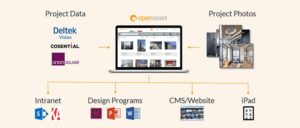
OpenAsset’s digital asset management (DAM) platform is built specifically for AEC firms tackling organizational challenges like SF330s. It keeps project images, project data, and employee records in one searchable library, and generates the component pieces of an SF330, such as Section E resumes and Section F project sheets, as InDesign or Word documents.
For firms running Deltek, the project-based ERP common across AEC, OpenAsset’s Deltek connector syncs fields, projects, keywords, and employee records from Deltek into the OpenAsset library, so the data behind your SF330 components matches the system your firm already maintains.
Whether or not you use a DAM, the principle holds. Keep one current version of every key person’s resume data and every project’s vital statistics, in a system your proposal team can search. The next SF330 stops being an archaeology project.
SF330 FAQ
How long does it take to prepare an SF330?
For a firm starting from unformatted source material, budget two to four hours per resume or project sheet: one to two hours to build it, plus another hour or two to tailor it to the RFP. If you maintain a library of component templates, you skip most of the build and pay only the tailoring cost. Also, account for the time spent deciding which resumes and projects to feature; many firms begin preparing months ahead of the solicitation.
Can I reuse an SF330 for multiple pursuits?
For Part I, the bulk of an SF330, you should not reuse an old submission. Part I is contract-specific by design, and evaluators can tell when a firm submits a lightly edited version of someone else’s pursuit. Part II, however, covers your firm’s general information. As long as you keep it up-to-date, you can safely reuse it. Most firms refresh their Part II once a year.
Where do I download the current SF330 form?
You can download the SF330 from the GSA’s architect-engineer qualifications page. The current edition is dated 7/2021. Skip the third-party form-filler sites; some host older editions.
Is there a page limit?
Outside of some light guidelines (such as using no more than 10 projects in Section F), the SF330 does not set a hard page limit. However, solicitations will often have specific requests, including page limits. When the two conflict, follow the RFP.
What happened to the SF254 and SF255?
In 2004, the SF330 replaced both, and the GSA retired them. The SF254 collected general firm qualifications, which the SF330 now handles in Part II. The SF255 collected project-specific qualifications, now Part I.
Does every firm on the team submit a Part II?
Typically each firm on the proposed team, and each office or branch playing a role, includes its own Part II. Confirm against the solicitation, since agencies vary in how they want subconsultant information packaged.
Rachelle is a dynamic AEC marketing leader focused on creativity, education, and empowering marketers. As Head of AEC Marketing Innovation at OpenAsset, co-founder of Proposal Industry Experts, and owner of RMR Consulting, she helps firms improve strategy, team collaboration, and pursuit efficiency.
With 15+ years of experience, Rachelle is a passionate advocate for burnout prevention, professional development, and community building. A frequent speaker at national and regional conferences, she’s also contributed to the first AI certification for proposal professionals. Her work bridges the gap between marketing and leadership, equipping professionals to thrive in a rapidly evolving industry.