






ProjectMark vs. OpenAsset: Which does your construction firm actually need?

Jun 14, 2023
4 min
Last updated: June 17, 2026
Are ProjectMark and OpenAsset competing for the same spot in your tech stack? And if they’re actually two different tools for two different problems, which one should you buy first?
Most content on this topic treats them as alternatives, which is why construction marketing and BD teams keep going in circles. They’re not alternatives. By the end of this article, you’ll know exactly what each tool does, where they overlap, and which one to prioritize based on where your firm’s biggest operational gap is right now.
What’s the difference between ProjectMark and OpenAsset?
OpenAsset is a digital asset management (DAM) system; ProjectMark is a customer relationship management (CRM) platform. They are in different categories and have different core jobs. OpenAsset stores and organizes project photography, employee CVs, and proposal assets, then connects them to your document production workflow. ProjectMark tracks business opportunities, client contacts, and pursuit pipelines to help teams manage BD and decide which bids to pursue.
Why construction firms keep comparing them
ProjectMark includes two content features: DataHub, a structured database for project records and team member data, and Content Manager, a document library for reusable proposal files. Both tools store project information and connect it to proposal workflows.
That overlap is narrower than it looks. OpenAsset is built to manage visual assets at scale: project photography, AI-powered image search, automatic resizing, and InDesign workflows. ProjectMark’s DataHub and Content Manager handle structured records and documents, not a searchable photo library.
For most construction marketing teams, these tools are not substitutes. They’re different parts of the same pursuit workflow.
How do OpenAsset and ProjectMark compare side by side?
The two platforms share surface-level features (both store project data; both connect to InDesign), but they differ in depth and purpose at every point that matters for proposal teams.
| OpenAsset | ProjectMark | |
| Primary category | Digital asset management (DAM) | Customer relationship management (CRM) |
| Project photography | AI search, auto-resizing, facial recognition, tagging taxonomy | DataHub stores project records; no AI photo search or auto-resizing |
| Employee CVs / resumes | Employee Module with InDesign templates | Team member records in DataHub; basic bio storage |
| InDesign integration | Drag images from DAM library directly into templates | Merges DataHub fields (records, bios) into proposal layouts |
| AI layer | Shred: proposal drafting, Go/No-Go analysis, AI chat against proposal history | Bolt AI: CRM data entry automation and record creation |
| BD pipeline / pursuit tracking | Not available | Core feature: pipeline dashboard, opportunity tracking, forecasting |
| Deltek Vision / Vantagepoint | Native integration | Not available |
| Procore | Native integration | Native integration |
| BuildingConnected | Not available | Native integration |
| Go/No-Go analysis | Via Shred | Native CRM feature |
| G2 rating (May 2026) | 4.7/5 · 201 reviews | 4.9/5 · 10 reviews |
| Pricing | Contact for pricing | Contact for pricing |
| SOC 2 Type II | Yes | Yes |
What does OpenAsset do, and what doesn’t it do?
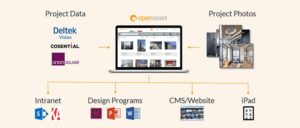
OpenAsset is a purpose-built digital asset management (DAM) platform for architecture, engineering, and construction (AEC) firms. OpenAsset’s DAM gives AEC marketing and proposal teams a single searchable library for project photography, employee CVs, and proposal assets, connected directly to the Adobe InDesign, Deltek, and Procore workflows AEC firms already use.
Construction teams use OpenAsset to tag and search thousands of project photos, pull images directly into Adobe InDesign via drag-and-drop, and generate staff resumes through the Employee Module. AI-powered features include Visual Search, facial recognition, and image similarity, which help large teams find the right photo even when tagging is incomplete. Key integrations include Deltek Vision, Deltek Vantagepoint, Procore, and Unanet CRM.
Sundt Construction, ranked 75th among the largest construction companies in the U.S. by Engineering News-Record (ENR), uses OpenAsset across 8 offices to manage project photography, connect Deltek Vision proposal workflows, and keep photo access consistent across regions.
Before OpenAsset, Sundt shared marketing photos on a drive accessible to the marketing team, while project teams stored photos locally on their own desktops, and each individual office kept event photos separately.
“It’s been invaluable to us as a company to have OpenAsset as a single source of project photos,” said Mary Norton, Marketing Manager at Sundt Construction.
Shred, OpenAsset’s AI proposal layer launched in August 2025, adds proposal drafting, Go/No-Go analysis, and AI chat against the firm’s own past proposals.
OpenAsset holds a 4.7/5 rating on G2 from 201 reviews as of May 2026. More than 1,000 AEC firms use the platform.
What OpenAsset doesn’t do
OpenAsset is not a CRM. It doesn’t track client relationships, manage opportunity pipelines, or help teams score and prioritize which pursuits to chase. Those are ProjectMark’s jobs.
What does ProjectMark do, and what doesn’t it do?
ProjectMark is a construction CRM built to manage the pursuit pipeline from first contact through bid decision. General contractors, specialty contractors, and A&E firms use it to track opportunities, manage client contacts, schedule follow-ups, run forecasting, and apply structure to go/no-go decisions.
ProjectMark’s content layer has two components. DataHub is the platform’s structured database for project records, team member data, and opportunity information. Content Manager handles reusable documents, proposal files, and content assets: the building blocks teams pull when assembling a bid response. The platform’s InDesign plugin connects to DataHub, merging structured fields (project records, employee bios) into proposal layouts. This is field-merging, not photo retrieval from a visual library.
Bolt AI, ProjectMark’s built-in AI assistant, handles CRM workflow automation: creating records, calculating values like cost per square foot, and executing multiple data entry tasks at once from plain-language input. Its job is reducing manual CRM work, not drafting proposals.
ProjectMark holds a 4.9/5 on G2 from 10 reviews as of May 2026, is SOC 2 Type II certified.
What ProjectMark doesn’t do
DataHub and Content Manager store structured records and documents. They are not a visual asset library. ProjectMark doesn’t offer AI-powered image search, automatic photo resizing, or a tagging taxonomy designed for managing thousands of project photos at scale.
Which one should your construction firm start with?
Start with the tool that addresses your biggest operational gap today, not the one with more features or the one a peer firm recommended.
Start with OpenAsset first if…
- Your proposal team spends time hunting for approved project photos across Procore folders, network drives, or individual computers.
- You operate across multiple offices and different regions can’t access each other’s project photography.
- Your proposal workflow is built around InDesign and you need assets available for direct drag-and-drop.
- Your firm runs Deltek Vision or Vantagepoint and you want project data and photography in sync
- Your proposal team rebuilds content from scratch on every pursuit, even when you’ve won similar projects before. OpenAsset centralizes your project library so Shred can draft new proposal sections from your own winning work automatically.
Start with ProjectMark first if…
- Your BD team lacks visibility into which pursuits are active, who owns them, and what stage they’re at.
- You’re tracking opportunities in a spreadsheet or a generic CRM that doesn’t reflect how construction business development actually works.
- Go/no-go decisions are ad hoc rather than scored and repeatable.
- Client follow-up is falling through the cracks between projects and pursuits.
Can you use both OpenAsset and ProjectMark together?
Yes, and for many mid-size construction firms, using both is the right answer. The two platforms address different problems without meaningful overlap in core function.
The practical sequence: ProjectMark tracks the opportunity and manages the client relationship through bid decision. Once the team commits to pursuing, OpenAsset and Shred handle proposal assembly: surfacing the right photos, pulling employee CVs, and drafting proposal sections from past work.
Bolt AI and Shred are not competing products. Bolt accelerates CRM data entry inside ProjectMark. Shred drafts proposals from a firm’s own proposal history, stored in OpenAsset. They operate at different points in the workflow and can coexist without conflict.
Is there a native integration between ProjectMark and OpenAsset?
No native integration currently exists between the two platforms; construction firms that use both run them independently within the same workflow. A custom API connection is theoretically possible for firms with development resources, but no native connector exists.
Frequently asked questions
Does ProjectMark have a digital asset management feature?
ProjectMark has two content tools: DataHub (structured project records and team member data) and Content Manager (reusable proposal documents and files). These are not a visual asset library. ProjectMark doesn’t offer AI-powered image search, automatic photo resizing, or a tagging taxonomy for managing thousands of project photos at scale.
Can ProjectMark’s Content Manager replace OpenAsset for photo management?
For a smaller firm with a modest photo library, it may be enough. For firms managing thousands of photos across multiple offices, it won’t hold up — the gap shows at proposal time when the answer to “find me a healthcare photo from two years ago” is “search the folders.”
How do OpenAsset’s and ProjectMark’s G2 ratings compare?
OpenAsset holds a 4.7/5 rating on G2 from 201 reviews as of May 2026. ProjectMark CRM holds a 4.9/5 from 10 reviews as of May 2026. Both ratings are legitimate, but the review count difference is worth noting: 201 reviews represent a mature, multi-year customer base across firm types and sizes, while 10 reviews represent a smaller and earlier sample.
Which construction firms use OpenAsset?
Sundt Construction (75th largest U.S. contractor by ENR, 8 offices), JHL Constructors (employee-owned Colorado GC), and HBW Construction (commercial contractor, Washington region) are among the construction firms on the platform. “
Knowing that we have the ability to search and find photos easier versus relying on memory is a gamechanger,” said Kelly Jones, Marketing Manager at HBW Construction.
Willmeng Construction, a Southwest GC, reported that 30+ hours per proposal were returned to their pursuits team in a single year — close to 2,000 hours total. See our Willmeng case study for details.
OpenAsset is used by more than 1,000 AEC firms in total.
Conclusion
You came into this article with a question most construction marketing teams share: are ProjectMark and OpenAsset actually the same type of tool, and which do we need?
Now you have a clear answer. They’re different tools: a CRM that manages the opportunity and a DAM that manages the assets that go into the response. They operate at different stages of the same pursuit workflow, and many construction firms eventually use both. The question isn’t which to choose. It’s which gap to close first, based on where your team is losing the most time today.
How to take action now:
- Audit your biggest daily bottleneck: hunting for photos and proposal assets, or tracking which pursuits are active and who owns them
- If the bottleneck is photos and proposals, request an OpenAsset demo and ask specifically about the Procore and Deltek integrations
- If the bottleneck is pipeline visibility and BD organization, request a ProjectMark demo focused on go/no-go scoring and pursuit tracking
- If you’re ready to add AI-assisted proposal drafting, ask OpenAsset about Shred and what the DAM foundation requirements look like
- If you need both, start with whichever gap is costing your team the most hours per week
This comparison is written by the OpenAsset team. We’ve represented ProjectMark’s capabilities based on their published documentation and encourage you to demo both tools.
Sources and references
- OpenAsset G2 reviews (4.7/5, 201 reviews, May 2026): https://www.g2.com/products/openasset/reviews
- ProjectMark CRM G2 reviews (4.9/5, 10 reviews, May 2026): https://www.g2.com/products/projectmark-crm/reviews
- Sundt Construction case study: https://openasset.com/clients/sundt-construction/ — source for ENR ranking, 8-office context, and Mary Norton quote
- JHL Constructors case study: https://openasset.com/clients/jhl-constructors/ — source for JHL firm overview
- HBW Construction case study: https://openasset.com/clients/hbw-construction/ — source for Kelly Jones quote
- ProjectMark integrations and plugins: https://help.projectmark.com/trainings/integrations-plugins — source for confirmed integrations including InDesign plugin
- ProjectMark plans and features: https://www.projectmark.com/plans — source for DataHub feature description
- Willmeng Construction case study: https://openasset.com/resources/willmeng-construction-openasset-case-study/ — source for 30+ hours per proposal / ~2,000 annual hours stat
Eric Liou is the Chief Product Officer at OpenAsset, where he leads product vision and strategy across product management, design, and AEC marketing innovations. With extensive experience in product leadership, he has built a strong track record of advancing AI-driven solutions that enhance efficiency, collaboration, and impact for industry professionals.
At OpenAsset, Eric is focused on building tools that streamline workflows and empower AEC firms to succeed in an evolving landscape. He is passionate about the intersection of technology and user experience, and is committed to delivering the next generation of AI-powered solutions tailored to the unique needs of AEC professionals.