
Proposal Writing Resources for AEC Firms

How to create a winning RFP response: Best practices for 2026

May 7, 2026

Businesswoman Working in The Office

Last Updated: May 7, 2026

Every RFP response requires a well-oiled, multidisciplinary machine to cross the finish line.

When you’re crafting an RFP response (or proposal, depending on your market), the to-do list is long. Build a plan, then figure out how you’re going to sell it. Write up company bios. Dig up old case studies. Assemble a winning cover letter. Throw in a tight deadline, and you need all hands on deck.

Then there’s that ever-present bugbear: compliance. Before you can even think about anything else, you have to identify which hoops the RFP needs you to jump through and build every following decision on top of those requirements.

Key takeaways

  • Before writing a single word, nail down your go/no-go criteria and compliance requirements. Everything else builds on top of those foundations.
  • Identify the client’s core pain points early and use them to develop win themes that guide every section of your response.
  • Your technical experts are your secret weapon, but they need structure and context to contribute effectively.
  • AI and content management tools are most valuable when used to organize, repurpose, and refine existing material, not to generate strategy from scratch.

Table of contents

RFP response tips and tricks: how to improve your RFP process

Go/no-go processes: Is an RFP worth pursuing?

Check every RFP requirement before you start writing

Identify the client’s needs and goals

Win themes: the foundation of every successful RFP response

Working with SMEs

Build a clear, compliant, and persuasive proposal

How to use content-driven design to make your response easier to evaluate

How to streamline the RFP response process with technology and AI

Craft winning RFP responses with OpenAsset

RFP response tips and tricks: how to improve your RFP process

That’s a lot to manage for one project, much less the half dozen that might be going on at any given time. But in the most efficient response pipelines, most of the work happens before you even start writing.

The best RFP responses lay the groundwork for fast, effective content creation early. They take the time beforehand to identify the client’s needs, figure out how those relate to their company’s expertise, and translate those connections into win themes that inform everything they write. They take the extra time to organize their disparate teams and find efficient ways to incorporate technical experts working in the field.

This may all sound like a lot of extra work, but it saves you more time in the long run. Let’s go through the ideal RFP response process from start to finish, beginning with whether you write an RFP response at all.

Go/no-go processes: Is an RFP worth pursuing?

The first decision every company needs to make when looking at an RFP is whether to pursue it or not. Some projects are obvious hits that fall squarely inside of your expertise. Others can be an awkward fit, or involve work that you have less documented success with, or are simply not enticing. Do you commit anyway?

This is the essence of the go/no-go process. It is understanding that every RFP response is a commitment, and when you commit, you must do so with purpose.

It can be tempting to play proposal writing like a numbers game and build an assembly line to send out as many responses as you can every month. After all, the more bets you make, the more chances you have to win a contract.

But any casino-goer can explain the limits of this method. Imagine walking up to a roulette table and putting a bet down on every single number on the wheel.

Sure, you are guaranteed to “win.” It is impossible for the ball to land on a number you haven’t bet on. But you are also guaranteed to lose, because no matter what number the ball falls on, you will get less money back than what you bet to cover the entire field.

It’s the same with responding to RFPs. Every chip you throw down on the roulette wheel is the money you pay your marketing team to spend all week (or more) writing a response. This is a great way to tank your RFP win rate, and if you throw down a chip on every single RFP you see but only win once, you’re still spending more money than you’re making!

The most successful firms are already shifting this way. The 46th Annual Deltek Clarity A&E Industry Study (May 2025) found that A&E firms are now submitting fewer proposals at higher pursuit values — a deliberate move toward more strategic, qualified business development. Casting a wider net is officially out of fashion.

When to say yes (or no) to an RFP

There are two sets of questions you need to ask every time you consider pursuing a new project. The first is to look inwards and ask if the company can feasibly take on that work.

  • What does your backlog look like right now? Does your company need new work soon, or are you booked a full year out?
  • What is the state of the proposal team? Is their pipeline running smoothly? Or are they already drowning in deadlines? This is the difference between a compelling, well-crafted response and a cookie cutter proposal that got hacked out in a week.
  • Picture what happens if you win. Does your team have the staffing capacity to handle this, or are you going to have to staff up to meet project demands?

Once you’ve decided you’re a good fit for the job, it’s time to ask: Is this job a good fit for you? Most of these questions relate to how likely your company is to actually win the work, but it is also important to ask what kind of an opportunity this job might potentially offer the company.

  • How does the project overlap with your existing experience? 
  • How can you illustrate your ability to execute this project? Your resume is a good start, but what else? Do you have any relevant reference letters? Awards? A strong reputation?
  • How strategically aligned is it? You most likely have an idea where you want your company to be in five years. Does this project help make that a reality, or is it a side quest?
  • What is your relationship to the client? Relationships and networking are what keep this industry running. Do you have an existing working relationship you want to maintain? Alternatively, is this an opportunity to catch the attention of an important client who would give you more work for years to come?

The answer to these questions changes every time. You may not have much experience in an emerging field like, for example, data centers, but are eager to get some. If you have already identified that it is your mission to break into that field, it may be worth the gamble, especially if you have a comfortable backlog of existing work.

This is doubly true because every firm, sector, and specialty is going to have its own business considerations. A foundation contractor is going to answer these questions very differently from an architect designing a 10-floor apartment. In these cases, your own experience will be your north star. Don’t discount it.

Check every RFP requirement before you start writing

So you’ve done your go/no-go check and you’re going for it. The next thing to look at are the compliance requirements.

The bare minimum every single RFP response must achieve is compliance. No exceptions.

In many cases, this is a legal concern. For example, if an RFP doesn’t request a quote for the work but you give one anyway, they may be required to pass on you regardless of what a great fit you might be.

No amount of clever marketing will help you if you fail to meet the RFP’s requirements. It is easier to start here and make sure you meet these non-negotiable requirements first, then add all your “nice to haves” on top.

It’s doubly important to do this first because those requirements will often heavily inform the structure of your proposal. RFPs will commonly request specific details like employee resumes, organizational charts, and cover letters. They’ll also often have structural requirements such as page limits or specific formatting.

Imagine working all month to write an in-depth, 60-page response, only to do your final compliance check and realize the page limit was 30. Not a great spot to find yourself in! This is why you start with compliance, then once you’ve checked all those boxes, you can start worrying about getting fancy with your marketing strategy.

How to manage an RFP’s compliance requirements

By far, the strongest tool in your arsenal to ensure compliance is the proposal management plan (PMP). Many companies use the PMP as a central document to coordinate between multiple teams and disciplines, define requirements and strategy, and track progress.

PMPs are powerful organizational tools that give everyone on a project a central place to go for answers. If a manager wants to track a project’s progress, they can refer to the PMP. When the project inevitably pivots two weeks in, you can put the updates in the PMP. Don’t know how to approach a certain section? Answer’s probably in the PMP.

The larger and more complex a project is, the more important a PMP is. If you’re a large firm with multiple teams coordinating on one project, it becomes non-negotiable. You will return to it time and again as you proceed through the proposal process. If you want to know more about how to build a PMP, you can find a comprehensive guide to proposal management here.

Identify the client’s needs and goals

If compliance is the bare minimum you need to achieve just to participate, then meeting your client’s needs is the bare minimum you need to achieve to get past the slush pile. Even the best winning RFP responses focus on this.

Luckily, just like with compliance, RFPs will usually tell you exactly what those needs are. Pay close attention to any sections that talk about the following:

  • A client’s objective or mission statement. The bluntest, most high-level view of what a client wants.
  • Why they are issuing an RFP. What are the needs or pressures that have motivated them to open their wallets and commission a new project?
  • What a successful outcome looks like to them. If an RFP brings this up, pay attention. They are telling you their dream scenario.

One of the oldest and most basic marketing strategies is to find a pain point and fix it. When an RFP starts talking about these topics, they are telling you exactly what those pain points are. They are handing you the roadmap to success.

It is literally like a stranger walking up to you at a bar and telling you exactly how to be their friend. What their favorite topics are, what kind of jokes they like, and what dreams and ambitions they have. Imagine if all communication was that easy!

Win themes: the foundation of every successful RFP response

Once you have identified those pain points, it’s time to start figuring out how to position yourself as the answer. Find a pain point, connect it to your company’s relevant expertise, and you have found a “win theme.”

Win themes are your core pillars. They aren’t a section you add to your response template, but the “beats” you want to hit time and time again throughout your entire response. They should come up in your cover letter. Your project approach. Your team bios. If you ever don’t know what to say in a section, refer to your win themes and find a way to talk about that.

You may well already know this strategy by another name, but the basic point of win themes is to identify your pitch early and to make sure you execute on it.

Working with SMEs

One of the fastest ways to get a treasure trove of information to feed those win themes is to simply get people from other departments involved. Whether they’re architects or engineers, your company’s technical experts have a wealth of lived experience that will make your RFP responses more precise and persuasive. These are your subject matter experts (SMEs).

But getting them involved introduces a conundrum. SMEs have a ton of project knowledge, but know a lot less about how to explain it. Marketers know exactly how to talk about projects, but don’t have 20 years of on-site experience. And everybody involved gets stressed quickly when they have to do the other person’s job.

SMEs are also stretched thin. According to McKinsey research, knowledge workers already spend 19% of their week searching for information and another 28% on email — leaving only a sliver of time for the deep, narrative work an RFP response actually needs.

SMEs are also the bottleneck most proposal teams already feel. According to OpenAsset’s roundup of RFP industry research, 51% of RFP teams name collaborating with subject matter experts as their number one challenge in the response process — ahead of finding accurate content (42%), meeting deadlines (35%), and team capacity (32%). The bottleneck isn’t the writing. It’s getting the experts to weigh in.

How to get better input from SMEs

Having experienced this phenomenon many times, OpenAsset’s Head of AEC Marketing Innovation, Rachelle Ray, has developed more than a few techniques to help SMEs tell their story as easily as possible.

“My advice for collaboration is always, always, always to be empathetic,” Ray said. “To make sure everyone is bought into whatever strategy or story you’re trying to tell, and then to try and help them along the way.”

It’s important to work cooperatively with an SME and meet them in the middle, but you have a number of options on how to do so.

  • Be precise when asking questions. It’s a lot easier for an SME to tell you what specific technical jargon about different types of steel means than to answer “so what do I need to know about our materials?”
  • Provide context. If you’re trying to answer a particular question or concern in an RFP, include that information.
  • You can provide the starting point yourself. Start with a rough draft, bullet points to expand on, or a previous answer you want them to talk more about.
  • Do your best to respect your SME’s schedule and, if your workplace allows, work with them directly. Conduct face-to-face interviews, write together on the topic, or be on-hand to answer questions while they’re working.
  • Don’t hesitate to ask follow-up questions if there’s something you don’t understand, even if it’s something basic. It can sometimes feel like you “should know that,” but there’s no need to worry. Often, SMEs are happy to explain regardless of how simple the question is.

A lot of these methods are accomplishing the same thing: They give an SME somewhere to start. You need to give them a handhold.

Imagine being asked to walk outside and go climb a sheer cliff. An expert rock climber might have the equipment and know how to do it, but you’re much less likely to know what to do.

It’s the same with your work: You’re used to the blank page and know how to navigate it. But give it to someone who hasn’t been writing for years, and you’re handing them a sheer cliff with no handholds. The more context you can provide and the more precise you can be in your questions, the more handholds they have to navigate that cliff.

Build a clear, compliant, and persuasive proposal

So far, we’ve done a lot of information gathering. Sooner or later, you have to actually sit down and write the response itself.

How long should an RFP response be?

When deciding how long an RFP response should be, check the RFP first. It will most likely tell you the maximum length your RFP response can be. Beyond that limit, there is no hard rule on length, but it’s best practice to focus on a tight, focused response over a padded one. Say what you need to, but only include what is relevant.

Often, length will also be dictated by how many sections are mandated by the RFP. Common ones include:

Cover letter

Your cover letter is your opening argument. You want to use it to demonstrate that you understand the client’s goals and are both willing and able to pursue them. Always start with the client’s needs and expectations, then build your cover letter from there. Even if an RFP does not explicitly request a cover letter, you should include one.

Executive summary

An executive summary is a snapshot introduction of the full proposal. A lot of executive summaries focus on empathy-building, which is an important part of their job, but you need to remember that this is an overview of your full proposal.

That includes more than commiserating about the client’s problem. It includes your team, experience, proposed plan, win themes, and qualifications. Be sure to include this substance, or else you’ll just find yourself writing a second, redundant cover letter.

Proposal narrative or project approach

Often, these two topics will be requested as a single section. It is such a common expectation that we recommend combining them even if it isn’t mandated.

This section is where you lay out the technical details of your pitch. You are attempting to prove two things with it.

  1. You have done your research and understand the client’s pain points.
  2. You have a specific, relevant plan to solve it.

This section will strongly benefit from the assistance of an SME. You can modify tone later, but the bones of the section need to come from the people that will actually be executing the project. They know best how to describe it, what technical details need to be included, and most importantly, how the project can be executed feasibly.

To get a better understanding on how to write this part, here is a great example of a winning RFP response with a stellar project approach section.

Relevant project examples and case studies

In an essay, these would be considered your supporting arguments. You’ve finished laying out your plan. Now it’s time to prove you can pull it off.

This is where you put your project sheets and portfolio. Case studies, examples of past similar projects, awards, safety ratings, bonding capacity, and letters of reference are also worth talking about here. However, only include what is directly relevant. Your examples will only help if they are genuinely similar to the project at hand. A glowing letter of recommendation from a completely different field won’t get you far.

One last tip: in the course of filling out this section, you’ll most likely have to talk about dollar value and square footage. Be sure to always list these separately. 

Team bios, resumes, and organizational chart

Most RFPs will request details on key figures on your team. When providing that information, it is important to personalize it for each project.

Many companies build out a generic bio that they copy and paste into every response, but people (and their resumes) are multifaceted. You won’t have room to fit everything there is to know about your team in every proposal, and different skills are going to be relevant to different proposals anyway.

It’s your job to match the most relevant and useful details with each RFP. You’re not trying to sell your team as experienced, generally competent people. You’re trying to sell them as The Best People for the Job.

Pricing and budget information

In many cases, pricing and budget will not be included in an RFP response. If an RFP does not explicitly request pricing and budget information, do not include it!

If it does make a request, then follow its instructions closely and carefully. In either case, the rule is the same: follow the RFP.

Your final compliance checklist

Once you have completed your response, always be sure to double-check the RFP for the following common compliance requirements:

  • All required sections have been completed.
  • The response is within the required page limit.
  • Required forms, attachments, and compliance documents are included. Also check to make sure that you have not included something the RFP did not ask for.
  • You have only included pricing if it was specifically requested.
  • You have successfully followed any other compliance restrictions that you have identified.
  • No previous client names or personal information have been included in any sections you have reused for the project.
  • The response has directly answered the RFP and the client’s needs.

If the response does not meet all of those bullet points, go back, even if the deadline is tomorrow. Making the deadline won’t matter if you have made a compliance error.

Once you have confirmed that you’ve successfully done all of the above, you can finally submit! Pat yourself on the back. For most RFP responses, it’s a long road getting here.

How to use content-driven design to make your response easier to evaluate

Everything detailed here is assuming the best of circumstances. It assumes that every response gets the scrutiny and care that will make it the very best version of itself. We all know that life, deadlines, and more sometimes don’t allow for that.

Case in point: the client themselves. You can control what goes on in your own company, but what a client does is entirely out of your hands. In a perfect world, every response gets read cover to cover, is thoroughly digested, and completely understood by its reader. We know this is optimistic.

In reality, responses get read all different ways. They get skimmed, divided between readers to tackle different sections, or, sometimes, even fed through AI or other software.

So hope for the best and write a response that is worth reading cover to cover. But also plan for the worst and write a response that still says something if it’s skimmed.

Substance first

One thing some firms get wrong in their RFPs: picking the flashiest visuals they have, not the most relevant.

Project photos and other images are some of the most obvious elements in your proposal that will be noticed even on a casual skim. Always prioritize images that are relevant to the type of work the RFP is asking for, even if they’re more mundane.

Use clear formatting

In addition, there are a number of little common sense tricks you can use to make your response legible even at a glance. Big, bold headers. Clear formatting. Using color to emphasize the details you want the client to see no matter what.

Direct, clear language also helps. It can be tempting to get flowery when writing, but you don’t want to trip up a reader that skipped over a few sentences.

How to streamline the RFP response process with technology and AI

In a dream world, every response would get your entire marketing department’s full, undivided attention and only go out the door once you are sure you have made it the absolute best it can be. Unfortunately, deadlines exist, and eventually, “done” is more important than “impeccable” or “perfect.”

Marketing teams run lean, assignments come in hot and fast, and RFP season always comes back like an avalanche. In order to keep up with it all, you need the right support tools.

Reuse approved content without starting from scratch

When discussing team bios, we emphasized that you should not just copy and paste the same team bios into every single RFP response you write. This does not, however, mean that you need to completely rewrite them every single time.

The most efficient option lies between both extremes. Tweaking old content to personalize it for a new client is an effective strategy to balance time and quality.

How exactly you tweak is something you will have to decide on a case-by-case basis, but this is why you start by establishing win themes. If ever in doubt, refer to those win themes, then figure out which parts of your bios and past projects resonate with them. Those are the parts you should be putting in when you personalize.

Use AI to support, not replace, your proposal strategy

AI can do a lot of useful things, but it is well out of its depth trying to replace your entire response pipeline.

AI adoption in AEC is moving fast. According to the 46th Annual Deltek Clarity A&E Industry Study (May 2025), 53% of architecture and engineering firms now use AI tools — up from 38% the year before — with proposal development named as one of the top use cases. The question isn’t whether to use AI on RFP responses. It’s how.

It can be incredibly helpful for managing your workload, handling repetitive tasks, fetching hard-to-reach information, and tracking objective metrics. That said, there are a few fundamental rules to understand about AI’s limitations.

  1. AI is only as effective as the data it has to work with.
  2. AI can do infinite grunt work, but it can’t make one decision.
  3. AI works best with firm boundaries and clear instructions.

Keeping those limitations in mind, AI can be effective in several specific roles when developing RFP responses.

  • Integrating existing content: If AI grows more effective as it accumulates more data, then managing a deep backlog of content is a perfect use of its talents. Once it’s integrated, it can be used for a range of jobs. Sifting through archival information, finding old case studies like your current project through pattern recognition, and remixing old boilerplate copy are all effective uses of AI. 
  • Editing and expanding existing content: AI can’t decide everything on its own, but it does offer helpful second opinions. If you’re struggling with writer’s block, you can springboard off of it for ideas.
  • Clean up technical language and track compliance: AI excels when it has clear definitions to work with, and compliance requirements tend to be both objective and binary. This is no replacement for a final check with a human, but a second pair of eyes to catch mistakes never hurts.

The one thing we do not recommend with AI is using it to create something entirely new. You crash headlong into all three limitations. Writing from scratch, the AI has little data to draw on, it has no boundaries restricting its output, and, worst of all, you’re asking it to make important decisions that affect your business.

In other words, you can’t trust AI to successfully identify your win themes. But you can trust it to look through a rough draft and tell you if that draft successfully talked about them.

The data is starting to confirm this. Gartner predicts that by 2028, AI agents will outnumber human sellers by 10 to 1 — and yet fewer than 40% of sellers will say AI actually improved their productivity. The lesson: scale isn’t the same as value. AI works when you point it at the right job.

Manage proposal assets in one place

You may have noticed a common theme to some of this advice: centralize.

Whether you’re building a PMP or developing win themes to guide your marketing strategy, the more you can organize a project into a single central pillar, the more smoothly it runs. Your company’s database can benefit from the same approach.

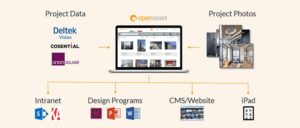
Using digital asset management software allows you to centralize the sum of your company’s knowledge in one spot, unlocking countless benefits in the process. It helps you speed up document creation. It helps maintain the company’s institutional knowledge, even as employees come and go. And it can reinforce consistent branding across multiple projects.

Most importantly, you can do it all faster.

Craft winning RFP responses with OpenAsset

OpenAsset is the digital asset management platform purpose-built for architecture, engineering, and construction firms. AEC marketing teams use OpenAsset to centralize project photography, employee bios, case studies, and past proposal content in one searchable library — then pull those assets directly into RFP responses, pitch decks, and marketing materials. If you’re already running PMPs, win themes, and SME workflows, you already believe in OpenAsset’s mission: organization.

With RFPs needing more input from more people on shorter deadlines than ever, organization is increasingly critical to success. OpenAsset ensures that strong organization never breaks down, even when you’re juggling five different responses in the same week.

Whether you need to keep those five projects straight or just need to find a case study to support your latest proposal, OpenAsset’s DAM library makes the process easy and intuitive. And with Shred — OpenAsset’s AI-powered proposal writing tool, fine-tuned on real AEC proposals — you can extract compliance requirements verbatim from an RFP, surface past responses in seconds, and pull approved project photos and team bios straight into InDesign or PowerPoint.

If you want to streamline your RFP response pipeline, try a demo today and experience the DAM that does more.