






15 Best AI Tools for Engineers in 2025
Oct 1, 2025
Engineering AI tools make bold claims—they promise to revolutionize how teams work: Work smarter. See your company more clearly. Make strategic moves that once seemed impossible.
Whether you’re in engineering, construction, or architecture, AEC firms hear the same pitch: the future is just an algorithm away. But achieving real results takes more than installing a tool. Promises come easy. Results demand effort.
Here’s a look at the AI tools that are actually helping engineering teams turn potential into real-world performance.
Real-World Advantages of AI for Engineers
In the AEC industry, AI offers numerous practical, proven use cases. But many of them boil down to a few key points: enabling smarter, more strategic decisions, improving process optimization, and maximizing effectiveness.
Preventive Maintenance: An In-Depth Example of AI in Engineering
Preventive maintenance is the practice of regularly inspecting and servicing equipment to identify issues before they cause a breakdown.
At first glance, it might feel like an “optional” tactic you can safely skimp on. But once you understand how and why it works, the use cases for it (and resulting savings) become self-evident.
Most preventive maintenance applications study a component (such as an HVAC unit, a motor, or a gearbox) over a long period of time. Early in the component’s life, when it’s working normally, you’re essentially building “control data.”
As that component gains wear and tear, you can measure that data against how the component functioned when it was healthy: It’s like a doctor checking in on your heart every year. Eventually, the data will give you telltale signs that a component is reaching the end of its lifecycle, so you can make the proper arrangements to replace it ahead of time.
Why This Matters for Engineering Teams
The core promise of preventive maintenance is improved uptime on equipment.
When you know equipment will fail ahead of time, you can schedule repairs during idle periods. Without preventive maintenance, equipment breaks mid-job, halts work, and pushes your entire project into crisis mode.
Less downtime drives more productivity, which leads to faster projects, stronger competitiveness, and higher profits.
Top Features of AI Engineering Tools
AI is no substitute for a trained, seasoned professional, but there are several niches where it can perform functions that are simply beyond human ability.
Several specific fields where AI is excelling include:
Automation to Enable More Strategic Work
One of the most widely touted benefits of AI is its ability to automate away manual and tedious tasks, clearing the way for you to focus on the more substantial parts of your job.
Rather than spending all day filling basic information into forms for the hundredth time, you can focus on more impactful activities like designing your next big component — or your next big proposal.
Predictive Analytics
Preventive maintenance is just one pillar of predictive analytics. AI can also use similar methods to predict future trends and analyze patterns across large data sets. These patterns might appear in workflows, product performance, or customer feedback.
Collaboration
Sometimes, it’s hard to know where to start — especially when you’re facing a complex system or a mountain of data. AI can’t do your work for you, but it can offer ideas to jumpstart your process, the same way you might bounce ideas off a coworker when you’re stuck.
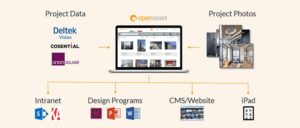
For example, one of OpenAsset’s greatest strengths is its ability to hunt down visual media from all corners of your company — even the forgotten or poorly documented ones. You might discover a photo you hadn’t seen before, one that perfectly fits the narrative you’re building, reinforces your message, or helps you tailor the proposal to the client’s priorities.
Customizability and Integration
The best AI tools don’t require you to change how you work; they adapt to fit your process. Whether you’re designing, modeling, or managing project data, customization features let you tailor your workspace, automate common tasks, and keep the tools you use most just a click away.
But flexibility means more than just interface tweaks: It also means integrating with the platforms your team already relies on, like project databases, asset libraries, or CRM systems. When your AI tools can pull and push data across platforms, your workflows stay connected and your team stays focused.
Faster Computing
Despite AI’s reputation as a computing hog, it’s actually less intensive than some other tools in the industry.
A prime example is physics simulations, which require lengthy and taxing calculations to execute properly. AI reduces the computational load by reasonably assuming what the result would be, without needing to actually crunch all the numbers.
It’s not a replacement for a real physics test, but it can offer preliminary results and accelerate initial design ideas before you put them to a more rigorous test.
Operating at Scale
The larger your company or project, the more you’re going to benefit from AI. One of its greatest strengths is the large amount of data it can work with and process.
On massive projects, it can track every moving part better than a person can. When your company utilizes thousands of tools, it can keep a closer eye on all of them. When you have swaths of data to sort through, it’s more efficient. And, the larger your database of legacy information is, the better it can learn from your past to give helpful future suggestions.
The 15 Best AI Tools for Engineers
1. Neural Concept
Location: Switzerland
Funding: $36M
AI Focus: Deep learning physics simulations with massive time reductions
Notable Clients: F1, Bosch, Ferrari, Airbus
Neural Concept is designed to take the guesswork out of engineering design through sheer quantity.
A designer might spend weeks working with their CAD program, painstakingly running lengthy physics simulations, tweaking based on the results, and then running more simulations. Neural Concept can simply conduct trial after trial without the lengthy waiting time. There’s no need for guesswork when you can just methodically test every option.
Instead of spending hours of computing time crunching an actual physics model, Neural Concept can simply conduct trial after trial automatically. It uses the long history of existing physics models to predict the results of each test.
From F1 teams to the aerospace industry, Neural Concept has been broadly adopted to speed up various physics simulations, aerodynamics chief among them.
While it is still recommended (like almost any AI tool) to check its work, you’ll have a far better idea of the best direction for your design. By seeing which test models are promising — and which are dead ends — your firm will have faster ideation that leads to truly exceptional results.
2. Buildots
Location: Israel
Funding: $151M
AI Focus: Improving reliability and efficiency through 360-degree monitoring
Notable Clients: Intel, JE Dunn, Multiplex
It’s easy for small details to fall through the cracks of a large construction project.
Managers can’t know what everyone on the project is doing day-to-day, complications inevitably arise on-site, and plans always change. A construction project is a living, breathing thing that evolves over time. It’s much easier to manage that project if everything happening on a site goes through one point. Buildots is that one point.
Buildots is your automated on-site assistant. Designed around 360-degree head cameras, Buildots can give you comprehensive knowledge of exactly what’s happening on your build site.
It knows which parts of the job are completed because it literally watched them happen. It can check reality against your drafted plans and tell you where the two are starting to diverge.
Buildots has numerous use cases from predictive analysis to centralizing information, but the bottom line is improving the reliability and efficiency of your company. It’s designed to double-check your project to catch mistakes and prevent delays. It also speeds up administrative tasks like backend reviews.
It won’t replace your site manager, but it’s a great secondary tool to work in concert with them.
3. OpenAsset and its Proposal Writing Assistant, Shred.ai
Location: UK & USA
AI Focus: Digital asset management and proposal writing assistance for every step of the RFP process
Notable Clients: DPR Construction, Clayco, JLL, Taylor Australia
A company with over 20 years of AEC experience, OpenAsset has traditionally supported the marketing side of the business with its time-tested digital asset management (DAM) software. Over the years, it’s introduced several useful AI features to its offerings.
Enhanced AI visual searches can generate results based on what’s in a photo, not just the tags, making even messy and poorly documented databases troves of useful data. Likewise, its Content Assist feature can generate new drafts of old marketing pitches, saving you time rehashing boilerplate copy.
Based on the success of using OpenAsset’s DAM in the proposal process, the company’s newest marquee proposal writing tool, Shred.ai, has one goal: Make proposals simpler, faster, and more successful.
It’s designed to assist with every step of the process, from drafting the proposal itself to ensuring compliance. It draws firmly on OpenAsset’s long-standing expertise, making routine tasks and massive databases more manageable and clearing the way for creativity.
Of particular value is the software’s ability to utilize institutional knowledge. Shred.ai digs through all those long-forgotten legacy databases to unearth information from all corners of your company.
If you need a refresher on how your company handled its last hospital construction proposal, Shred.ai can help. It can also find media assets to reuse, and auto-populate the routine info you enter into proposals every day.
4. Bentley Systems OpenSite+
Location: Global
Financials: $1.1B revenue
AI Focus: AI design software built specifically for site engineering
Notable Clients: SPL Powerlines UK, Guangdong Airport Authority
Like a few other companies on this list, Bentley Systems is an already known and trusted provider of construction software. It’s a CAD software expert that already had experience with AI-adjacent concepts like digital twins long before it became a buzzword.
As Senior Product Manager David Settlemyer puts it, OpenSite+ is about “letting an engineer be an engineer, not a drafter.”
And it brings a vast array of value-added tools to the table to accomplish that. For example, OpenSite+ lets users use natural language instead of needing to know specific programming lingo, lowering the barrier to use.
The software also speeds up the design process by analyzing a project’s earthwork – such as excavation and soil movement – and offering design suggestions in real-time. It automatically performs mundane tasks such as adding notes and dimensions (annotating), identifying elements in the design (labeling), and organizing drawings into print-ready documents (sheeting). It also makes individual elements – such as sidewalks and parking layouts – editable objects that can be quickly adjusted.
Bentley claims that these tools are so powerful, they’ll “accelerate drawing production by up to 10 times.”
5. ALICE Technologies
Location: USA
Funding: $55M
AI Focus: Optimizing complex project timelines and scheduling
Notable Clients: Beck Group, Andrade Gutierrez, Parsons
ALICE is designed with one highly specific job in mind: to optimize a complex and overwhelming project timeline. It finds the most efficient schedule by generating every possible option, then offering a shortlist of the best ones.
It’s all easily visualized on a scatterpoint graph, allows for what-ifs like overtime or delayed milestones, and changes its models based on your project’s specific parameters and restrictions.
Once it’s done, you should have all the information you need to not just build a schedule, but also know how much and what kind of manpower you’ll need to contract to fulfill it.
6. Ansys AI Integrations
Location: Global
Financials: Acquired by Synopsys, $35B (2025)
AI Focus: AI-accelerated physics simulations that maintain accuracy
Notable Clients: LG Electronics, Robert Bosch Engineering, Seagate Technology
Ansys develops physics simulation programs designed to prioritize accuracy and speed.
Even before the advent of AI, the company spent decades developing comprehensive simulation tools—including Finite Element Analysis (FEA), which models how materials respond to stress and force, and Computational Fluid Dynamics (CFD), which analyzes fluid flow and air movement. Ansys got its start digitizing FEA processes that were previously done by hand, significantly improving speed and accuracy.
Its use of AI follows in the same spirit. It’s intended to make another generational leap in calculation speed. By implementing AI, Ansys has reduced the time it takes a computer to make physics calculations by hours.
Ansys has also developed machine learning processes designed to turn a weakness — vast swathes of unorganized junk data from old projects sitting on a company’s hard drive — into a strength.
Analyzing all that data by hand would be expensive and time-consuming enough to be entirely impractical. Machine learning, however, thrives on such backlogs and can use them to model future simulations more efficiently.
7. C3.ai
Location: USA
Funding: $481M
AI Focus: Enterprise AI platform with proven predictive maintenance applications
Notable Clients: Shell, U.S. Air Force
C3 provides enterprise-scale software applications for a variety of fields. For engineers, its most relevant use is predictive maintenance, where C3 has a proven track record maintaining over 10,000 components across Shell’s operations.
Particularly notable is C3’s willingness to partner directly with a company, sculpting its product to meet that partner’s needs. Sticking with the Shell case study, the two companies are working so closely together that C3 has even incorporated some of Shell’s own proprietary work into its own algorithm.
8. Autodesk Forma
Location: USA
Financials: $6.1B revenue
AI Focus: Generative design and visualization of physics models
Notable Clients: Stantec, RSP, Jacobs, Gray Puksand
Autodesk is one of the largest names in design software. It is so foundational to the industry that, even among its AI competitors, you’ll often find compatibility — with Autodesk integration listed as a selling point.
Examples of incorporating AI into its product include, most notably, the Autodesk Forma AI. Forma, an all-in-one site design tool, is built to assist engineers during every step of the pre-production process.
Among Forma’s many features, it collects and visualizes existing data from a construction site. If you’re already working inside Autodesk’s ecosystem, Forma can also port that information into other programs such as Revit.
Once it’s time to start designing, Forma lets you both test and design in the same program, eliminating time spent sending files back and forth between platforms. In the same way, if you ever have to work with customer models that leave room for improvement, Forma can help whip them into shape.
Forma also features a full suite of models for wind, daylight, noise, and more, as well as numerous ways to intuitively attach notes via Forma Board. Put it all together, and you have a broad-reaching, Swiss Army Knife of a software suite.
9. Siemens
Location: Global
Financials: $82B+ revenue
AI Focus: Efficiency through comprehensive analytics at scale
Notable Clients: Volkswagen
From predictive maintenance to in-depth monitoring systems, Siemens is another automation giant that’s been developing cutting-edge technology for decades.
Unsurprisingly, much of Siemens’ existing software provides an excellent foundation for engineering AI tools. Its former Industry of Things (IoT) software, MindSphere, has been reborn as the Insights Hub, but its core specialty remains analytics.
The basic concept behind many of Siemens’ products is that, by using large enough data sets, inefficiencies and irregularities can be detected and corrected before they become problematic. This is particularly useful for repetitive or automated functions, or for discovering consistent design defects in a product that need improvement.
In one predictive maintenance example, Siemens’ software monitored the lifespan of several motors and, by tracking changes in the components’ motor vibration, could accurately predict impending bearing failure months before it actually happened.
Siemens also offers Siemens NX, a CAD/CAM software suite that utilizes AI to automatically personalize itself for individual users. It’s sort of like an assistant that, after a few weeks on the job, knows when to hand you a wrench before you even ask for it.
10. Matterport Cortex AI
Location: USA
Financials: $170M revenue
AI Focus: Automated 3D mapping, digital twins, and the ability to modify both.
Notable Clients: Swinerton, Burns & McDonnell, Takenaka Corporation
Another company that already had an established niche in the AEC world, Matterport specializes in 3D mapping of real-world interior spaces.
Even before AI, its business model centered on developing digital twins of interior spaces. Matterport then used those twins for everything from CAD file generation to photorealistic virtual tours — often more convincing than traditional proof-of-concept mockups.
Matterport has leapt into the AI space with its newest software, Cortex, to automate this entire process. All you need are panoramic images of a space, and Cortex can do the rest. The program will even give you accurate dimensional measurements of the room.
Most strikingly, Cortex lets you manipulate the digital twins you create.
Previously, making changes to the layout – like repositioning HVAC systems or structural elements – meant revisiting the site and recreating the model from scratch. With Cortex’s generative AI, those digital twins are now far more flexible and easier to update, making design iterations faster and less labor-intensive.
11. Altair
Location: USA
Financials: $665M revenue, acquired by Siemens
AI Focus: AI-augmented CAE and physics testing
Notable Clients: SOM, DYMACO, Beck Engineering
Altair is another company finding new uses for AI to improve its already-existing specialties. You may already be familiar with its CAE software platform, Altair HyperWorks.
On top of everything they’ve already done, Altair has leveraged AI to speed up its physics simulations and improve accessibility.
The program allows for both no-code and code-based modeling. That means more people across your firm—regardless of technical background—can interact with it directly and contribute meaningfully. Those with coding experience can continue using the software as they have, while designers can use Altair’s no-code platform to generate their ideas.
Most recently, Altair was acquired by Siemens, another AI engineering tool on this list, and now has the backing of one of the largest engineering companies in the world. It is predicted that the two will continue as partners, bringing even more AI benefits to engineers.
12. Versatile CraneView
Location: USA
Financials: $29.3M revenue
AI Focus: IoT- and AI-fueled analytics for crane operation
Notable Clients: Herrick Steel, Turner
Versatile’s CraneView is the ultimate analysis tool for crane operation.
By attaching one of the company’s proprietary devices to your crane, it can track everything that the crane does while in operation, giving you anecdotal data from real-world construction projects.
The tool takes data gathered by CraneView to detect patterns and trends in your workflow. It then uses that data to improve project speed and efficiency.
You can see the rate at which work is getting done under real workplace conditions — complete with all their inevitable delays and hiccups — as well as identify where your project might be consistently running into hitches.
Versatile also provides a suite of other highly specialized software. Calendar, one of its value-added products, can take all that data and compare it with your project schedule to check if reality is keeping up with the schedule you set. You can also schedule material deliveries based on your crane’s actual pace, rather than relying on rough estimates.
Another Versatile product, Control Center, is a management app built specifically for steel project managers. It serves as the central hub for many of Versatile’s other tools.
13. PTC Creo
Location: USA
Financials: $2.3B revenue
AI Focus: Generative design CAD software
Notable Clients: MAN Energy Solutions, Lixil
Like many other CAD companies on this list, PTC’s Creo software suite has already spent years developing a dedicated user base. The software focuses on creating 3D models that are easy to update by changing specific measurements or settings — known as parametric modeling.
PTC’s parametric-based system is a particularly sensible fit for AI.
Even before its advent, parametric software was all about designing models around a list of rules and requirements, rather than drafting dimensions one inch at a time. Today’s AI, where users input goals or constraints in plain English, feels like a natural evolution of parametric modeling.
The latest version, Creo 12, introduced design tools for components made of composite materials. It has also developed tools for streamlining annotations, designing 3D-printed components, and simulating milling processes where machines cut and shape parts from solid material.
With new generative design functions, Creo 12 is helping companies across industries design lighter components without compromising on other parameters.
14. Procore Helix
Location: USA
Financials: $1B revenue
AI Focus: “Construction management with INDUS.AI integration”
Notable Clients: Turner Construction, Balfour Beatty, Clark Construction
Procore is a foundational company in the AEC field. Over the years, it has developed software tools to assist with almost every step of a construction project, from bidding on a job to invoicing once it’s completed.
Procore has been introducing small AI features bit by bit over the past few years.
It’s gathered many of these offerings into one package: Procore Helix is a bundled solution focused primarily on analytics applications.
It is designed to centralize a company’s data, helping users make educated decisions about everything from project health to workflow optimization. The bundle also includes Procore’s AI copilot (for workflow assistance), agent builder (for creating custom AI tools), and developer studio (for integrations).
Most importantly, Procore stresses that when Helix gives you statistics, it’s drawn from real, hard data, rather than “educated guesses” based on precedents and general principles.
In dynamic environments like construction, decisions driven by real-world data lead to more accurate, reliable outcomes. Helix skips the guesswork and draws its conclusions straight from your company’s database, giving you better, more accurate data to make decisions with.
15. nPlan
Location: UK
Funding: $18.5M
AI Focus: Managing construction project schedules
Notable Clients: ExxonMobil, Shell, Rail Project Victoria, Kier Group
nPlan has one mission: To manage scheduling for construction projects and stop project overrun.
Its primary function is to flag potential causes for delays and predict how a project may run long. Using that data, it can not only track ongoing projects, but also help you generate plans for new ones. It’s effectively predictive maintenance for your project’s timeline.
It has found a niche partnering with numerous massive railway companies, but its models are based on a massive 750,000+ project database containing everything from highway projects to power plants.
Get The AI Tool for Engineering Firms Who Want to Win More Work
When you have thousands of choices, picking the right AI engineering software to empower your company isn’t easy — especially if you’re not a tech expert! Choosing the right AI partner follows the same rules as any smart business decision.
OpenAsset is built for AEC marketers and proposal writers who need to move faster and win more work.
With AI tools empowering faster research, more efficient workflows, and winning proposals, OpenAsset is the DAM that does more. And now, with Shred, you can get practical help for every step of the proposal process. Whether you’re grasping for ideas for a proposal pitch or want to check compliance one last time before you hit send, Shred will be at your side.
Explore the DAM and proposal tools trusted by 1,000+ AEC firms.