






How to write a proposal cover letter in 2026: Examples + free template

Dec 11, 2025
9 min

Last updated — December 11, 2025
Proposal cover letters are brief overviews that introduce the more in-depth content of a proposal. Cover letters are normally the first page of a proposal, making them the first impression you will give and your first opportunity to convince the reader to work with you. These letters directly communicate with the client and set the stage for the following proposal details.
If your proposal cover letter is not convincing enough, the reader might not read your entire proposal and choose a competitor. That’s why understanding the do’s and don’ts of proposal cover letter writing is crucial.
In this blog, you’ll learn how to structure and write a proposal cover letter, what makes a good proposal, and get a free downloadable template for your firm to use.
| Key takeaways: winning proposal cover letters in 2026 Purpose: A proposal cover letter frames your firm’s value and primes evaluators for the full submission. Proposal win-rate benchmark: Competition is high: The American Institute of Architecture’s Billings Index (the leading economic indicator in forecasting non-residential construction) hovers below 50, making proposal cover letters important to capture your prospect’s attention. Tech edge: 68% of proposal teams now use generative AI to craft faster, more tailored messages. Success formula: In your proposal cover letter: 1) Use a powerful, client-focused opener, 2) State the problem and your unique solution 3) Quantify benefits 4) Invite discussion 5) Close with a clear next step. |
Table of contents
What is a proposal cover letter?
Why your proposal cover letter matters in 2026
What should be on a proposal cover letter?
How to write a proposal cover letter
What makes a good proposal cover letter?
RFP cover letter mistakes to avoid
Proposal cover letter examples
Free proposal cover letter template
Answers to top proposal cover letter questions
How to create quality proposal cover letters every time
What is a proposal cover letter?
A proposal cover letter is a letter that accompanies an RFP response or bid submission. Its primary purpose is to introduce the proposal, explain its relevance to the recipient, and persuade the reader of the value and credibility of what’s being offered. It sets the tone for the entire proposal, so make sure it’s well-crafted.
The cover letter needs to be persuasive and blow your prospect away because it provides a first impression. Since it’s often the first thing the recipient will see, it plays a key role in the recipient’s decision to even consider reading the full proposal.
The cover letter is frequently the initial opportunity for your proposal to align with the reader’s objectives. While it goes on top of the proposal, it shouldn’t be confused with an executive summary that outlines the main highlights of your proposal.
Why your proposal cover letter matters in 2026
Your cover letter is one of the most important parts of your proposal. It’s your best opportunity to grab your client’s attention and get them invested in what you have to offer.
This has always held true, but it’s more important than ever in today’s market.
Everyone’s fighting to stand out and earn attention. Proposal reviewers are required to read every proposal, but that doesn’t mean they’re engaged.
After all of the hours you’ve painstakingly put into that proposal, you don’t want someone to skim your proposal; you want it to stick.
The AEC market is tight — and competitive
Month after month, the AIA/Deltek Architecture Billings Index (ABI) has reported the same thing: flat conditions, soft markets, and no end in sight. For almost two years straight, the index has hovered just below 50.
The ABI’s simplest tracking metric follows architecture firm billings on a scale of 0 to 100. 50 marks a perfectly flat market, with the exact same number of firms reporting an increase in billings as those reporting a decrease.
Below that, and the market is shrinking.
October 2025’s score was 47.6, an improvement from September’s score of 43.3. Yet, despite the increase, the market is not seeing growth, making your proposal cover letter more important than ever.
Clients aren’t growing on trees, but they are there for the firms that put in the extra effort, stand out, and make a connection.
And it starts with your cover letter.
Why you need a quality proposal cover letter
Your cover letter is the one section of your proposal everyone will read. And, if it doesn’t catch their attention, it might be the last thing they carefully read. In today’s increasingly competitive market, clients don’t have time to read every word of every proposal they receive.
Think of the cover letter as your movie trailer: It has seconds to spark curiosity and make the audience care. If it doesn’t, they’ll tune out, even if the full story is great. A strong opening earns attention and makes people want to see how your proposal unfolds.
A cover letter helps busy clients decide if they’re interested in reading the complete proposal. Therefore, having a winning proposal cover letter is just as important as the actual proposal.
The proposal cover letter gives you a chance to leave clients with a memorable first impression. While proposals lean towards factual information, cover letters offer a more personal touch. Establishing an emotional connection from the beginning significantly increases the likelihood of the reader engaging with your entire proposal.
Is your RFP process setting you up to win — or just to respond?
In two minutes, get a full proposal process scorecard that reveals how close your current workflow is to supporting repeatable wins.
What should be on a proposal cover letter?
Though the specifics of your proposal may vary based on the nature of your offer and your sector, the proposal cover letter should consistently stick to the following structure:
Contact Iinformation
It’s essential to include your contact details, including your name, email, and phone number, as well as your organization’s information, such as its name, email, phone number, website, and even its social media handles. For bonus points, include the link to your LinkedIn profile in the heading, too, so the reader can get a deeper understanding of who you are.
Make these details easy to find by placing them at the top or bottom of the cover letter, ensuring they’re in a bold and easy-to-read font so potential clients have no problem finding them. Using the company’s letterhead for the letter not only ensures the inclusion of this information but also gives a professional touch.
Greeting
This is your chance to introduce your company and what you do. It’s your first opportunity to make a positive impression and establish a connection with the reader.
Begin with a concise statement about your company. This could be your mission statement, a brief history, or an overview of what makes your organization unique. This is your chance to highlight areas where your company excels, which helps you establish credibility.
Additionally, highlight your primary areas of specialization or the main services/products you offer. This will give the reader a clear understanding of your role and what you do.
Summary
Often, decision-makers are drowned in proposals, and they might not have the time or patience to go through every detail initially. A concise summary ensures that they can quickly understand your proposal’s primary objectives and value.
You should provide details about your value propositions at a high level and connect how they meet your client’s requirements. By summarizing how your proposal addresses the client’s specific challenges or needs, you can instantly resonate with them, emphasizing that your solution is tailored to their situation.
Offer
Continuing with the offer, this is where you should further explain how you can provide a personalized solution. Clarify to the client the unique value your solution brings to solve their problem.
Having captured your potential client’s interest, you now have to focus on keeping it. Achieve this by highlighting the clear benefits that directly address their challenges, making it easy to understand.
While you’ll be mentioning how your work will benefit the prospect, you should also explain what they will win from choosing to work with you.
Here are some tips on how you can accomplish this:
- Select the three to five primary attributes of your solution
- Explain their advantages for your client in a concise statement
- Be straightforward– This is what we provide. This is how it solves your issue
References
In situations where multiple firms submit proposals, having strong and relevant references can set you apart from competitors. It offers an added layer of reassurance to prospective clients about your experience and competence. Essentially, relevant references help the client understand why they should choose you over others.
References also show the prospective client or partner that others have trusted you and that you’ve delivered results. By showcasing references from satisfied clients or partners, you demonstrate that you have been trusted in the past, which can solve any insecurity or concerns the potential client might have.
Visuals
Visuals aren’t a must for proposal cover letters. However, they can enhance its impact by emphasizing crucial information. If you have a designer on your team, you can incorporate graphics that highlight the key points of the letter.
Some examples of what this might look like:
- Highlighting a customer satisfaction quote in a different font to make it stand out
- Using callout boxes to draw attention to your key value propositions (especially helpful for busy teams skimming the page)
- Using the company letterhead
- Including the signature of a senior person at your company
Conclusion
Similar to introductions, many cover letters tend to focus more on the body content than the concluding paragraph. However, ending on a powerful note is as crucial as creating a compelling start. It’s recommended to conclude your cover letter by highlighting a significant benefit and the value your project will offer to the company.
Additionally, when wrapping up your proposal cover letter, always encourage them to continue by reading the complete proposal.
How to write a proposal cover letter
Now that you know the structure to follow on the proposal cover letter, it’s time to go into the details of how to write a proposal letter.
Make your first sentence powerful
Don’t “save” your best-selling points and statistics for later.
Starting with a powerful opening sentence can grab the reader’s attention immediately, encourage them to continue reading, and make your proposal stand out. It’s beneficial to use impactful verbs and straightforward wording to ensure your initial sentence remains engaging and brief.
It’s important to note that a “powerful” opening is not the same as being quirky for quirky’s sake. You still need to think about what your reader cares about. Otherwise, yes, your business proposal may stand out, but it could be for the wrong reason.
Being memorable means nothing if you’re not also persuasive.
Demonstrate you understand the problem
In any proposal, it’s essential to demonstrate to your client that you understand the problem they’re facing. Highlight their goals and the reasons behind your collaboration. Present the company’s challenges in an easily comprehensible manner. Dedicate a section to focus on the company’s concerns, and later in the cover letter, you can introduce the proposed solutions.
Offer to discuss the proposal further
Before ending your cover letter, you should stress your readiness to dive deeper into the proposal and address any questions or concerns the reader might have. Additionally, this serves as a chance for you to propose a face-to-face meeting with the potential client to further increase your chances of landing the project.
Thank the issuer for the opportunity
In the cover letter, you have the opportunity to express gratitude to the proposal’s recipients. Recognizing their participation in the process and expressing appreciation for the opportunity not only demonstrates courtesy but also signals to all reviewers that you’ve closely read the RFP guidelines.
Build a persuasive closer
After completing the structure and details of your proposal cover letter, end with a persuasive closing demonstrating your understanding of the next steps. Clients want to understand how you’ll assist them in achieving their objectives and the next steps for moving forward. This demonstrates to them that you can simplify the process by detailing the necessary steps to advance.
Mention the opportunity to discuss the proposal further. Some examples of what this might look like include:
- “We look forward to the opportunity to discuss our proposal further.”
- “Once you’ve had an opportunity to review our proposal, please don’t hesitate to reach out and follow up with any questions.”
- “Our team will be following up in a week for an update and see if there are any additional ways we can support your team. “
Include a signature
Don’t forget to include a signature! But who signs it? Who signs the proposal cover letter varies based on different factors. The signee is often the person who has worked most closely with the client.
This can be the person who:
- Has been managing the company’s relationship with the client,
- Has been in charge of your strategy for pursuing them, or
- Carried out the research leading to the proposal.
When multiple people fit this description, it’s recommended that you have the proposal cover letter signed by the individual with the highest authorization level, ideally someone the client knows.
Otherwise, you should consider having the executive director of your organization sign the cover letter and include their contact details for professionalism. People to consider for signing the proposal cover letter include:
- Executive director
- VP
- Account manager
- Executive of executives
- CEO (a strategy used by small firms or when the RFP represents a large portion of a responder’s annual revenue)
- Someone with a senior title
What makes a good proposal cover letter?
So, now we know how to structure a proposal cover letter and how to write one, but how can we make it stand out? Here are some tips you should follow to craft a good proposal cover letter.
Capture your reader’s attention early
Within the framework of a proposal, the first paragraph is the best chance you have to catch your reader’s interest. This means the introduction is one of the most essential parts of your proposal cover letter. It’s crucial to catch the reader’s attention immediately, so think of an engaging way to introduce yourself and your company. You can do this by finding a way to relate to them or showing that you understand their needs.
Mirror clients’ words and phrases
When writing a proposal cover letter, it’s essential to align your language with the client’s terminology to show that you understand their needs. Failing to do so might not only display a lack of alignment and agreement.
Prioritize the prospect
A common mistake is making a proposal letter about yourself. Clients aren’t focused on your achievements or your professional journey. They want to understand how you’ll assist them in reaching their objectives. Therefore, the cover letter should focus on how you plan to help the client in reaching their objectives.
If you do want to mention special company achievements, make sure they are relevant to your client’s objectives and provide value.
Get straight to the point
Keep it simple. Be clear and avoid any uncertainty. Being unclear can break trust quickly. So, gather all your information before writing, so you don’t sound unsure. Make sure what you write is accurate. You’re the expert. Write confidently and avoid wasting your client’s (or your) time by putting unnecessary information in your proposal cover letter. The goal is to have clients read to the conclusion and sign.
Stand out from the competition
The proposal cover letter shows that you understand the client’s worries. It helps you be different from others and encourages clients to read your entire proposal. After reading the cover letter, they can then look at the more detailed parts.
Moreover, the proposal cover letter is your first chance to highlight your value proposition and what makes your offer unique compared to others. For the cover letter, you should focus on how you can distinguish yourself from competitors. You don’t want to “sound” the same as the competition.
RFP cover letter mistakes to avoid
Now that we’ve seen what makes a cover letter good, take a look at what makes a cover letter bad. Here are the proposal cover letter mistakes to avoid.
Repeating the executive summary
Avoid repeating content from the executive summary within your proposal cover letter. Each document — the executive summary, proposal, and cover letter — should be separate. Repetitive information can damage the impact of your message and possibly bore or discourage the reader.
Not Utilizing the Right Software
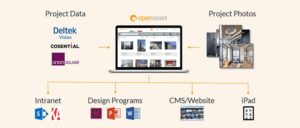
When creating RFP responses, you need to manage digital assets while keeping everything accurate and up to date. With the right software, like a digital asset management DAM system, you can store and manage all your project images, videos, and other media in one place. This makes it easy to find and incorporate the most relevant and impressive visuals into your RFP to make it more compelling.
With a DAM, you can quickly search, access, and integrate assets from the software directly into your RFP documents. This means that with the right DAM integrations for your industry, you can create documents in seconds with pre-designed templates.
Additionally, a DAM helps ensure that all images and media used are in line with your brand guidelines and accessed by the right people.
TIP: Want to know more ways a digital asset management (DAM) system can help you create RFP responses and win more clients? Read our Ultimate DAM Guide now.
Not reading the RFP multiple times
Overlooking details is the first challenge in the RFP response process. The data presented by the client within the RFP serves to guide and inform your proposal. Hence, it’s crucial to carefully review the RFP multiple times to ensure all essential elements are seen and there is no critical information missing.
Moreover, if you don’t follow the client’s RFP guidelines, they’ll most likely ignore your response, and all your effort will be lost to those who did thoroughly read the RFP.
Not understanding the client’s needs
This might seem like a general mistake, but it’s a big one. If you don’t understand what the client wants, your whole response won’t matter. For this reason, you need to read the RFP carefully to know what the client is looking for. Don’t send a proposal that’s missing details or doesn’t match what they need.
Making the cover letter too long
Your cover letter should always be one page unless you’re dealing with a long proposal of 100+ pages. If you do end up with a longer cover letter, it might be because you are including too much detail. Instead of describing every detail of your proposal (save that for the executive summary), focus on the top three aspects that will catch the reader’s attention. This will leave the reader wanting to know more, encouraging them to read the entire proposal.
Proposal cover letter examples
It’s time to take a look at good proposal cover letter examples to help you further understand what is expected.
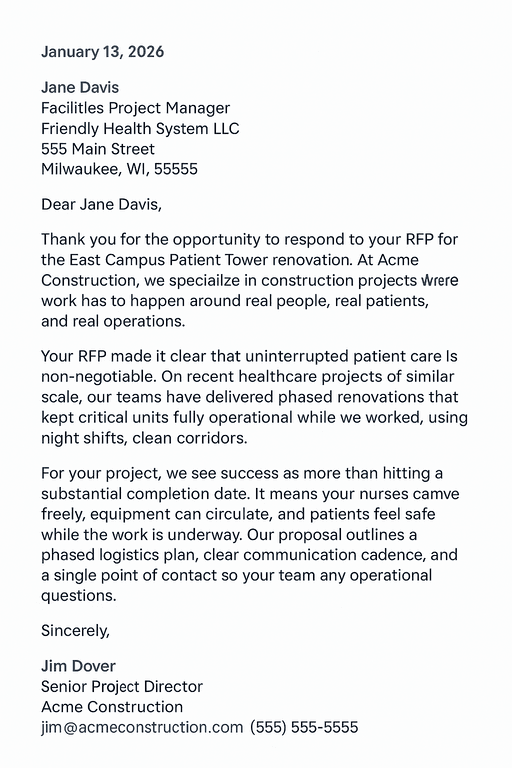
Construction proposal letter example
This construction RFP response cover letter example highlights strategies that work for any proposal, providing inspiration even if your project falls outside construction.
(Please note, all examples, including people and company names, are fictional for the purpose of providing examples.)
The Acme Construction example below demonstrates how a concise, client-centered cover letter can make a technical project feel personal. It doesn’t get lost in jargon or process; instead, it focuses on the client’s world — patients, staff, and operations — while subtly positioning the proposal team as the solution.
Architecture RFP response cover page example
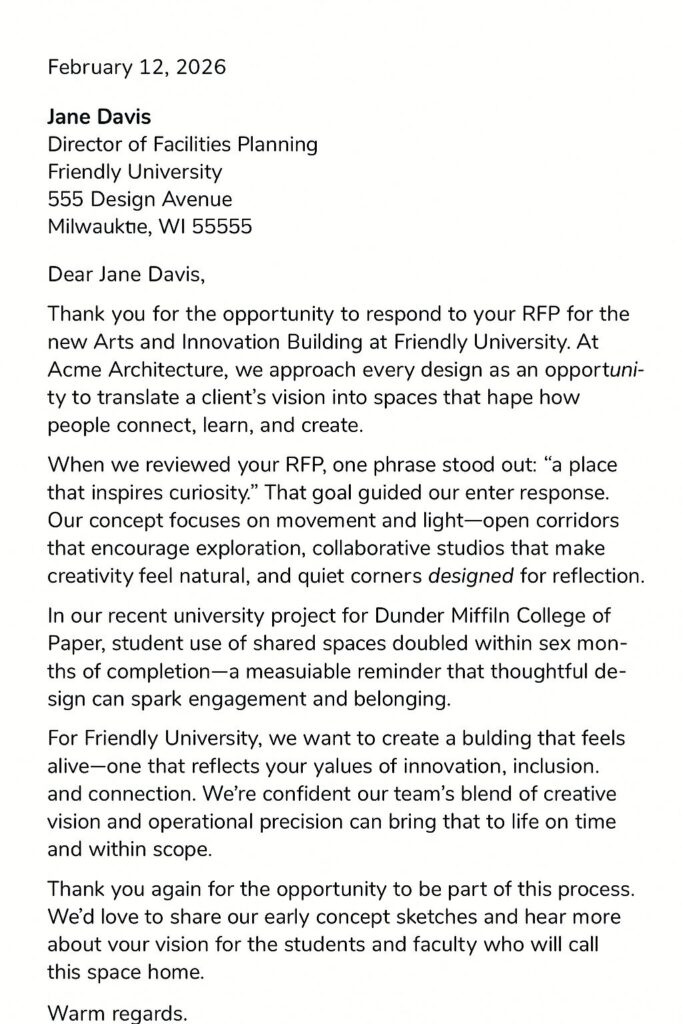
The following is a proposal cover letter for an architecture project.
The Acme Architecture example below demonstrates how to hold a reviewer’s attention by tying design ideas to emotion and human experience. It proves that even in RFP responses, empathy and curiosity are more persuasive than buzzwords and blueprints.
Engineering cover letter example for a proposal
The third example cover letter is for an engineering proposal.
This example shows how an engineering proposal can stay creative and human, even when the RFP centers on budget, scope, and schedule. It demonstrates how clarity, credibility, and authentic connection can still make a pragmatic response memorable and persuasive.

Find more examples here
If you’re still looking for more help on how to write a good proposal letter, OpenAsset has covered this topic elsewhere as well. You can find six more examples of successful cover letters here. Engineering experts have even more engineering proposal writing tips they can follow, as well!
Free cover letter for proposal template
Below, you can download a FREE proposal cover letter template made for the AEC industry from OpenAsset partner and proposal writing guru, Rachelle Ray. Just enter your name and email for immediate access.
Answers to top proposal cover letter questions
If you’re looking for proposal cover letter best practices, you’re not alone! Here are the top frequently asked questions about how to write successful cover letters for proposals.
How do you write a cover letter for a proposal?
Writing a cover letter for a proposal starts with understanding your prospect’s needs and clearly communicating how your firm can meet them.
Begin with a strong, client-focused opening that shows you understand their project goals. From there, summarize your value proposition and explain how your approach solves their problem better than competitors. Conclude with a confident call to action, such as inviting further discussion or encouraging the reader to review the full proposal.
How long should a cover letter be for a proposal?
A proposal cover letter should be one page. This ensures your message is concise, focused, and easy for decision-makers to digest. Remember: Prospects are reviewing multiple proposals, and are short on time.
What is the purpose of a proposal cover letter?
A proposal cover letter sets the tone for everything that follows. Its purpose isn’t just to introduce your submission; it’s to earn attention, build trust, and show the client you understand what matters most to them.
While the proposal itself covers the technical details, the cover letter also creates the human connection. It frames your firm’s expertise within the client’s story, helping reviewers feel confident that you “get it” so they are engaged and excited to learn what you have to offer.
What key elements should be included in a proposal cover letter?
A strong proposal cover letter includes contact information, an attention-grabbing introduction, high-level points from your solution (often giving a powerful example), and a conclusion that invites prospects to take the next step with you.
How do I address the recipient of a proposal cover letter if I don’t know their name?
If you’ve exhausted all resources and still can’t find the decision-maker’s name, use a professional and inclusive greeting such as “Dear Selection Committee,” “Dear Evaluation Team,” or “Dear Project Manager.” Avoid overly generic salutations such as “To Whom It May Concern.”
Can I use a standard template for every proposal cover letter?
While you can use a template, every cover letter should be tailored to the prospect and the specific project. Keep your layout, formatting, and branding consistent across proposals, but tailor the message, tone, and examples to each opportunity. Think of your template as a framework, not a fill-in-the-blank form. Make it flexible enough to adapt, but consistent enough to save time.
Can AI help me with the proposal writing process?
When used thoughtfully, AI can make the proposal process faster and more consistent, while freeing up proposal writers to focus on the strategic, creative work. For example, AI proposal writing tools like Shred.ai can help by automatically analyzing past proposals, identifying relevant examples that best suit a new RFP, and organizing key information.
How to create quality proposal cover letters every time
Is your proposal process showcasing your team’s brilliance, or burying it?
Your proposal cover letter is your first chance to connect — but it’s not the only moment that matters. Behind every great first impression is a process that supports clarity, confidence, and consistency from start to finish.
The Proposal Power Index helps you evaluate how well your process delivers on that promise.
With this quick and easy quiz, you’ll get a scorecard that uncovers which parts of your workflow elevate your work…and which ones quietly drain your team’s time and energy.
Take the quiz now and get your custom scorecard in just two minutes.
With over 10 years of content management experience, Janelle Poisel has a proven track record of crafting compelling narratives and delivering content that resonates with B2B audiences. She is dedicated to helping teams learn how to meet their audience with the right content, at the right place, and at the right time as they navigate their unique customer journeys.