






Build or buy: What AI costs firms in the built environment

Sep 29, 2026
3 min
Every firm in the built environment is asking some version of the same question right now. Do we build our own AI tools, or do we buy something purpose-built?
Rafal Bergman PhD PMP, OpenAsset’s Director of AI Engineering, has a clean way of framing it: nobody has a map for these waters yet. What separates the firms that come through is who’s steering, someone who knows the difference between a problem worth building a boat for and one better solved by buying passage on someone else’s. That distinction informs the whole of the build or buy decision.
Why building feels like the obvious choice
The appeal is real. Tools like Claude and ChatGPT are capable enough that firm leaders, who have spent years watching some software vendors overpromise, are drawn to the idea of building something themselves. It feels like control, and it feels cheaper, and with agentic AI now mainstream, the barrier to prototyping in-house has never been lower.
For firms with in-house technical capability and a narrow, well-defined problem, this can work: a one-off script to reformat data, or a quick automation for a repetitive task.
Where DIY AI tends to fall short
Most firms can build something. That’s not really in question. The more useful question is what “build” means once the prototype has to survive contact with real work, real-world data and real users, and with whoever built it eventually moving on.
On a recent trip to Sydney with Director of Australia Operations Liam Nicholls, a few bid writers walked us through what they’d built. It handled the basics well: run a prompt, point it at a folder of shared content, get a decent draft back. It was even reasonable at matching a straightforward project to a straightforward brief. Where it needed more from them was the harder judgement calls, catching a revised deadline in an addendum, keeping partner and sub-consultant experience attributed to the right company when the source material was messy, and reframing a firm’s real strength to fit what a client needed, the way a workplace portfolio can win a hospital brief if someone knows to pitch it as healthy environments for staff. All of it was possible, but only when someone remembered to gather the right files and ask. And once a bid was submitted, whatever it helped write stayed in that one conversation, out of reach for the next person chasing something similar.
There’s a second cost that’s easy to miss until it lands: a DIY build is usually wired to one specific model, and providers set expiry dates on those models, not the firms using them. When a model is retired, there’s no opt-out. The workflow someone spent months tuning has to be rebuilt against whatever replaced it, on the model provider’s timeline, not your firm’s.
There’s a third, quieter question worth asking before anyone builds anything: what happens when the person who built it leaves? People move roles or leave firms entirely, and a DIY tool tends to live as much in that person’s head as it does in the code itself, in the reasoning behind a prompt and the workarounds nobody wrote down. None of that transfers automatically. The firm still legally owns whatever was built. Understanding how it works is a different kind of ownership, and it walks out the door with the person who leaves.
Delay is the other cost that’s easy to underestimate. “Let’s build this ourselves” or “let’s try everything out first” both sound like due diligence, but in a market moving this fast, six months of evaluation is six months a competitor spends already using a purpose-built tool to win work.
What buying gets you
Purpose-built AI tools for the built environment come with something DIY can’t easily replicate: years of product engineering aimed specifically at how our industry works, built without needing access to any one firm’s proprietary data to get there. A platform built specifically for architecture, engineering, and construction firms has already solved the messy, unglamorous problems, from inconsistent file naming to decades of legacy project archives, that a general-purpose AI tool has no context for.
Take that same bid scenario. A purpose-built tool knows a project’s cost on completion isn’t the figure quoted when it was first submitted two years ago, and that a proposal a firm submitted isn’t the same thing as a project it won. None of that is a filing problem a shared folder solves. It’s domain knowledge built up over years of working inside how the industry operates, at a scale, thousands of documents deep, that a single-tool build usually isn’t built to hold. OpenAsset’s Shred is one example of a platform built this way for the sector, but the underlying point holds across any vertical AI tool: the workflow is designed around the outcome the industry needs, not a general-purpose response to whatever’s typed into it.Buying also means the maintenance and development burden sits with someone whose full-time job is exactly that: keeping the tool current as the underlying models change, and building whatever end users ask for next, another agent, another feature. A DIY build makes the firm responsible for both, indefinitely.
The tradeoff is fit. An off-the-shelf tool won’t match a firm’s internal process on day one the way a bespoke build theoretically could. The question is whether that theoretical fit is worth the actual time it takes to build, test, and maintain it.
A useful way to split the decision
The mistake many firms make is treating build versus buy as one decision. It’s really two, and for most firms the real answer is build and buy, not one or the other. The real question is which parts of the stack a firm wants to own.
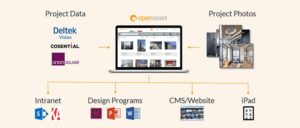
There’s the operational core: managing a project photo library and pulling the right images, staff bios, and credentials into an RFP response. This is high-volume, well-understood work that every firm in the sector does, and a specialist platform has already solved it properly. OpenAsset and Shred, for example, connect a firm’s digital asset library directly to proposal generation, so the right photography, staff bios, and past project content land in a response automatically. Building an equivalent internally means a firm is funding, from the ground up, a category of problem someone else has already spent years getting right.
Then there’s the proprietary edge, and it’s easy to misread what that means. A purpose-built tool can already describe a firm’s estimating logic or design methodology in a proposal. The proprietary edge is something further: an estimating calculator that runs the firm’s actual formula, or a tool that automates a design workflow built on decades of project data, something that does the proprietary thing rather than writing about it. This is where custom development earns its cost, because the payoff is differentiation a vendor can’t sell to every competitor at once.
| Buy (vertical platform) | Build (custom in-house) | |
| Best suited to | Shared, high-volume operational workflows | Proprietary methods unique to one firm |
| Time to value | Weeks | Months to years |
| Ongoing maintenance | Vendor’s responsibility | Firm’s responsibility, indefinitely |
| Risk if the builder leaves | Low | High |
| Where the value comes from | Immediate parity with the rest of the market | Long-term differentiation, if it works |
Firms that get this right tend to buy the shared foundation and build only where the return is clearly proprietary, rather than trying to build everything or buy everything. It’s the judgement Rafal is describing: not every problem needs a firm to build its own vessel, only the ones where the destination is proprietary enough that no other vendor’s boat goes there.
Reading the market right now
Businesses across Asia Pacific are showing real appetite to invest in AI tools. Australia is a clear example: Anthropic’s own research ranks it first globally for Claude usage on a per-capita basis, running at more than six times the rate its population size would predict, and Roy Morgan puts overall AI tool usage at 58% of Australians.
That enthusiasm isn’t evenly spread though. Australia’s National AI Centre found fewer than 30% of construction businesses have adopted AI at an enterprise level, well behind sectors like health, education, and services, where more than half already have. Individual employees in the built environment are experimenting at the same rate as everyone else. It’s firm-wide, structured adoption that lags, and that gap is exactly where the build or buy decision matters most.
So, build or buy?
There’s one question worth asking before either path: is building and maintaining this technology a differentiator for the firm, or is it just infrastructure it needs to have? Infrastructure is worth buying, freeing up the time and people building it would have consumed. Anything proprietary is where the investment belongs.
Nobody has a map for where AI in the built environment goes next. But the firms getting the most value from it right now aren’t the ones that built the most boats, or bought the most passage. They were clear about which one their problem called for before they set out.
Caroline Caneva has spent over twenty years inside the architecture, design, and construction industry — working alongside the practitioners, understanding the pressures, and building the kind of marketing that moves things forward in this sector. Her career spans marketing and growth leadership at some of Australasia’s most recognised design practices, including a full rebrand across eleven studios at Plus Studio. Seven years at the Design Institute of Australia gave her a sector-wide view of the professional community, and her contribution to Australian design was awarded with an Honorary Fellowship (FDIA hon).
Caroline’s experience now informs her work as a speaker, writer, and advocate for how technology and AI can practically transform the way built environment firms market themselves and win work.