







AI for proposal writing: Tips, tools + 17 ways to win more RFPs in 2026

Mar 25, 2026
11 min

Last Updated March 25, 2026
Key takeaways: AI proposal writing in 2026
- AI speeds up and improves proposal creation. AI tools automate repetitive tasks so that teams can meet tight deadlines and concentrate on big picture, strategic decisions.
- AI can assist in several fields. From summarizing meeting notes to implementing boilerplate content, AI can contribute during every step of the proposal process.
- AI requires human oversight. Rather than a replacement for a trained professional, consider it like an eager but untrained intern. No matter how you use it, always check its work.
Implementing AI is a process. In order to properly utilize it, look for potential pain points in your current process, assess how AI or other tools can help resolve them, and remember to formally train your team on how to use it best.
Proposal deadlines are getting tighter, competition is fiercer, and expectations are higher than ever. If your team is still stuck manually searching through RFPs, writing repetitive boilerplate sections, or scrambling to personalize proposals at the last minute, you’re not alone. This is where AI tools for proposal writing, like Shred.ai come in.
Artificial Intelligence (AI) is transforming the way businesses approach proposal writing. AI can help your team work faster, smarter, and more strategically. Whether you’re part of a small marketing team or a large proposal department, learning how to leverage AI’s potential is no longer a competitive advantage—it’s a necessity.
In this guide, we’ll walk you through everything you need to know about using AI for proposal writing, including the benefits and challenges of adoption, practical tips for putting AI into action, how to use AI for proposal writing, and more.
Table of Contents
What is AI in proposal writing?
- The data on AI in proposal writing
What is discriminative vs generative AI for proposals?
- Discriminative AI for proposal writing
- Generative AI for proposal writing
What are the benefits of using AI for proposal writing?
- Improve efficiency and speed
- More time to focus on creativity
- Enhance accuracy and quality
- Personalize your proposals
What are the challenges of using AI when writing proposals?
- Weak data privacy and security
- Using incorrect content
- Risk of plagiarism
- Using biased data
- Relying on algorithms
How to reduce turnaround time with AI
- Summarize without missing key information
- Four ways to use AI for summaries
- Draft boilerplate content
- Three ways to manage boilerplate content with AI
- Personalize proposals
- Five ways to personalize proposals
- Proofread and edit content
- Five ways to apply AI in your proofreading process
- Conduct competitive analysis
- Five ways to use AI for market analysis
How to review AI-generated proposal content
- Don’t forget your human touch
- How to build your review process
- Monitor performance
- Embrace continuous improvement and evolution
Steps to integrate AI in your proposal writing workflow
- Assessing current writing process
- Selecting the right AI tool
- Training teams on AI tools
- Monitoring and evaluating AI impact
Streamline proposal writing with OpenAsset
Could a smarter proposal process save you 10+ hours every week?
Take the quiz to get a custom scorecard showing how your RFP process is creating avoidable work — and how teams like yours are gaining back hours.
What is AI in proposal writing?
AI is a useful support tool for proposal writers that accelerates proposal writing time, manages repetitive and tedious busywork, and double-checks the accuracy of your work. Beyond direct writing support, AI can also summarize lengthy documents instantly, speeding up background administrative tasks.
However, AI also requires firm and regular oversight. AI is only as smart as the data it is trained on, which can lead to inaccuracies and skewed, biased data, and should not be used to complete projects wholesale. AI is a tool to collaborate with, not a replacement for proposal writers.
The data on AI in proposal writing
According to Statista, the Artificial Intelligence market is projected to reach $347.05 billion in 2026, with the largest market size being the United States ($62.6 billion in 2026).
Additionally, McKinsey data cites that over the next three years, 92% of companies plan to increase their AI investments.
Simply put, Artificial Intelligence (AI) enhances proposal writing by automating tasks, improving content quality, and streamlining the process. But what makes up the AI used for proposal writing? Let’s take a more detailed look at the AI models helping with proposal writing.
What is discriminative vs generative AI for proposals?
When someone talks about AI in a modern context, they are usually referring to generative AI specifically. Discriminative AI has existed in your everyday reality for years now as your email spam detector, the fraud detector protecting your bank account, and speech recognition software. New AI software like ChatGPT or Claude is a new class of AI: generative AI.
Discriminative AI for proposal writing
Discriminative AI focuses on classifying and analyzing available data. In proposal writing, it helps identify pertinent information from extensive data sources, ensuring that only relevant content is included. This approach enhances the accuracy and relevance of proposals by filtering out unnecessary information.
Generative AI for proposal writing
Alternatively, generative AI creates new content based on existing data patterns. In the context of AI proposals, it can draft sections, suggest phrasing, and offer creative ways to present information. This capability accelerates the writing process and helps overcome challenges such as writer’s block.
“Generative AI isn’t just a shiny new tool in our kit. I believe its imminent boom will redefine the jobs in the AEC industry, making adoption critical.” —Kumar Parakala, President at GHD Digital
What are the benefits of using AI for proposal writing?
Here’s why you need AI when writing your next proposal:
Improve efficiency and speed
AI automates repetitive tasks such as data collection and formatting, significantly reducing the time required to prepare proposals. This acceleration allows you to meet tight deadlines more effectively.
More time to focus on creativity
AI takes care of the routine parts of proposal creation, giving you more time to focus on the creative side—crafting compelling stories and innovative solutions. That extra space helps make your proposals more persuasive and better tailored to what each client really needs.
In 2025, Inventive found that early adopters of AI have seen up to a 30-40% reduction in response times. In September, Responsive.io also reported a number of success stories, from saving Data Axle 30-50% time on their RFPs to saving 20 hours per project at Stibo Systems.
Time saved there is time that can be spent getting ahead on other work. Or, even better, further developing your proposal pipeline so you can be even more ahead tomorrow.
Enhance accuracy and quality
OpenAsset’s State of Proposals in AEC Marketing Report highlights the responsibility of accuracy between teams, stating 71% of participants report that the Marketing Team is responsible for the accuracy of proposals, while only 22% of Technical Experts or Subject Matter Experts are held responsible.
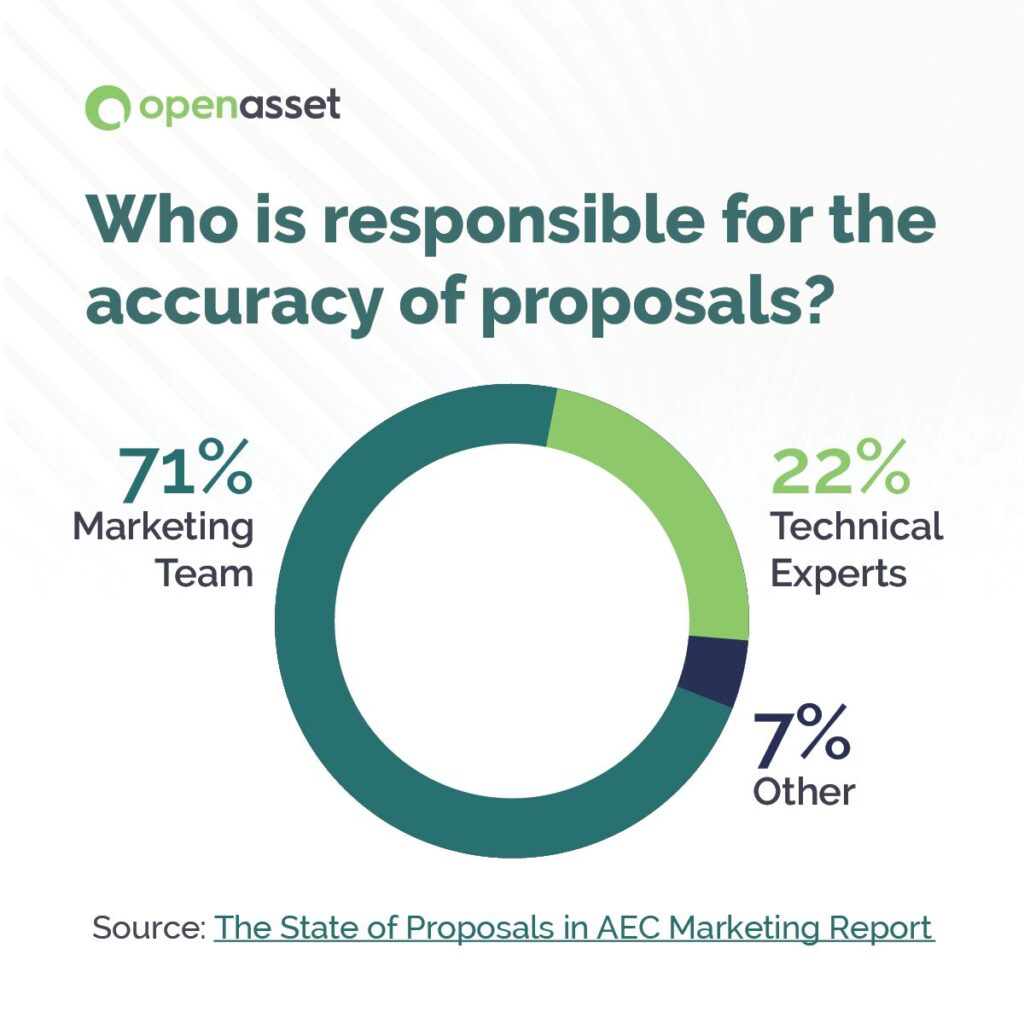
This emphasizes that while technical accuracy is important, overall proposal quality is primarily the marketing team’s responsibility.
How can AI help? AI tools assist by minimizing errors and ensuring that all information in your proposals is up-to-date and accurate. This, in turn, helps create higher-quality proposals and meet the high expectations placed on marketing teams.
Personalize your proposals
AI can customize your proposals by analyzing client data and previous interactions, allowing teams to tailor content to address specific client concerns and preferences. This personalization increases the likelihood of proposal acceptance and project wins.
What are the challenges of using AI when writing proposals?
While AI for proposal writing offers numerous benefits, it also introduces several challenges that organizations must address to ensure effective and ethical use. These challenges include: weaker data privacy and security, the risk of plagiarism, a reliance on algorithms, and the potential to produce incorrect or biased content based on what information it draws from.
Weak data privacy and security
Integrating AI tools in your proposal writing often involves processing sensitive information. Data must remain confidential and protected from unauthorized access. However, AI systems can be vulnerable to cyberattacks, data breaches, and unauthorized data sharing, which may compromise personal and organizational information.
Fortunately, implementing robust security measures, such as encryption and access controls, can help safeguard data privacy. It’s also just as important to use a trusted AI tool that follows strict security and IT compliance standards.
Using incorrect content
AI-generated content may sometimes contain factual inaccuracies or misinterpretations. Relying solely on AI for proposal writing can lead to the use of incorrect information and inconsistencies, potentially resulting in a lack of uniformity and harming the credibility of the proposal.
To address this, it’s crucial to always provide human oversight for review to verify the content produced by AI tools. This can be accomplished by assigning team members to fact-check AI-generated content and cross-reference data sources. Following this review process will help maintain accuracy and reliability without harming your proposal’s credibility.
“I think of AI as an eager intern. It really wants to do a good job, but doesn’t have the experience or nuanced skills that I’ve accumulated over the years. So, my intern helps me get 80% of the way there, and then I can review and refine the last 20%” —Rachelle Ray, Head of AEC Marketing Innovation, OpenAsset
Risk of plagiarism
AI tools generate content based on existing data and patterns, which raises concerns about originality and potential plagiarism. Proposals that accidentally copy existing materials can lead to ethical and legal issues.
Therefore, it’s important to confirm that AI-generated content is unique and properly cited by running it through plagiarism detection tools, reviewing source references for accuracy, and rephrasing any flagged sections. This process can help maintain originality and protect your proposal from plagiarism accusations.
Using biased data
AI systems learn patterns based on the data they’re trained on. If this training data contains biases—whether related to gender, race, or other factors—the AI can perpetuate and even amplify these biases in its outputs.
For example, an AI tool trained predominantly on data from a specific demographic may produce content that unintentionally favors that group, leading to proposals that are not inclusive or that misrepresent specific audiences. Such biases can damage the credibility of your proposals and turn away potential clients or partners.
While you can’t have much control over the datasets of the AI tools out there, you can choose AI tools trained on datasets representative of diverse populations and perspectives.
To avoid using biased data, you should periodically review and test AI-generated content for signs of bias, making adjustments to the training data or algorithms as necessary.
You should also implement a review process where human editors assess AI-generated content to identify and correct biased language or perspectives.
Relying on algorithms
Over-reliance on AI tools and their algorithms can lead to reduced human judgment and creativity in proposal writing. While AI can assist with drafting and data analysis, human expertise is essential for strategic decision-making and tailoring proposals to specific audiences.
Remember— AI should be used to assist, not to replace. Balancing AI assistance with human input ensures that proposals are both accurate and compelling.
“There may be a future where procurement is using AI to review proposals, but right now, proposals are still largely a human-to-human relationship. AI isn’t quite able to mimic the depth and complexity of that connection– that’s a very human set of skills that are vital to great proposals.” —Rachelle Ray, Head of AEC Marketing Innovation, OpenAsset
AI proposal generator tools
Modern AI tools come equipped with features that streamline and enhance the proposal writing process. Below are key functionalities to look for when searching for AI tools for proposal writing:
- Intelligent import: AI can extract and import relevant information from RFPs, past proposals, or project databases—helping you quickly populate responses with accurate content.
- Auto-response generation: These tools use AI to draft answers to standard or repeat questions automatically, saving time and maintaining consistency across proposals.
- Content recommendations: AI can suggest templates, boilerplate language, or previously approved responses based on the proposal context, reducing manual effort and improving alignment with brand standards.
- Natural Language Processing (NLP) Capabilities: NLP allows AI tools to understand context, tone, and meaning, enabling more human-like and relevant content generation that better meets client expectations.
- Grammar and style checkers: Built-in grammar and tone-checking tools help refine AI-generated content to ensure it’s professional, clear, and consistent with your organization’s voice.
How to reduce turnaround time with AI
AI proposal writing tools like Shred.ai can be used to help proposal writers complete work faster by implementing pre-approved boilerplate, proofreading existing copy for typos and compliance errors, and offering suggestions to personalize proposals to more effectively target specific key audiences. AI also performs useful administrative functions such as summarizing internal documents and rapidly conducting market analysis of competitors and potential clients.
1. Summarize without missing key information
Navigating lengthy RFPs, meeting notes, or technical documents can be overwhelming, especially when key requirements are scattered across pages or buried in dense language.
While AI-powered summarization tools can assist in condensing information, they must be used cautiously in the AEC industry, where precision and compliance are non-negotiable. This is because AI summaries are not always capable of capturing nuanced scope language, compliance requirements, or context buried in past-tense bullet lists and fragmented formatting.
For example, when your team receives five RFPs in one week, AI can scan each for keywords related to scope, geography, budget, or required qualifications. This helps prioritize which documents to read in full and which to decline, without burning hours on each.
However, AI should never replace a full review of the original source, especially when responding to formal RFPs.
Four ways to use AI for summaries
- Summarize executive bios: Trim down long resumes into focused, role-specific highlights that emphasize relevant experience, certifications, or industry expertise—especially helpful when tailoring bios for different proposals.
- Condense meeting notes: Convert unstructured kickoff meeting notes into organized lists of action items, responsibilities, and deadlines to ensure clarity and follow-through.
- Reduce word count: AI can help refine lengthy proposal sections by rephrasing wordy content more concisely—without sacrificing clarity or impact. Just be sure to review the output carefully to avoid unintended meaning changes.
- Summarize requirements (without relying solely on AI): AI tools may assist in flagging compliance language, submission instructions, or evaluation criteria, but a human should always cross-reference these outputs against the full RFP to ensure accuracy.
In proposal writing—especially in AEC—missing even a single requirement can be the difference between shortlisting and disqualification. AI summaries help organize and support your process, but they don’t replace human review.
2. Draft boilerplate content
Creating standard sections for each proposal can be repetitive and time-consuming. AI tools, like shred.ai, can automate this by generating boilerplate content, which saves you time by instantly producing consistent, on-brand text for commonly used sections like company overviews, service offerings, or compliance statements.
This ensures uniformity across proposals and frees up your team to focus on more strategic, client-specific content. Plus, with editable templates, you can easily tweak the AI-generated content to match the tone, format, or requirements of each RFP without starting from scratch every time.
For example, a proposal manager at an architecture firm maintains a centralized library of team bios. When a new RFP comes in, AI pulls relevant bios from the database and adjusts the language based on the client’s industry and project type.
This saves hours of rewriting while still delivering bios that feel tailored and relevant to the project.
Three ways to manage boilerplate content with AI
- Project case studies: AI can help generate repeatable formats for showcasing past projects, allowing you to swap in key metrics, outcomes, or client names without reauthoring the entire section.
- Compliance and legal language: Automate language for standard disclaimers, regulatory compliance, insurance coverage, and safety protocols that appear across multiple proposals.
- Cover letters and executive summaries: While these require personalization, AI can draft a baseline that aligns with your voice and proposal theme, giving you a strong starting point.
Boilerplate content is a cornerstone of efficient proposal writing. When done manually, it’s easy to introduce inconsistencies or miss required language. With AI, you can maintain accuracy, ensure brand alignment, and dramatically reduce turnaround times.
Automating repetitive sections allows your proposal team to spend more energy where it counts—customizing the narrative to win the client’s trust and business.
3. Personalize proposals
According to The State of Personalization report by Twilio Segment, over 92% of businesses are leveraging AI-driven personalization to drive growth.
Tailoring proposals to address the unique preferences and priorities of each client increases the likelihood of a favorable response. AI can analyze client data to facilitate this customization.
You can start by gathering insights from past interactions, preferences, and feedback, then use an AI tool, like LTV.ai, to tailor content based on client-specific information. Lastly, adjust language, focus on client priorities, and reference past collaborations to make the proposal resonate.
For example, a marketing agency uses AI to analyze a prospective client’s recent campaigns and social media activity. The AI tool identifies the client’s emphasis on sustainability, allowing the agency to highlight its eco-friendly initiatives in the proposal, aligning with the client’s values.
Five ways to personalize proposals
- Industry-specific messaging: Use AI to adjust your messaging depending on the client’s industry, ensuring your value proposition aligns with their sector’s challenges and goals.
- Client name and brand integration: AI can automatically replace placeholders and inject the client’s name, company details, and even tone of voice across the proposal to feel more personalized and thoughtful.
- Referencing past wins: If you’ve worked with the client before, AI can surface relevant case studies or testimonials to remind them of your shared success.
- Adapting tone and formality: Some clients prefer a formal tone, while others may lean toward a conversational style. AI tools with tone adjustment features help you match the client’s communication preferences.
- Highlight relevant team members: AI can recommend team bios or expertise that best match the client’s project, reinforcing your proposal’s credibility and fit.
In such a competitive environment, generic proposals just don’t cut it. Clients want to feel seen, understood, and valued. Personalization powered by AI allows you to demonstrate that you’ve done your homework—without manually rewriting every section.
4. Proofread and edit content
When they developed their report on the state of proposals in AEC marketing, OpenAsset asked marketers about the number of rounds of reviews tied to proposals and found that 87% of respondents commit to 2-5 rounds of review before finalizing proposals.
Fortunately, according to GlobalVision’s independent market research, 89% of regulatory survey respondents said that using AI-powered automated proofreading solutions significantly reduced their compliance review process, allowing them to deliver products to market faster.
Ensuring your proposal is free from grammatical errors and maintains a professional tone is crucial. AI-powered proofreading tools like Grammarly can assist in refining language, correcting errors, and improving readability across all sections of your document.
For example, an engineering firm submits technical proposals that must be both precise and accessible. With AI proofreading tools, they can ensure that complex technical language is clear and free of errors, enhancing the proposal’s readability for non-technical stakeholders.
Five ways to apply AI in your proofreading process
- Correct grammar and punctuation: AI tools like Grammarly or ProWritingAid automatically scan your proposal for grammar, punctuation, and syntax issues—saving editors hours of manual review.
- Check for clarity and tone: Proposals often need to sound persuasive yet formal. AI tools can suggest changes to sentence structure, tone, or word choice to better align with the intended audience.
- Maintain consistency in terminology: When proposals involve multiple contributors, AI tools can help maintain consistent language, acronyms, and formatting across the entire document.
- Simplify complex language: AI can flag overly technical or complicated phrasing and suggest simpler alternatives, making the proposal easier to digest for reviewers with varied expertise.
- Refine executive summaries and cover letters: These sections require extra polish. AI can help smooth out transitions, tighten up messaging, and elevate your writing for maximum impact.
5. Conduct competitive analysis
Understanding your competitors’ strategies can give your proposal a competitive edge. AI tools like Crayon make it possible to monitor market trends, analyze competitor messaging, and uncover gaps that your team can strategically fill.
AI can position your proposal in a way that directly addresses client concerns while showcasing your strengths.
For example, a software development company uses AI tools to monitor competitors’ features and reviews. This information allows them to highlight their unique features and top customer support in proposals, differentiating them from the competition.
Five ways to use AI for market analysis
- Analyze competitor proposals: If past competitor proposals are publicly available or internally archived, AI can compare themes, language, and structure—helping you avoid repetition and find opportunities to stand out.
- Benchmark pricing or service models: AI tools can scan competitor websites or industry publications to assess pricing strategies or service tiers that your proposal can either match or strategically counter.
- Spot industry messaging trends: Use AI to track shifts in how competitors are framing their solutions or responding to market demands. This helps you adapt your narrative to reflect what buyers are currently prioritizing.
- Identify gaps in service: AI can flag recurring customer complaints or unmet needs in competitor reviews, giving you insight into pain points your proposal can address more effectively.
- Monitor positioning and differentiators: Some AI tools can analyze multiple competitors at once to identify what each brand claims as its “unique” advantage, making it easier for your team to craft a more authentic and distinct position.
Proposal writing isn’t just about selling your services—it’s about showing why you’re the best option. An AI competitive analysis ensures your messaging is proactive, targeted, and backed by market intelligence.
This strategic awareness could be the difference between being shortlisted or ignored.
How to review AI-generated proposal content
To maximize the benefits provided by AI for proposal writing, consider the following tips for AI proposal writing:
Don’t forget your human touch
While AI tools can generate content rapidly, it’s essential to infuse your proposals with human insight and empathy. This ensures that the content resonates with the target audience and addresses their specific needs.
As mentioned above, AI should enhance your writing process, not replace the unique perspectives and experiences that only humans can provide. Adding a human touch to your proposal can make the difference that wins the project.
How to build your review process
To mitigate challenges such as data privacy concerns, inaccuracies, and potential biases, establish a robust review system. This process should involve:
- Human Oversight: Assign experienced team members to verify the accuracy and relevance of AI-generated content.
- Compliance Checks: Ensure that the proposal adheres to all client requirements and industry standards.
- Bias Detection: Review content for any unintended biases to promote fairness and inclusivity.
These steps will help you enhance the credibility and effectiveness of your proposals.
Monitor performance
Regularly assess the outcomes of your AI-assisted proposals. You can do this by analyzing metrics such as approval rates and feedback to identify areas for improvement. This monitoring enables you to fine-tune both your AI tools and proposal strategies for better results.
Embrace continuous improvement and evolution
Developing proposals is an evolving process. It is best to use AI to draft initial versions and then refine them through multiple iterations. This repeated process allows for continuous improvement, ensuring that each version is more polished and aligned with the proposal’s objectives.
Additionally, AI for proposal writing is continually advancing. Make sure to stay informed about the latest developments and be prepared to adapt your processes accordingly.
This commitment to ongoing learning and adaptation ensures that your proposals remain competitive and effective.
“The more you work with any tool, the better you understand it and how to get the best results from it. AI is no different! We have to play, iterate, and experiment to get the best results. There’s no “one right way” to use it.” —Rachelle Ray, Head of AEC Marketing Innovation, OpenAsset
Steps to integrate AI in your proposal writing workflow
Now you understand the importance of integrating AI into your proposal writing workflow. But what steps should you take to implement it in your daily work? To ensure a seamless integration, consider the following steps:
1. Assessing the current writing process
The first step is to evaluate your existing proposal development process. Identify areas that are time-consuming, prone to errors, or repetitive. Understanding these pain points will help determine where AI can have the most significant impact.
For example, if your team spends considerable time summarizing information or drafting initial responses, these tasks could be streamlined using AI tools.
To find your pain points:
- Start by mapping out your current proposal workflow from start to finish.
- Interview team members involved in the process and ask where they feel bottlenecks or frustration.
- Track how long each task takes, and review past proposals for common errors or inconsistencies.
This assessment will give you a clear picture of where AI can save time and improve quality.
| Need help analyzing your pain points? Take OpenAsset’s Proposal Power Index quiz to get a custom scorecard showing how your RFP process is creating avoidable work — and how teams like yours are gaining back hours. Get my custom report → |
2. Selecting the right AI tool
Once you’ve identified areas for improvement, research and choose AI tools that align with your specific needs and budget. Look for a solution that is user-friendly and is tailored for proposal writing.
Key features to consider within the AI tool include content generation, editing assistance, and workflow management.
For example, tools that offer automated content generation can help draft sections of proposals like project descriptions and employee bios. This reduces the time spent on initial drafts and accelerates your proposal workflows.
To help select the right AI tool for proposal writing, ask yourself:
- Does this AI tool integrate with our current proposal or document management system?
- Is it designed specifically for proposal writing, or is it a more general writing tool?
- Does it offer pre-built templates or reusable content libraries?
- Can the tool generate, edit, and organize proposal content efficiently?
- What kind of data security and privacy measures are in place?
- Does the provider offer training, onboarding support, or live webinars for our team?
- How easy is it for non-technical team members to use and understand the tool?
- What is the pricing structure, and does it fit within our team’s budget?
- Can we customize AI-generated responses to match our brand voice and tone?
- Are there analytics or reporting features to track tool usage and proposal performance?
Answering these questions will make you better equipped to choose a tool that enhances your proposal process and fits seamlessly into your team’s workflow.
3. Training teams on AI tools
After selecting the appropriate AI tools, invest in comprehensive training for your team. Effective training ensures that team members can utilize the tools efficiently and confidently.
Consider enrolling your team in specialized courses or workshops focused on AI applications in proposal writing. Courses like “Generative AI for Proposal Professionals” provide hands-on experience and practical knowledge.
Additionally, choose an AI tool that offers built-in user support, including onboarding assistance, detailed documentation, and access to webinars or live workshops. Many reputable AI platforms provide ongoing training resources and responsive customer service, which help teams stay up to date on new features and best practices.
Choosing a tool with good training and support options can shorten the learning curve and increase long-term adoption across your team.
4. Monitoring and evaluating AI impact
Be sure to monitor the effectiveness of AI integrations for proposal writing. Regularly assess metrics like proposal turnaround times, content quality, and win rates to understand the impact.
To help with this, you should gather feedback from team members to identify any challenges or areas for improvement. This ongoing evaluation will help you make informed decisions about adjusting workflows, retraining staff, or exploring additional AI functionalities.
FAQs about AI in proposal writing
How does NLP work in proposal writing tools?
NLP (Natural Language Processing) helps AI read and understand text the way humans do. In proposal writing, it scans your past winning proposals to learn what words, phrases, and structures worked best. It can also check your new proposal for clarity, tone, and whether it matches what the client asked for. Think of it like a smart editor that has read thousands of proposals and knows what gets results.
How to use AI to personalize a proposal?
AI can pull key details from a client’s RFP, website, and past communications to help you tailor your proposal to their specific needs. It can suggest language that reflects the client’s priorities and flag generic sections that need a personal touch. However, AI works best as a starting point. Your team still needs to add the real relationship knowledge and project-specific details that only you know. A personalized proposal still needs a human voice at its core.
How to train your team on AI proposal tools?
Start with simple, hands-on practice by having your team use the tool on a real, low-stakes proposal. Pair newer staff with experienced proposal writers so they learn when to trust the AI and when to override it. It’s important to teach your team that AI can make confident-sounding mistakes, so fact-checking everything the tool produces is non-negotiable. Short, regular training sessions work better than one big workshop.
How can CMOs use AI for proposals?
CMOs can use AI to make sure every proposal reflects the firm’s brand voice and uses consistent, approved messaging. AI tools can also track which proposal themes and approaches are winning work, giving CMOs real data to improve strategy. That said, CMOs should be cautious about over-relying on AI-generated content without review, since inaccurate claims in a proposal can damage trust and credibility.
Streamline proposal writing with OpenAsset
If you’re in the AEC industry, you know how critical speed, accuracy, and consistency are in the proposal process.
OpenAsset is a Digital Asset Management (DAM) solution built for architecture, engineering, and construction firms—helping teams streamline proposal development while keeping content organized, brand-aligned, and project-relevant.
With OpenAsset’s AI-powered features, such as automated keyword tagging, visual search, image similarity, content assistance, facial recognition, and more, you can simplify tagging, searching, and categorizing images—helping your team save time and focus on impactful projects.
Plus, firms using OpenAsset report up to 30% reduction in proposal preparation time.
Ready to integrate cutting-edge AI tools into your everyday AEC tasks?
With over 10 years of content management experience, Janelle Poisel has a proven track record of crafting compelling narratives and delivering content that resonates with B2B audiences. She is dedicated to helping teams learn how to meet their audience with the right content, at the right place, and at the right time as they navigate their unique customer journeys.